 Add to Chrome
 Add to Firefox
 Add to Edge
Stochastic Autoregressive Learning
Aug 07, 2026
Motivated by LLMs, which generate outputs by iteratively sampling from next-token distributions, we introduce a PAC-learning model for binary stochastic autoregressive learning. This generalizes the deterministic autoregressive learning framework of Joshi et al., COLT 2025. In our model, one fixed generator assigns a Bernoulli next-token distribution to every prompt string. Starting from an input prompt, a token is sampled and appended to the prompt; the same generator is then applied again to this expanded prompt; this procedure is repeated for $M$ steps. Three forms of supervision are considered: base one-step samples, chain-of-thought (CoT) samples that reveal full random trajectories of length $M$, and end-to-end (e2e) samples that reveal only the final token of length $M$ trajectories. For a generator class, we study the minimum number of samples $m_{base}(\varepsilon),m_{CoT}(\varepsilon), m_{e2e}(\varepsilon)$, resp., required to learn the one-step probabilities in the base model, and the final-token probability in the CoT and e2e models, under squared loss error~$\varepsilon$. We show that stochastic autoregressive learning fundamentally differs from the deterministic theory. At scale $\varepsilon$, there is no universal comparison between the three learning tasks: both $m_{CoT}/m_{base}$ and $m_{e2e}/m_{CoT}$ can be made simultaneously arbitrarily larger than $M/\varepsilon$, the natural analogue for the existing deterministic results. Nevertheless, after altering scales, for every class, CoT learning at scale $\varepsilon$ is upper-bounded by base learning at scale $\varepsilon/M^2$, whereas e2e learning at scale $\varepsilon$ is upper-bounded, up to logarithmic factors, by $(M/\varepsilon) m_{CoT}(Θ(\varepsilon))$. These dependencies and scales are essentially tight. We complement these bounds by studying dimension $d$ logistic functions in our model.

Mathematical perspective on genetic algorithms with optimization guided operators
Jun 10, 2026Recent work in ML applies genetic algorithms at inference time to iteratively improve solutions to optimization problems. The basic mutation and recombination operators involved are qualitatively different from those studied classically. Mutations are no longer random; an ML algorithm mutates a solution with the goal of improving an objective. Similarly, recombination is not based on random collages of parent solutions. Instead, it is an ML optimization-based operator whose goal is to synthesize improved solutions from its inputs. Thus, these mutation and recombination operators are more likely to improve the objective, but their computational cost is much higher. We introduce a general model of genetic algorithms and formulating optimization in this model as a query-complexity problem, using the language of reinforcement learning. We then study specialized models. We show that some optimization problems require generation, mutation, and recombination to be solved. We then obtain qualitatively tight algorithms for a family of problems within this framework that captures the nontrivial role of diversity in the solution pool, a key feature of practical ML genetic algorithms.
A Hierarchical Language Model with Predictable Scaling Laws and Provable Benefits of Reasoning
May 13, 2026We introduce a family of synthetic languages with hierarchical structure -- generated by a broadcast process on trees -- for which the role of context length and reasoning in autoregressive generation can be analyzed precisely. At the heart of our analytic approach is an \emph{exact $k$-gram ansatz} in place of transformers with context length $k$, a substitution we then validate empirically. Using this ansatz we derive explicit asymptotic predictions for distributional statistics of the sequences produced by a trained model, instantiated in two settings. For the \emph{Ising broadcast process} (a soft-constrained language), we prove that the variance of the generated sum scales log-linearly in the context depth and its kurtosis converges to that of a Gaussian -- both deviating from the true language for any sublinear context. For the \emph{coloring broadcast process} (a hard-constrained language) in the freezing regime, bounded-context autoregression produces sequences that, with high probability, are inconsistent with \emph{any} valid coloring of the underlying tree. Together these results imply an $Ω(n)$ lower bound on the context length required to faithfully sample length-$n$ sequences. In contrast, we prove that an autoregressive \emph{reasoning} model with only $Θ(\log n)$ working memory can sample exactly from the true language -- an exponential improvement. We confirm both the lower-bound predictions and the reasoning-based upper bound empirically with transformers trained on the synthetic language; the trained models track our asymptotic predictions quantitatively across a wide range of context sizes.
The Benefits of Temporal Correlations: SGD Learns k-Juntas from Random Walks Efficiently
May 11, 2026We study how temporal correlations in the data can make certain sparse learning problems efficiently learnable by gradient-based methods. Our focus is on Boolean k-juntas, a canonical sparse learning problem known to pose barriers for gradient-based methods under independent uniform samples. We show that this picture changes when the samples are generated by a lazy random walk on the hypercube. In this setting, the temporal dependencies can be exploited by a two-layer ReLU network trained using stylized-SGD with a temporal-difference loss, which compares target and predicted increments across consecutive samples. For every fixed k, the resulting sample complexity is essentially linear in the ambient dimension d. By contrast, we show that for large-batch gradient methods using standard convex pointwise losses, temporal correlations do not provide the same advantage.
Some Theoretical Limitations of t-SNE
Apr 14, 2026t-SNE has gained popularity as a dimension reduction technique, especially for visualizing data. It is well-known that all dimension reduction techniques may lose important features of the data. We provide a mathematical framework for understanding this loss for t-SNE by establishing a number of results in different scenarios showing how important features of data are lost by using t-SNE.
Denoising distances beyond the volumetric barrier
Apr 01, 2026We study the problem of reconstructing the latent geometry of a $d$-dimensional Riemannian manifold from a random geometric graph. While recent works have made significant progress in manifold recovery from random geometric graphs, and more generally from noisy distances, the precision of pairwise distance estimation has been fundamentally constrained by the volumetric barrier, namely the natural sample-spacing scale $n^{-1/d}$ coming from the fact that a generic point of the manifold typically lies at distance of order $n^{-1/d}$ from the nearest sampled point. In this paper, we introduce a novel approach, Orthogonal Ring Distance Estimation Routine (ORDER), which achieves a pointwise distance estimation precision of order $n^{-2/(d+5)}$ up to polylogarithmic factors in $n$ in polynomial time. This strictly beats the volumetric barrier for dimensions $d > 5$. As a consequence of obtaining pointwise precision better than $n^{-1/d}$, we prove that the Gromov--Wasserstein distance between the reconstructed metric measure space and the true latent manifold is of order $n^{-1/d}$. This matches the Wasserstein convergence rate of empirical measures, demonstrating that our reconstructed graph metric is asymptotically as good as having access to the full pairwise distance matrix of the sampled points. Our results are proven in a very general setting which includes general models of noisy pairwise distances, sparse random geometric graphs, and unknown connection probability functions.
Online Realizable Regression and Applications for ReLU Networks
Feb 22, 2026Realizable online regression can behave very differently from online classification. Even without any margin or stochastic assumptions, realizability may enforce horizon-free (finite) cumulative loss under metric-like losses, even when the analogous classification problem has an infinite mistake bound. We study realizable online regression in the adversarial model under losses that satisfy an approximate triangle inequality (approximate pseudo-metrics). Recent work of Attias et al. shows that the minimax realizable cumulative loss is characterized by the scaled Littlestone/online dimension $\mathbb{D}_{\mathrm{onl}}$, but this quantity can be difficult to analyze. Our main contribution is a generic potential method that upper bounds $\mathbb{D}_{\mathrm{onl}}$ by a concrete Dudley-type entropy integral that depends only on covering numbers of the hypothesis class under the induced sup pseudo-metric. We define an \emph{entropy potential} $Φ(\mathcal{H})=\int_{0}^{diam(\mathcal{H})} \log N(\mathcal{H},\varepsilon)\,d\varepsilon$, where $N(\mathcal{H},\varepsilon)$ is the $\varepsilon$-covering number of $\mathcal{H}$, and show that for every $c$-approximate pseudo-metric loss, $\mathbb{D}_{\mathrm{onl}}(\mathcal{H})\le O(c)\,Φ(\mathcal{H})$. In particular, polynomial metric entropy implies $Φ(\mathcal{H})<\infty$ and hence a horizon-free realizable cumulative-loss bound with transparent dependence on effective dimension. We illustrate the method on two families. We prove a sharp $q$-vs.-$d$ dichotomy for realizable online learning (finite and efficiently achievable $Θ_{d,q}(L^d)$ total loss for $L$-Lipschitz regression iff $q>d$, otherwise infinite), and for bounded-norm $k$-ReLU networks separate regression (finite loss, even $\widetilde O(k^2)$, and $O(1)$ for one ReLU) from classification (impossible already for $k=2,d=1$).
Why ReLU? A Bit-Model Dichotomy for Deep Network Training
Feb 22, 2026Theoretical analyses of Empirical Risk Minimization (ERM) are standardly framed within the Real-RAM model of computation. In this setting, training even simple neural networks is known to be $\exists \mathbb{R}$-complete -- a complexity class believed to be harder than NP, that characterizes the difficulty of solving systems of polynomial inequalities over the real numbers. However, this algebraic framework diverges from the reality of digital computation with finite-precision hardware. In this work, we analyze the theoretical complexity of ERM under a realistic bit-level model ($\mathsf{ERM}_{\text{bit}}$), where network parameters and inputs are constrained to be rational numbers with polynomially bounded bit-lengths. Under this model, we reveal a sharp dichotomy in tractability governed by the network's activation function. We prove that for deep networks with {\em any} polynomial activations with rational coefficients and degree at least $2$, the bit-complexity of training is severe: deciding $\mathsf{ERM}_{\text{bit}}$ is $\#P$-Hard, hence believed to be strictly harder than NP-complete problems. Furthermore, we show that determining the sign of a single partial derivative of the empirical loss function is intractable (unlikely in BPP), and deciding a specific bit in the gradient is $\#P$-Hard. This provides a complexity-theoretic perspective for the phenomenon of exploding and vanishing gradients. In contrast, we show that for piecewise-linear activations such as ReLU, the precision requirements remain manageable: $\mathsf{ERM}_{\text{bit}}$ is contained within NP (specifically NP-complete), and standard backpropagation runs in polynomial time. Our results demonstrate that finite-precision constraints are not merely implementation details but fundamental determinants of learnability.
Learning and Testing Convex Functions
Nov 14, 2025We consider the problems of \emph{learning} and \emph{testing} real-valued convex functions over Gaussian space. Despite the extensive study of function convexity across mathematics, statistics, and computer science, its learnability and testability have largely been examined only in discrete or restricted settings -- typically with respect to the Hamming distance, which is ill-suited for real-valued functions. In contrast, we study these problems in high dimensions under the standard Gaussian measure, assuming sample access to the function and a mild smoothness condition, namely Lipschitzness. A smoothness assumption is natural and, in fact, necessary even in one dimension: without it, convexity cannot be inferred from finitely many samples. As our main results, we give: - Learning Convex Functions: An agnostic proper learning algorithm for Lipschitz convex functions that achieves error $\varepsilon$ using $n^{O(1/\varepsilon^2)}$ samples, together with a complementary lower bound of $n^{\mathrm{poly}(1/\varepsilon)}$ samples in the \emph{correlational statistical query (CSQ)} model. - Testing Convex Functions: A tolerant (two-sided) tester for convexity of Lipschitz functions with the same sample complexity (as a corollary of our learning result), and a one-sided tester (which never rejects convex functions) using $O(\sqrt{n}/\varepsilon)^n$ samples.
Online Learning of Neural Networks
May 14, 2025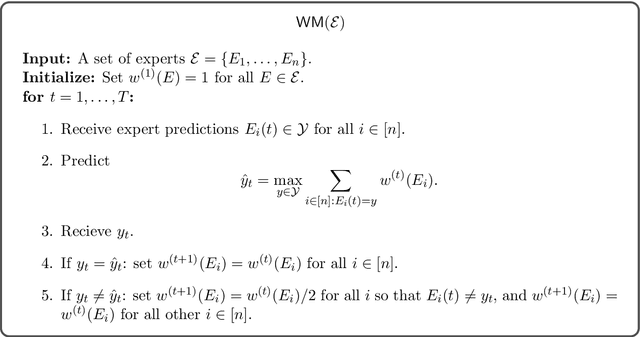
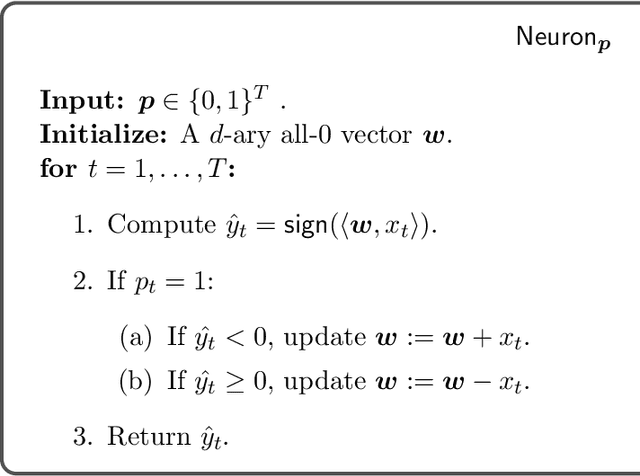
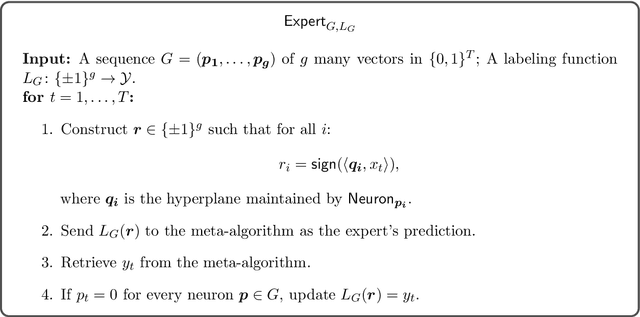
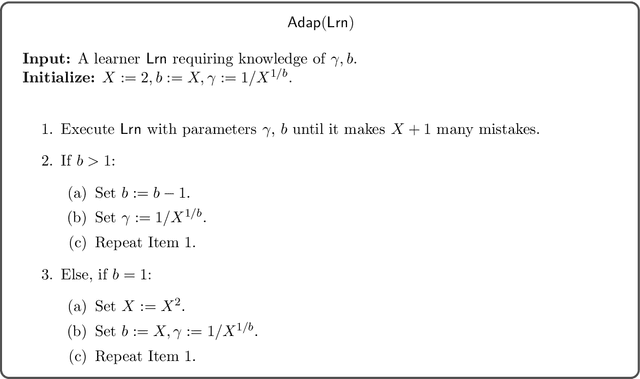
We study online learning of feedforward neural networks with the sign activation function that implement functions from the unit ball in $\mathbb{R}^d$ to a finite label set $\{1, \ldots, Y\}$. First, we characterize a margin condition that is sufficient and in some cases necessary for online learnability of a neural network: Every neuron in the first hidden layer classifies all instances with some margin $\gamma$ bounded away from zero. Quantitatively, we prove that for any net, the optimal mistake bound is at most approximately $\mathtt{TS}(d,\gamma)$, which is the $(d,\gamma)$-totally-separable-packing number, a more restricted variation of the standard $(d,\gamma)$-packing number. We complement this result by constructing a net on which any learner makes $\mathtt{TS}(d,\gamma)$ many mistakes. We also give a quantitative lower bound of approximately $\mathtt{TS}(d,\gamma) \geq \max\{1/(\gamma \sqrt{d})^d, d\}$ when $\gamma \geq 1/2$, implying that for some nets and input sequences every learner will err for $\exp(d)$ many times, and that a dimension-free mistake bound is almost always impossible. To remedy this inevitable dependence on $d$, it is natural to seek additional natural restrictions to be placed on the network, so that the dependence on $d$ is removed. We study two such restrictions. The first is the multi-index model, in which the function computed by the net depends only on $k \ll d$ orthonormal directions. We prove a mistake bound of approximately $(1.5/\gamma)^{k + 2}$ in this model. The second is the extended margin assumption. In this setting, we assume that all neurons (in all layers) in the network classify every ingoing input from previous layer with margin $\gamma$ bounded away from zero. In this model, we prove a mistake bound of approximately $(\log Y)/ \gamma^{O(L)}$, where L is the depth of the network.