 Add to Chrome
 Add to Firefox
 Add to Edge
Test-Time Scaling in Reasoning LLMs: Inference Regimes, Evaluation, and Reproducibility
Aug 04, 2026
Large language models can solve substantially harder reasoning problems with more inference-time compute. The term "test-time scaling," however, now covers diverse inference algorithms that extend deliberation along a single trajectory, sample completed candidates and aggregate them through voting or verification, or search over unfinished partial states. These algorithms differ in their statistical structure, compute accounting, and failure modes. Treating these procedures as interchangeable under a single scalar "budget," or reporting accuracy without the inference protocol that produced it, makes results difficult to compare across studies. We develop a systematic account of test-time scaling along three axes. First, we formalize test-time scaling as budgeted inference over the implicit prefix tree of an autoregressive model and distinguish three structural regimes: single-trajectory sequential scaling, leaf-level scaling with terminal reduction, and prefix-level scaling. Second, we treat the evaluated object as the entire inference system and develop evaluation principles that separate end-to-end system performance from candidate-bank diagnostics. We introduce an evaluation profile whose coordinates and simple functionals recover or bound common repeated-sampling metrics, and prescribe protocol-matched reporting of compute and uncertainty. Third, we specify reproducibility requirements for inference protocols, distinguishing exact replay from distributional reproducibility and identifying the artifacts needed to support each. We also organize the open-weight reasoning ecosystem by model-side and interface mechanisms, apply these principles to broad-knowledge, symbolic-reasoning, and competition-mathematics benchmarks, and assemble over 2 billion full reasoning traces for release with progressively richer verifier and token-level signals.

Agent Team Work Zone: An Automated, Persistent Workspace for Long-Lived Coding Agent Teams
Jul 24, 2026Large Language Model (LLM) agents have significantly improved coding and programming workflows. Claude Code, in particular, is one of the most powerful LLM coding agents and is capable of conducting complex coding tasks. However, several drawbacks can undermine long-term agentic workflows. (1) Irrecoverable agent teams: The Agent Teams feature is powerful, but the working state accumulated by each teammate is lost and cannot be resumed once the process stops, for example, when a terminal is closed. (2) Compaction erodes working detail: Compaction condenses the conversation into a summary, causing an agent's working details to become vague. (3) Agentic "technical debt": Over time, a user's decisions and the agents' operations become trapped in compacted old chats, making the project increasingly difficult to maintain and review. (4) Heavy prompt writing: Assigning or handing off tasks requires users to repeatedly write long prompts to achieve the expected agentic performance. We propose ATWZ (Agent Team Work Zone), a filesystem-based operations layer built around Claude Code's native Agent Teams that addresses these problems. Its central design principle is to treat each agent and teammate as a human employee and preserve their important working state in files stored in a dedicated directory called a "workstation," together with the skills, hooks, and scripts that use and maintain these files. With ATWZ, an agent team can periodically back up its working state, allowing an agent's knowledge to be recovered after compaction. After a process ends, the team can be restored with a single command. These features also substantially mitigate the agentic "technical debt" described above. Moreover, within ATWZ, agent "employees" can send documents to one another, greatly reducing the effort required to write prompts.
MemTrace: Probing What Final Accuracy Misses in Long-Term Memory
Jun 15, 2026LLM agents increasingly maintain long-term memory of user facts across sessions. Yet such memory is usually evaluated by aggregating accuracy over question rows or episodes. Because this approach scores question rows independently, even when several questions probe the same fact, it cannot show how that fact behaves as conditions change. We introduce MemTrace, a benchmark whose unit of measurement is the knowledge point: a single typed fact about the user, rather than an individual question. MemTrace probes each fact along three controlled dimensions: memory age, defined by how many sessions ago the fact appeared in the history; question type, covering current state, earlier state, and trajectory of change; and evidence condition, covering present, missing, and contradicted-by-false-premise settings. Evaluating 13 memory-system configurations across four paradigms, we find that similar pooled accuracy hides different failures: recovering a fact's current and earlier states does not imply tracking how it changed, and safe abstention does not imply correcting a false premise. The dominant bottleneck is evidence use, not retrieval: when systems fail, the evidence was retrievable 10 times more often than it was missing. These results suggest that improving long-term memory requires better use of reachable evidence, not simply more storage or retrieval.
CausalGuard: Conformal Inference under Graph Uncertainty
May 21, 2026Estimating treatment effects from observational data requires choosing an adjustment set, but valid adjustment depends on an unknown causal graph. Graph misspecification can cause under-coverage, while graph-agnostic conformal wrappers may regain nominal coverage only through large padding. We introduce CausalGuard, a structure-weighted conformal framework that calibrates after aggregating graph-conditional doubly robust pseudo-outcomes. Candidate DAGs are proposed from an LLM-derived edge prior, pruned by conditional-independence tests, and reweighted by Bayesian Information Criterion. A composite nonconformity score then calibrates the posterior-weighted pseudo-outcome. CausalGuard provides distribution-free finite-sample marginal coverage for this aggregated pseudo-outcome; under causal identification, overlap, conditional-mean nuisance stability, and concentration on target-aligned valid adjustment strategies, its conditional mean converges to the true Conditional Average Treatment Effect. Across five benchmarks, CausalGuard attains mean coverage above the nominal 90% level for the directly evaluable target and reduces width when graph-agnostic conformal baselines require large padding. Stress tests show that CausalGuard suppresses invalid collider adjustment and remains stable under misspecified priors when the retained candidate set is data-supported.
Reliability-Gated Source Anchoring for Continual Test-Time Adaptation
May 13, 2026Continual test-time adaptation (CTTA) updates a pretrained model online on an unlabeled, non-stationary stream while anchoring it to a frozen source checkpoint. This anchor is useful only when the source remains reliable. On CCC-Hard, however, a ResNet-50 source falls to approximately $1.3\%$ top-$1$ accuracy, while existing source-anchored CTTA methods continue applying the same anchor strength. We call this failure mode blind anchoring and propose RMemSafe, a reliability-gated extension of ROID that uses the frozen source's normalized predictive entropy to attenuate all explicit source-coupled uses in the objective. When the source posterior approaches uniformity, the gate closes: the source anchor and agreement filter vanish, and the objective reduces to a source-agnostic fallback comprising ROID's base losses plus marginal calibration. Combined with ASR, RMemSafe achieves the lowest error on $8$ of $9$ matched-split continual-corruption cells and is the best reset-based method on all $9$, improving ROID+ASR by $1.05$~pp on ResNet-50 and $0.48$~pp on ViT-B/16. A controlled source-degradation sweep shows a $1.13{\times}$ shallower harm slope than ROID+ASR, consistent with the graceful-decay prediction. The entropy gate detects high-entropy source collapse, not confidently wrong low-entropy sources; this scope is explicitly evaluated and discussed.
AgentCE-Bench: Agent Configurable Evaluation with Scalable Horizons and Controllable Difficulty under Lightweight Environments
Apr 10, 2026Existing Agent benchmarks suffer from two critical limitations: high environment interaction overhead (up to 41\% of total evaluation time) and imbalanced task horizon and difficulty distributions that make aggregate scores unreliable. To address these issues, we propose AgentCE-Bench built around a unified grid-based planning task, where agents must fill hidden slots in a partially completed schedule subject to both local slot constraints and global constraints. Our benchmark offers fine-grained control through two orthogonal axes: \textbf{Scalable Horizons}, controlled by the number of hidden slots $H$, and \textbf{Controllable Difficulty}, governed by a decoy budget $B$ that determines the number of globally misleading decoy candidates. Crucially, all tool calls are resolved via static JSON files under a \textbf{Lightweight Environment} design, eliminating setup overhead and enabling fast, reproducible evaluation suitable for training-time validation. We first validate that $H$ and $B$ provide reliable control over task horizon and difficulty, and that AgentCE-Bench exhibits strong domain consistency and model discriminability. We then conduct comprehensive experiments across 13 models of diverse sizes and families over 6 domains, revealing significant cross-model performance variation and confirming that AgentCE-Bench provides interpretable and controllable evaluation of agent reasoning.
ACE-Bench: Agent Configurable Evaluation with Scalable Horizons and Controllable Difficulty under Lightweight Environments
Apr 07, 2026Existing Agent benchmarks suffer from two critical limitations: high environment interaction overhead (up to 41\% of total evaluation time) and imbalanced task horizon and difficulty distributions that make aggregate scores unreliable. To address these issues, we propose ACE-Bench built around a unified grid-based planning task, where agents must fill hidden slots in a partially completed schedule subject to both local slot constraints and global constraints. Our benchmark offers fine-grained control through two orthogonal axes: Scalable Horizons, controlled by the number of hidden slots $H$, and Controllable Difficulty, governed by a decoy budget $B$ that determines the number of globally misleading decoy candidates. Crucially, all tool calls are resolved via static JSON files under a Lightweight Environment design, eliminating setup overhead and enabling fast, reproducible evaluation suitable for training-time validation. We first validate that H and B provide reliable control over task horizon and difficulty, and that ACE-Bench exhibits strong domain consistency and model discriminability. We then conduct comprehensive experiments across 13 models of diverse sizes and families over 6 domains, revealing significant cross-model performance variation and confirming that ACE-Bench provides interpretable and controllable evaluation of agent reasoning.
When Domains Interact: Asymmetric and Order-Sensitive Cross-Domain Effects in Reinforcement Learning for Reasoning
Feb 01, 2026Group Relative Policy Optimization (GRPO) has become a key technique for improving reasoning abilities in large language models, yet its behavior under different domain sequencing strategies is poorly understood. In particular, the impact of sequential (one domain at a time) versus mixed-domain (multiple domain at a time) training in GRPO has not been systematically studied. We provide the first systematic analysis of training-order effects across math, science, logic, and puzzle reasoning tasks. We found (1) single-domain generalization is highly asymmetric: training on other domains improves math reasoning by approximately 25\% accuracy, while yielding negligible transfer to logic and puzzle; (2) cross-domain interactions are highly order-dependent: training in the order math$\rightarrow$science achieves 83\% / 41\% accuracy on math / science, while reversing the order to science$\rightarrow$math degrades performance to 77\% / 25\%; (3) no single strategy is universally optimal in multi-domain training: sequential training favors math (up to 84\%), mixed training favors science and logic, and poor ordering can incur large performance gaps (from 70\% to 56\%). Overall, our findings demonstrate that GRPO under multi-domain settings exhibits pronounced asymmetry, order sensitivity, and strategy dependence, highlighting the necessity of domain-aware and order-aware training design.
Mid-Think: Training-Free Intermediate-Budget Reasoning via Token-Level Triggers
Jan 11, 2026Hybrid reasoning language models are commonly controlled through high-level Think/No-think instructions to regulate reasoning behavior, yet we found that such mode switching is largely driven by a small set of trigger tokens rather than the instructions themselves. Through attention analysis and controlled prompting experiments, we show that a leading ``Okay'' token induces reasoning behavior, while the newline pattern following ``</think>'' suppresses it. Based on this observation, we propose Mid-Think, a simple training-free prompting format that combines these triggers to achieve intermediate-budget reasoning, consistently outperforming fixed-token and prompt-based baselines in terms of the accuracy-length trade-off. Furthermore, applying Mid-Think to RL training after SFT reduces training time by approximately 15% while improving final performance of Qwen3-8B on AIME from 69.8% to 72.4% and on GPQA from 58.5% to 61.1%, demonstrating its effectiveness for both inference-time control and RL-based reasoning training.
Demystifying Hybrid Thinking: Can LLMs Truly Switch Between Think and No-Think?
Oct 14, 2025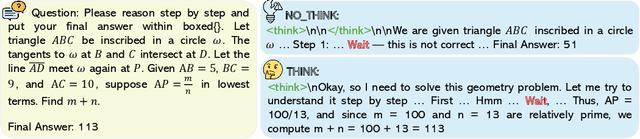
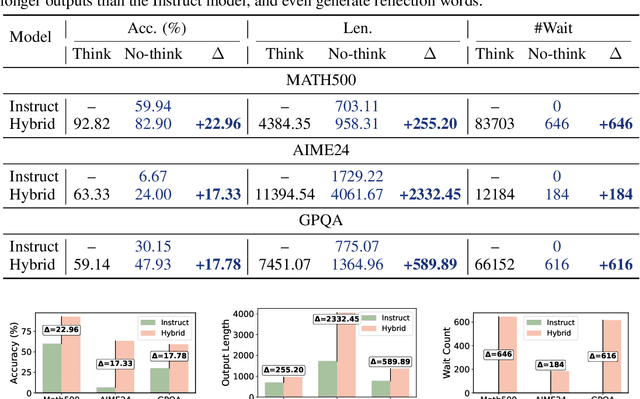
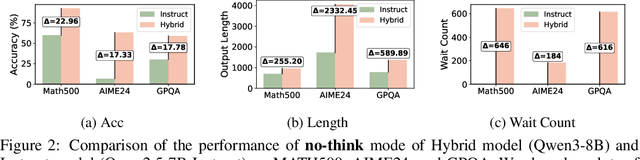
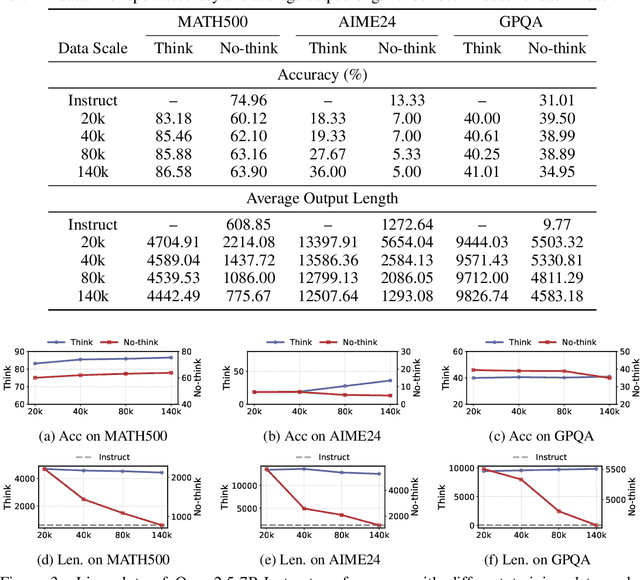
Hybrid thinking enables LLMs to switch between reasoning and direct answering, offering a balance between efficiency and reasoning capability. Yet our experiments reveal that current hybrid thinking LLMs only achieve partial mode separation: reasoning behaviors often leak into the no-think mode. To understand and mitigate this, we analyze the factors influencing controllability and identify four that matter most: (1) larger data scale, (2) using think and no-think answers from different questions rather than the same question, (3) a moderate increase in no-think data number, and (4) a two-phase strategy that first trains reasoning ability and then applies hybrid think training. Building on these findings, we propose a practical recipe that, compared to standard training, can maintain accuracy in both modes while significantly reducing no-think output length (from $1085$ to $585$ on MATH500) and occurrences of reasoning-supportive tokens such as ``\texttt{wait}'' (from $5917$ to $522$ on MATH500). Our findings highlight the limitations of current hybrid thinking and offer directions for strengthening its controllability.