 Add to Chrome
 Add to Firefox
 Add to Edge
VideoMDM: Towards 3D Human Motion Generation From 2D Supervision
Jun 11, 2026
We introduce VideoMDM, a diffusion-based framework that trains 3D human motion priors directly from accurate 2D poses extracted from monocular videos, without any 3D ground truth. A pretrained 2D-to-3D lifter provides approximate 3D pose sequences that serve as a noisy teacher: these are diffused, denoised by the model in 3D, and supervised in 2D by reprojecting the prediction and comparing against accurate keypoints. We show that, under mild assumptions, a depth-weighted 2D reprojection loss is equivalent in expectation to direct 3D supervision, and we adapt standard 3D motion regularizers - velocity consistency and over-parameterized representation alignment - to this 2D setting. Unlike methods that lift 2D to 3D only at inference, VideoMDM learns a coherent 3D motion manifold during training. On HumanML3D it nearly closes the gap to fully 3D-supervised MDM (FID 0.88 vs 0.54); On real video datasets Fit3D and NBA the method learns to generate motions consistently preferred by humans, with strong quantitative results.

SpectralSplats: Robust Differentiable Tracking via Spectral Moment Supervision
Mar 25, 20263D Gaussian Splatting (3DGS) enables real-time, photorealistic novel view synthesis, making it a highly attractive representation for model-based video tracking. However, leveraging the differentiability of the 3DGS renderer "in the wild" remains notoriously fragile. A fundamental bottleneck lies in the compact, local support of the Gaussian primitives. Standard photometric objectives implicitly rely on spatial overlap; if severe camera misalignment places the rendered object outside the target's local footprint, gradients strictly vanish, leaving the optimizer stranded. We introduce SpectralSplats, a robust tracking framework that resolves this "vanishing gradient" problem by shifting the optimization objective from the spatial to the frequency domain. By supervising the rendered image via a set of global complex sinusoidal features (Spectral Moments), we construct a global basin of attraction, ensuring that a valid, directional gradient toward the target exists across the entire image domain, even when pixel overlap is completely nonexistent. To harness this global basin without introducing periodic local minima associated with high frequencies, we derive a principled Frequency Annealing schedule from first principles, gracefully transitioning the optimizer from global convexity to precise spatial alignment. We demonstrate that SpectralSplats acts as a seamless, drop-in replacement for spatial losses across diverse deformation parameterizations (from MLPs to sparse control points), successfully recovering complex deformations even from severely misaligned initializations where standard appearance-based tracking catastrophically fails.
Time-to-Move: Training-Free Motion Controlled Video Generation via Dual-Clock Denoising
Nov 09, 2025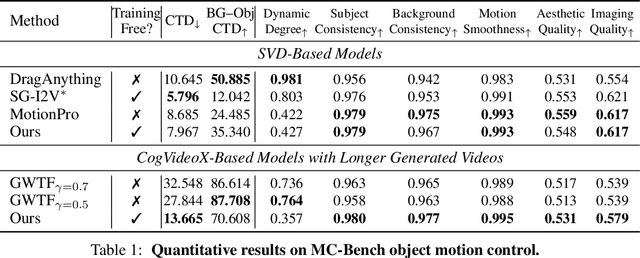
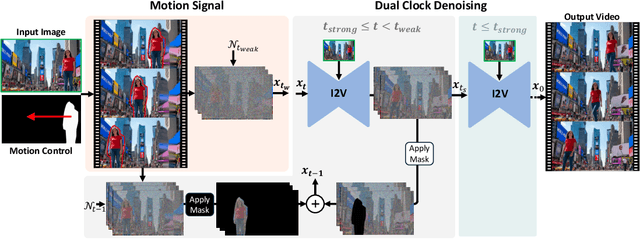
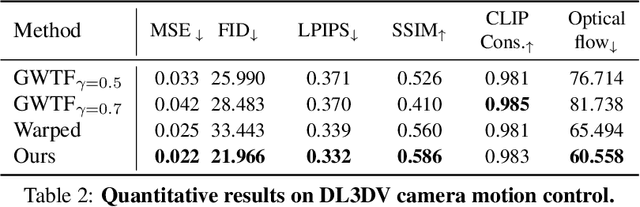
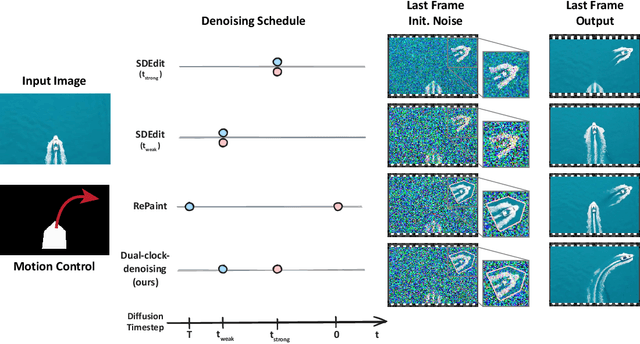
Diffusion-based video generation can create realistic videos, yet existing image- and text-based conditioning fails to offer precise motion control. Prior methods for motion-conditioned synthesis typically require model-specific fine-tuning, which is computationally expensive and restrictive. We introduce Time-to-Move (TTM), a training-free, plug-and-play framework for motion- and appearance-controlled video generation with image-to-video (I2V) diffusion models. Our key insight is to use crude reference animations obtained through user-friendly manipulations such as cut-and-drag or depth-based reprojection. Motivated by SDEdit's use of coarse layout cues for image editing, we treat the crude animations as coarse motion cues and adapt the mechanism to the video domain. We preserve appearance with image conditioning and introduce dual-clock denoising, a region-dependent strategy that enforces strong alignment in motion-specified regions while allowing flexibility elsewhere, balancing fidelity to user intent with natural dynamics. This lightweight modification of the sampling process incurs no additional training or runtime cost and is compatible with any backbone. Extensive experiments on object and camera motion benchmarks show that TTM matches or exceeds existing training-based baselines in realism and motion control. Beyond this, TTM introduces a unique capability: precise appearance control through pixel-level conditioning, exceeding the limits of text-only prompting. Visit our project page for video examples and code: https://time-to-move.github.io/.