 Add to Chrome
 Add to Firefox
 Add to Edge
SpectralSplats: Robust Differentiable Tracking via Spectral Moment Supervision
Mar 25, 2026
3D Gaussian Splatting (3DGS) enables real-time, photorealistic novel view synthesis, making it a highly attractive representation for model-based video tracking. However, leveraging the differentiability of the 3DGS renderer "in the wild" remains notoriously fragile. A fundamental bottleneck lies in the compact, local support of the Gaussian primitives. Standard photometric objectives implicitly rely on spatial overlap; if severe camera misalignment places the rendered object outside the target's local footprint, gradients strictly vanish, leaving the optimizer stranded. We introduce SpectralSplats, a robust tracking framework that resolves this "vanishing gradient" problem by shifting the optimization objective from the spatial to the frequency domain. By supervising the rendered image via a set of global complex sinusoidal features (Spectral Moments), we construct a global basin of attraction, ensuring that a valid, directional gradient toward the target exists across the entire image domain, even when pixel overlap is completely nonexistent. To harness this global basin without introducing periodic local minima associated with high frequencies, we derive a principled Frequency Annealing schedule from first principles, gracefully transitioning the optimizer from global convexity to precise spatial alignment. We demonstrate that SpectralSplats acts as a seamless, drop-in replacement for spatial losses across diverse deformation parameterizations (from MLPs to sparse control points), successfully recovering complex deformations even from severely misaligned initializations where standard appearance-based tracking catastrophically fails.

MDNF: Multi-Diffusion-Nets for Neural Fields on Meshes
Sep 04, 2024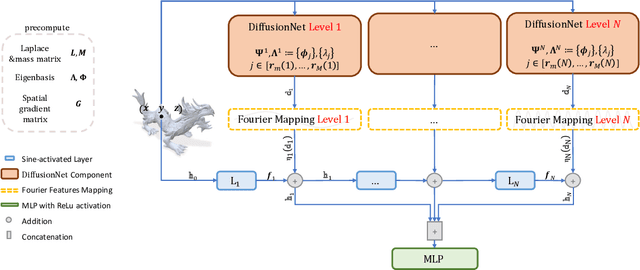

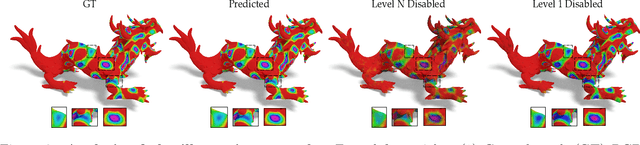

We propose a novel framework for representing neural fields on triangle meshes that is multi-resolution across both spatial and frequency domains. Inspired by the Neural Fourier Filter Bank (NFFB), our architecture decomposes the spatial and frequency domains by associating finer spatial resolution levels with higher frequency bands, while coarser resolutions are mapped to lower frequencies. To achieve geometry-aware spatial decomposition we leverage multiple DiffusionNet components, each associated with a different spatial resolution level. Subsequently, we apply a Fourier feature mapping to encourage finer resolution levels to be associated with higher frequencies. The final signal is composed in a wavelet-inspired manner using a sine-activated MLP, aggregating higher-frequency signals on top of lower-frequency ones. Our architecture attains high accuracy in learning complex neural fields and is robust to discontinuities, exponential scale variations of the target field, and mesh modification. We demonstrate the effectiveness of our approach through its application to diverse neural fields, such as synthetic RGB functions, UV texture coordinates, and vertex normals, illustrating different challenges. To validate our method, we compare its performance against two alternatives, showcasing the advantages of our multi-resolution architecture.