 Add to Chrome
 Add to Firefox
 Add to Edge
Tight Sample Complexity Bounds for Entropic Best Policy Identification
May 13, 2026
We study best-policy identification for finite-horizon risk-sensitive reinforcement learning under the entropic risk measure. Recent work established a constant gap in the exponential horizon dependence between lower and upper bounds on the number of samples required to identify an approximately optimal policy. Precisely, known lower bounds scale in $Ω(e^{|β| H})$ where $H$ is the horizon of the MDP, while the state-of-the-art upper bound achieves at best $O(e^{2|β| H})$ (arXiv:2506.00286v2) using a generative model. We show that this extra exponential factor can be traced to overly loose concentration control for exponential utilities. To close this open gap, we revisit the analysis of this problem through a forward-model based algorithm building on KL-based exploration bonuses that we adapt to the entropic criterion. The improvement we get is due to two main novel technical innovations. We leverage the smoothness properties of the exponential utility to derive sharper concentration bounds, and we propose a new stopping rule that exploits further this tightness to obtain a sample complexity that matches the lower bound.

Where Do We Stand with Implicit Neural Representations? A Technical and Performance Survey
Nov 06, 2024
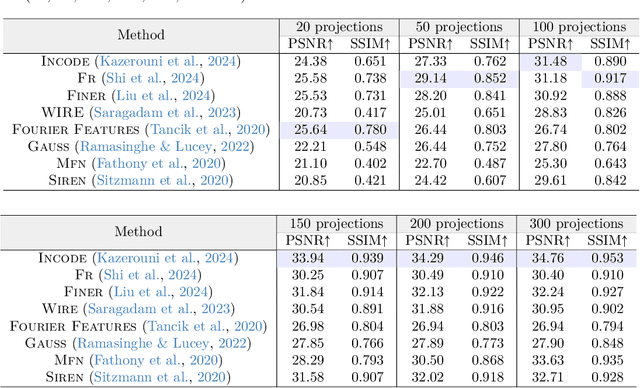
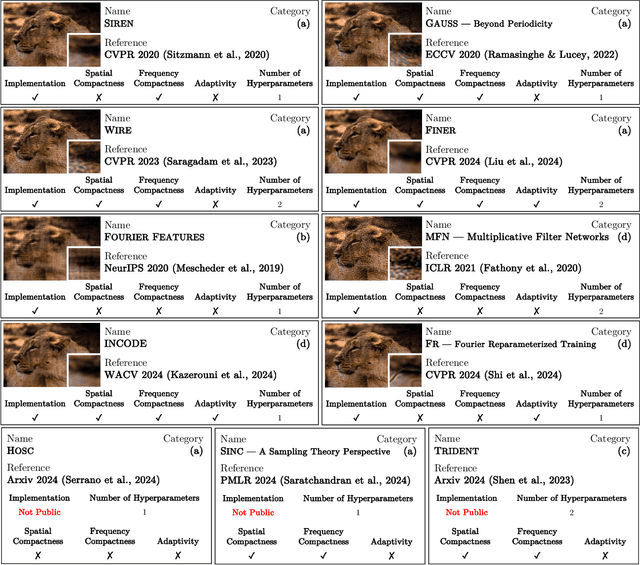

Implicit Neural Representations (INRs) have emerged as a paradigm in knowledge representation, offering exceptional flexibility and performance across a diverse range of applications. INRs leverage multilayer perceptrons (MLPs) to model data as continuous implicit functions, providing critical advantages such as resolution independence, memory efficiency, and generalisation beyond discretised data structures. Their ability to solve complex inverse problems makes them particularly effective for tasks including audio reconstruction, image representation, 3D object reconstruction, and high-dimensional data synthesis. This survey provides a comprehensive review of state-of-the-art INR methods, introducing a clear taxonomy that categorises them into four key areas: activation functions, position encoding, combined strategies, and network structure optimisation. We rigorously analyse their critical properties, such as full differentiability, smoothness, compactness, and adaptability to varying resolutions while also examining their strengths and limitations in addressing locality biases and capturing fine details. Our experimental comparison offers new insights into the trade-offs between different approaches, showcasing the capabilities and challenges of the latest INR techniques across various tasks. In addition to identifying areas where current methods excel, we highlight key limitations and potential avenues for improvement, such as developing more expressive activation functions, enhancing positional encoding mechanisms, and improving scalability for complex, high-dimensional data. This survey serves as a roadmap for researchers, offering practical guidance for future exploration in the field of INRs. We aim to foster new methodologies by outlining promising research directions for INRs and applications.