 Add to Chrome
 Add to Firefox
 Add to Edge
From Failure to Alignment: A Requirements Engineering Framework for Machine Learning Systems
Jun 30, 2026
Organisations designing, developing, and deploying machine learning systems (MLS) need to be able to check that these systems are trustworthy, and communicate this clearly to their stakeholders, be they different categories of users, engineers, or wider society. By focusing on stakeholders, Requirements Engineering is well positioned to drive the design and engineering of MLS that align with the needs of their stakeholders. Yet, we still need a systematic process for modelling and reasoning about requirements for MLS that is driven both by stakeholders' needs and constraints for MLS development. This paper proposes a framework entitled REAL (Requirements Engineering for mAchines that Learn - and Fail) to help develop MLS that align with stakeholders' needs by adopting a requirements engineering approach. This model-based framework is based on three principles. First, weaving together requirements for data, models, and the system as a whole. Second, using failure to drive the exploration of alternative requirements. Third, iterative and traceable refinement of MLS requirements. We demonstrate the proposed framework using an example from autonomous driving and show that REAL supports the development of MLS that better align with stakeholders' requirements. A replication package is available online.
* 12 pages

Safe and Socially Aware Multi-Robot Coordination in Multi-Human Social Care Settings
Jul 03, 2025This research investigates strategies for multi-robot coordination in multi-human environments. It proposes a multi-objective learning-based coordination approach to addressing the problem of path planning, navigation, task scheduling, task allocation, and human-robot interaction in multi-human multi-robot (MHMR) settings.
On Specifying for Trustworthiness
Jun 22, 2022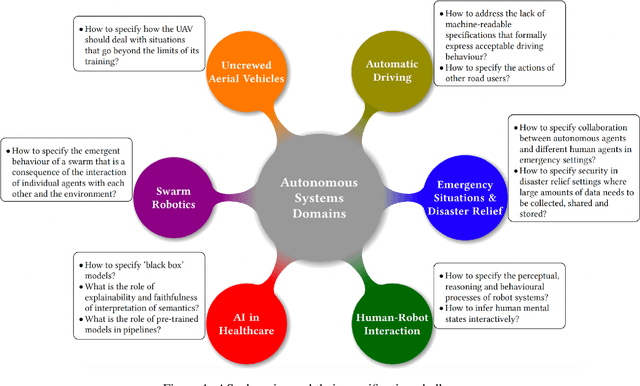
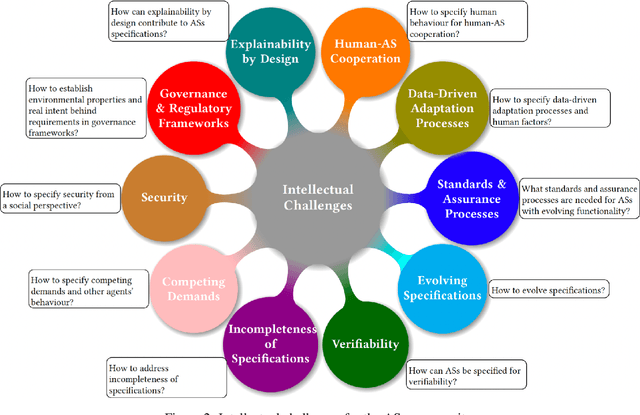
As autonomous systems are becoming part of our daily lives, ensuring their trustworthiness is crucial. There are a number of techniques for demonstrating trustworthiness. Common to all these techniques is the need to articulate specifications. In this paper, we take a broad view of specification, concentrating on top-level requirements including but not limited to functionality, safety, security and other non-functional properties. The main contribution of this article is a set of high-level intellectual challenges for the autonomous systems community related to specifying for trustworthiness. We also describe unique specification challenges concerning a number of application domains for autonomous systems.