 Add to Chrome
 Add to Firefox
 Add to Edge
ABBEL: LLM Agents Acting through Belief Bottlenecks Expressed in Language
Dec 23, 2025
As the length of sequential decision-making tasks increases, it becomes computationally impractical to keep full interaction histories in context. We introduce a general framework for LLM agents to maintain concise contexts through multi-step interaction: Acting through Belief Bottlenecks Expressed in Language (ABBEL), and methods to further improve ABBEL agents with RL post-training. ABBEL replaces long multi-step interaction history by a belief state, i.e., a natural language summary of what has been discovered about task-relevant unknowns. Under ABBEL, at each step the agent first updates a prior belief with the most recent observation from the environment to form a posterior belief, then uses only the posterior to select an action. We systematically evaluate frontier models under ABBEL across six diverse multi-step environments, finding that ABBEL supports generating interpretable beliefs while maintaining near-constant memory use over interaction steps. However, bottleneck approaches are generally prone to error propagation, which we observe causing inferior performance when compared to the full context setting due to errors in belief updating. Therefore, we train LLMs to generate and act on beliefs within the ABBEL framework via reinforcement learning (RL). We experiment with belief grading, to reward higher quality beliefs, as well as belief length penalties to reward more compressed beliefs. Our experiments demonstrate the ability of RL to improve ABBEL's performance beyond the full context setting, while using less memory than contemporaneous approaches.

Intrinsically-Motivated Humans and Agents in Open-World Exploration
Mar 31, 2025What drives exploration? Understanding intrinsic motivation is a long-standing challenge in both cognitive science and artificial intelligence; numerous objectives have been proposed and used to train agents, yet there remains a gap between human and agent exploration. We directly compare adults, children, and AI agents in a complex open-ended environment, Crafter, and study how common intrinsic objectives: Entropy, Information Gain, and Empowerment, relate to their behavior. We find that only Entropy and Empowerment are consistently positively correlated with human exploration progress, indicating that these objectives may better inform intrinsic reward design for agents. Furthermore, across agents and humans we observe that Entropy initially increases rapidly, then plateaus, while Empowerment increases continuously, suggesting that state diversity may provide more signal in early exploration, while advanced exploration should prioritize control. Finally, we find preliminary evidence that private speech utterances, and particularly goal verbalizations, may aid exploration in children.
BAMDP Shaping: a Unified Theoretical Framework for Intrinsic Motivation and Reward Shaping
Sep 09, 2024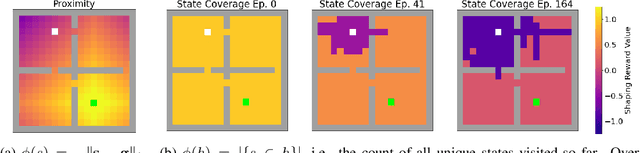
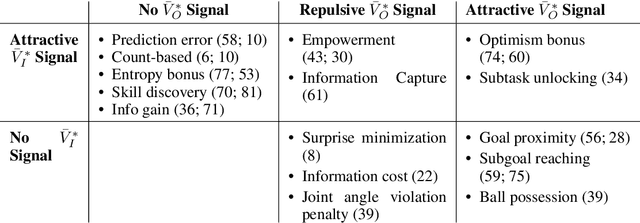
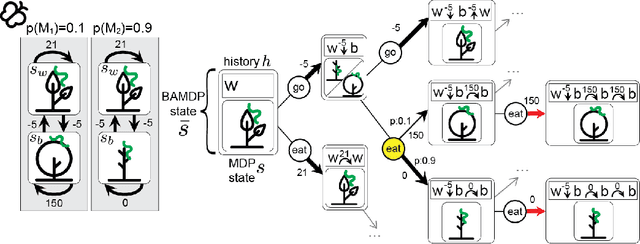
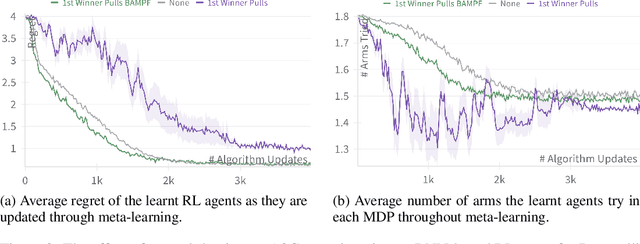
Intrinsic motivation (IM) and reward shaping are common methods for guiding the exploration of reinforcement learning (RL) agents by adding pseudo-rewards. Designing these rewards is challenging, however, and they can counter-intuitively harm performance. To address this, we characterize them as reward shaping in Bayes-Adaptive Markov Decision Processes (BAMDPs), which formalizes the value of exploration by formulating the RL process as updating a prior over possible MDPs through experience. RL algorithms can be viewed as BAMDP policies; instead of attempting to find optimal algorithms by solving BAMDPs directly, we use it at a theoretical framework for understanding how pseudo-rewards guide suboptimal algorithms. By decomposing BAMDP state value into the value of the information collected plus the prior value of the physical state, we show how psuedo-rewards can help by compensating for RL algorithms' misestimation of these two terms, yielding a new typology of IM and reward shaping approaches. We carefully extend the potential-based shaping theorem to BAMDPs to prove that when pseudo-rewards are BAMDP Potential-based shaping Functions (BAMPFs), they preserve optimal, or approximately optimal, behavior of RL algorithms; otherwise, they can corrupt even optimal learners. We finally give guidance on how to design or convert existing pseudo-rewards to BAMPFs by expressing assumptions about the environment as potential functions on BAMDP states.