 Add to Chrome
 Add to Firefox
 Add to Edge
Opal: Private Memory for Personal AI
Apr 02, 2026
Personal AI systems increasingly retain long-term memory of user activity, including documents, emails, messages, meetings, and ambient recordings. Trusted hardware can keep this data private, but struggles to scale with a growing datastore. This pushes the data to external storage, which exposes retrieval access patterns that leak private information to the application provider. Oblivious RAM (ORAM) is a cryptographic primitive that can hide these patterns, but it requires a fixed access budget, precluding the query-dependent traversals that agentic memory systems rely on for accuracy. We present Opal, a private memory system for personal AI. Our key insight is to decouple all data-dependent reasoning from the bulk of personal data, confining it to the trusted enclave. Untrusted disk then sees only fixed, oblivious memory accesses. This enclave-resident component uses a lightweight knowledge graph to capture personal context that semantic search alone misses and handles continuous ingestion by piggybacking reindexing and capacity management on every ORAM access. Evaluated on a comprehensive synthetic personal-data pipeline driven by stochastic communication models, Opal improves retrieval accuracy by 13 percentage points over semantic search and achieves 29x higher throughput with 15x lower infrastructure cost than a secure baseline. Opal is under consideration for deployment to millions of users at a major AI provider.

FineZip : Pushing the Limits of Large Language Models for Practical Lossless Text Compression
Sep 25, 2024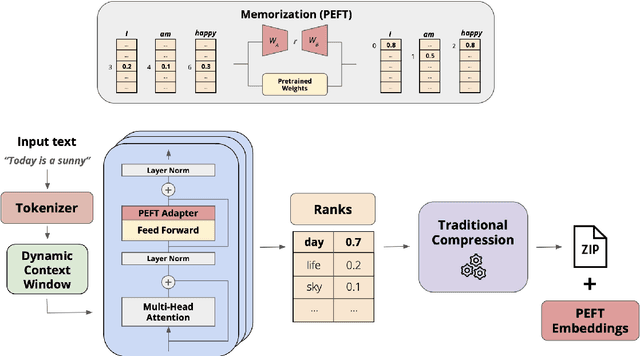
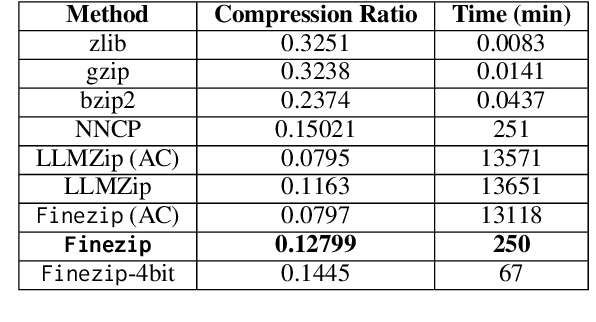
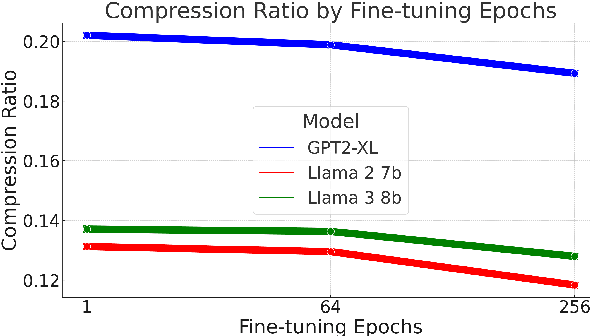
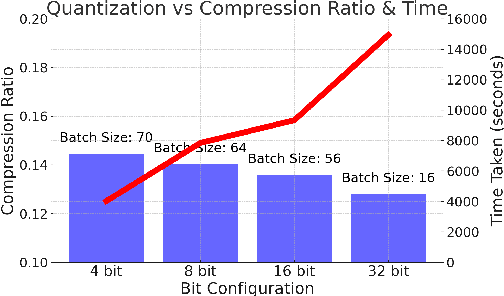
While the language modeling objective has been shown to be deeply connected with compression, it is surprising that modern LLMs are not employed in practical text compression systems. In this paper, we provide an in-depth analysis of neural network and transformer-based compression techniques to answer this question. We compare traditional text compression systems with neural network and LLM-based text compression methods. Although LLM-based systems significantly outperform conventional compression methods, they are highly impractical. Specifically, LLMZip, a recent text compression system using Llama3-8B requires 9.5 days to compress just 10 MB of text, although with huge improvements in compression ratios. To overcome this, we present FineZip - a novel LLM-based text compression system that combines ideas of online memorization and dynamic context to reduce the compression time immensely. FineZip can compress the above corpus in approximately 4 hours compared to 9.5 days, a 54 times improvement over LLMZip and comparable performance. FineZip outperforms traditional algorithmic compression methods with a large margin, improving compression ratios by approximately 50\%. With this work, we take the first step towards making lossless text compression with LLMs a reality. While FineZip presents a significant step in that direction, LLMs are still not a viable solution for large-scale text compression. We hope our work paves the way for future research and innovation to solve this problem.