 Add to Chrome
 Add to Firefox
 Add to Edge
A Paradigm Shift: Fully End-to-End Training for Temporal Sentence Grounding in Videos
Apr 03, 2026
Temporal sentence grounding in videos (TSGV) aims to localize a temporal segment that semantically corresponds to a sentence query from an untrimmed video. Most current methods adopt pre-trained query-agnostic visual encoders for offline feature extraction, and the video backbones are frozen and not optimized for TSGV. This leads to a task discrepancy issue for the video backbone trained for visual classification, but utilized for TSGV. To bridge this gap, we propose a fully end-to-end paradigm that jointly optimizes the video backbone and localization head. We first conduct an empirical study validating the effectiveness of end-to-end learning over frozen baselines across different model scales. Furthermore, we introduce a Sentence Conditioned Adapter (SCADA), which leverages sentence features to train a small portion of video backbone parameters adaptively. SCADA facilitates the deployment of deeper network backbones with reduced memory and significantly enhances visual representation by modulating feature maps through precise integration of linguistic embeddings. Experiments on two benchmarks show that our method outperforms state-of-the-art approaches. The code and models will be released.

OmniPrism: Learning Disentangled Visual Concept for Image Generation
Dec 16, 2024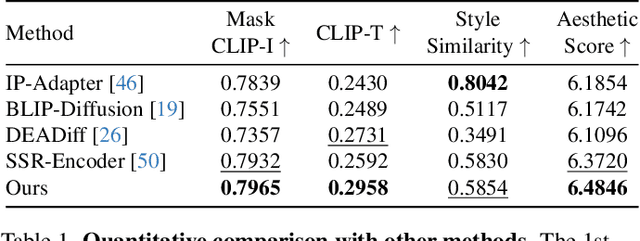
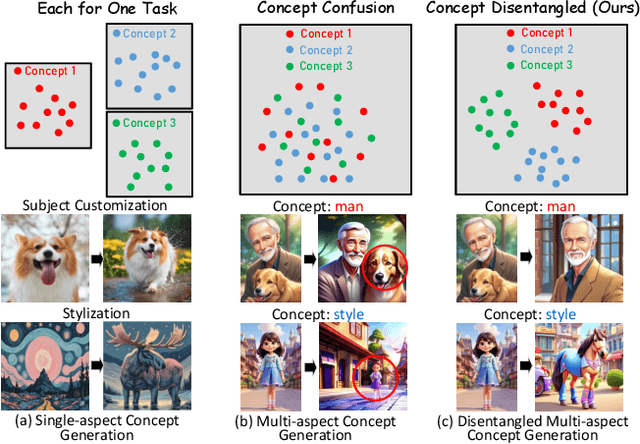


Creative visual concept generation often draws inspiration from specific concepts in a reference image to produce relevant outcomes. However, existing methods are typically constrained to single-aspect concept generation or are easily disrupted by irrelevant concepts in multi-aspect concept scenarios, leading to concept confusion and hindering creative generation. To address this, we propose OmniPrism, a visual concept disentangling approach for creative image generation. Our method learns disentangled concept representations guided by natural language and trains a diffusion model to incorporate these concepts. We utilize the rich semantic space of a multimodal extractor to achieve concept disentanglement from given images and concept guidance. To disentangle concepts with different semantics, we construct a paired concept disentangled dataset (PCD-200K), where each pair shares the same concept such as content, style, and composition. We learn disentangled concept representations through our contrastive orthogonal disentangled (COD) training pipeline, which are then injected into additional diffusion cross-attention layers for generation. A set of block embeddings is designed to adapt each block's concept domain in the diffusion models. Extensive experiments demonstrate that our method can generate high-quality, concept-disentangled results with high fidelity to text prompts and desired concepts.