 Add to Chrome
 Add to Firefox
 Add to Edge
Streamliners for Answer Set Programming
Apr 21, 2026
Streamliner constraints reduce the search space of combinatorial problems by ruling out portions of the solution space. We adapt the StreamLLM approach, which uses Large Language Models (LLMs) to generate streamliners for Constraint Programming, to Answer Set Programming (ASP). Given an ASP encoding and a few small training instances, we prompt multiple LLMs to propose candidate constraints. Candidates that cause syntax errors, render satisfiable instances unsatisfiable, or degrade performance on all training instances are discarded. The surviving streamliners are evaluated together with the original encoding, and we report results for a virtual best encoding (VBE) that, for each instance, selects the fastest among the original encoding and its streamlined variants. On three ASP Competition benchmarks (Partner Units Problem, Sokoban, Towers of Hanoi), the VBE achieves speedups of up to 4--5x over the original encoding. Different LLMs produce semantically diverse constraints, not mere syntactic variations, indicating that the approach captures genuine problem structure.

A Model-Oriented Approach for Lifting Symmetries in Answer Set Programming
Aug 05, 2022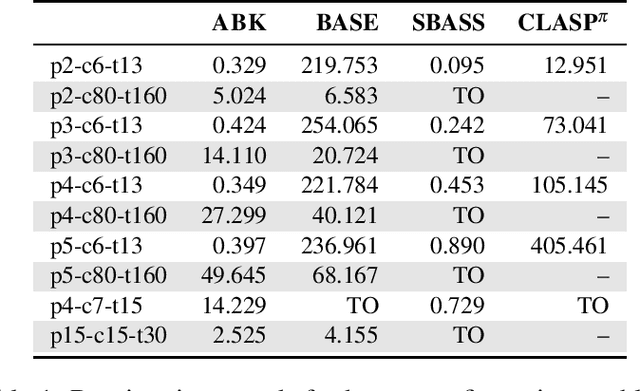
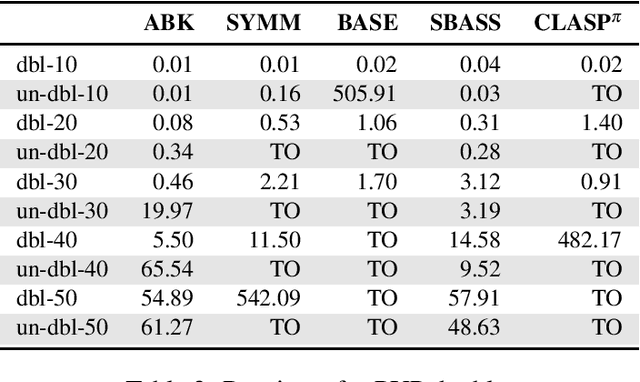
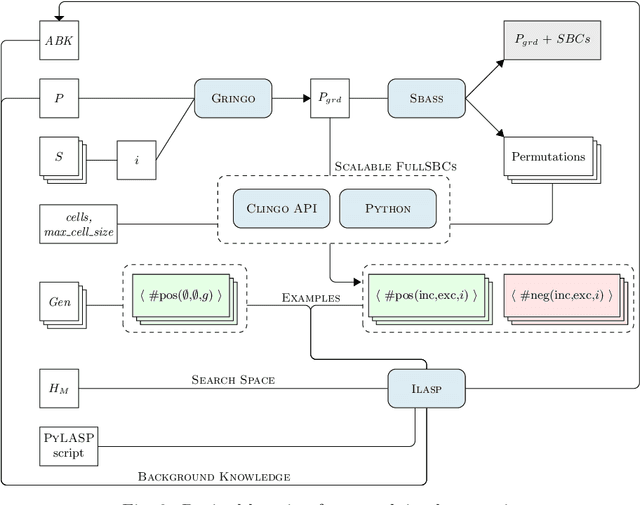
When solving combinatorial problems, pruning symmetric solution candidates from the search space is essential. Most of the existing approaches are instance-specific and focus on the automatic computation of Symmetry Breaking Constraints (SBCs) for each given problem instance. However, the application of such approaches to large-scale instances or advanced problem encodings might be problematic since the computed SBCs are propositional and, therefore, can neither be meaningfully interpreted nor transferred to other instances. As a result, a time-consuming recomputation of SBCs must be done before every invocation of a solver. To overcome these limitations, we introduce a new model-oriented approach for Answer Set Programming that lifts the SBCs of small problem instances into a set of interpretable first-order constraints using a form of machine learning called Inductive Logic Programming. After targeting simple combinatorial problems, we aim to extend our method to be applied also for advanced decision and optimization problems.
* In Proceedings ICLP 2022, arXiv:2208.02685. arXiv admin note: text overlap with arXiv:2112.11806
Efficient lifting of symmetry breaking constraints for complex combinatorial problems
May 14, 2022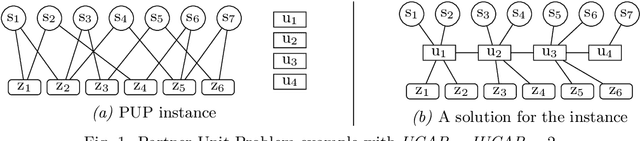
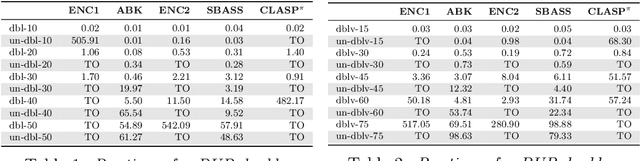
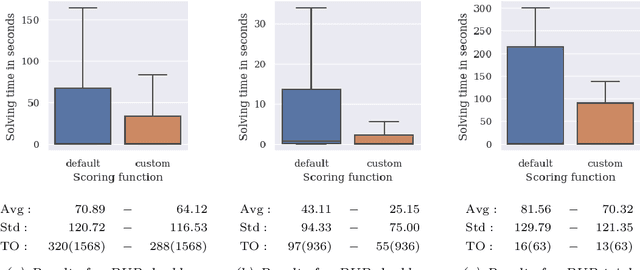
Many industrial applications require finding solutions to challenging combinatorial problems. Efficient elimination of symmetric solution candidates is one of the key enablers for high-performance solving. However, existing model-based approaches for symmetry breaking are limited to problems for which a set of representative and easily-solvable instances is available, which is often not the case in practical applications. This work extends the learning framework and implementation of a model-based approach for Answer Set Programming to overcome these limitations and address challenging problems, such as the Partner Units Problem. In particular, we incorporate a new conflict analysis algorithm in the Inductive Logic Programming system ILASP, redefine the learning task, and suggest a new example generation method to scale up the approach. The experiments conducted for different kinds of Partner Units Problem instances demonstrate the applicability of our approach and the computational benefits due to the first-order constraints learned.
Lifting Symmetry Breaking Constraints with Inductive Logic Programming
Dec 23, 2021Efficient omission of symmetric solution candidates is essential for combinatorial problem-solving. Most of the existing approaches are instance-specific and focus on the automatic computation of Symmetry Breaking Constraints (SBCs) for each given problem instance. However, the application of such approaches to large-scale instances or advanced problem encodings might be problematic since the computed SBCs are propositional and, therefore, can neither be meaningfully interpreted nor transferred to other instances. As a result, a time-consuming recomputation of SBCs must be done before every invocation of a solver. To overcome these limitations, we introduce a new model-oriented approach for Answer Set Programming that lifts the SBCs of small problem instances into a set of interpretable first-order constraints using the Inductive Logic Programming paradigm. Experiments demonstrate the ability of our framework to learn general constraints from instance-specific SBCs for a collection of combinatorial problems. The obtained results indicate that our approach significantly outperforms a state-of-the-art instance-specific method as well as the direct application of a solver.