 Add to Chrome
 Add to Firefox
 Add to Edge
DragonCrawl: A Generative, Intent-Based Framework for Scalable Mobile End-to-End Testing
Jul 30, 2026
As mobile applications grow in complexity, traditional End-to-End (E2E) testing frameworks struggle with UI volatility, maintenance overhead, and cross-platform scalability. This paper presents DragonCrawl, an AI-driven mobile testing system for continuous regression testing that has evolved from embedding-based similarity matching to generative intent-based reasoning using large language models. Unlike prior LLM-based testing research focused on exploratory testing and crash detection, DragonCrawl validates specific user flows on every code change, blocking commits that break critical functionality. By leveraging GPT-4o's multimodal capabilities, DragonCrawl achieves 91.6% pass rate on iOS and 92.2% on Android across 1,013 automated tests running continuously in CI/CD pipelines. The system reduces test onboarding time from 96-120 hours to under 4 hours and has saved an estimated 27 developer years in test maintenance effort. We present the architectural evolution from V1 (semantic embedding matching) to V2 (generative intent-based reasoning), discuss implementation challenges including token explosion and memory constraints, and report operational experience from production deployment. The integration of multimodal vision for end-state detection and tool calling for backend state transitions enables comprehensive regression testing that bridges UI interactions with system state. Our results demonstrate that AI-driven testing can maintain stability while eliminating the brittleness of traditional automated tests, enabling continuous quality assurance at scale.

Stable Stair-Climbing of a Quadruped Robot
Sep 08, 2018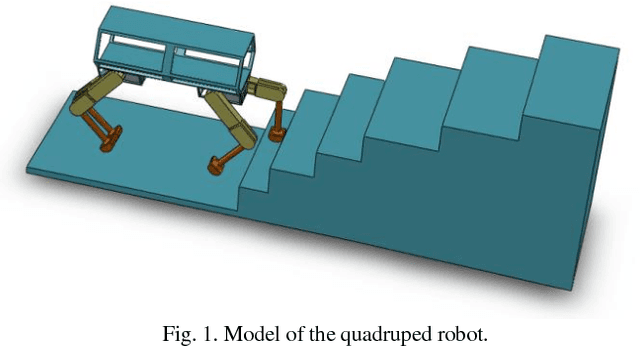
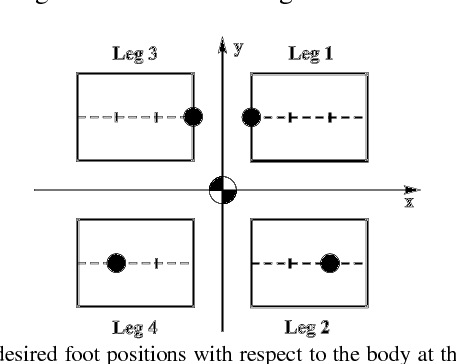
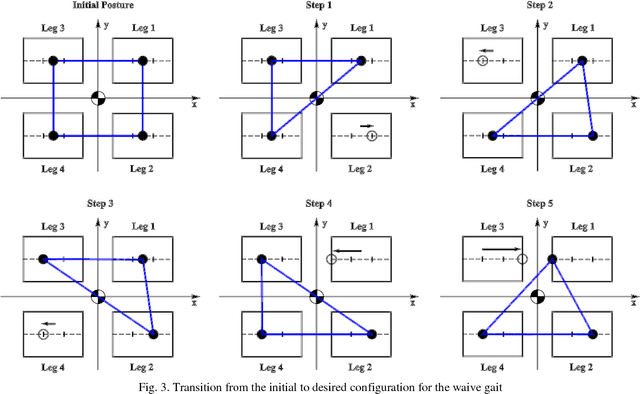
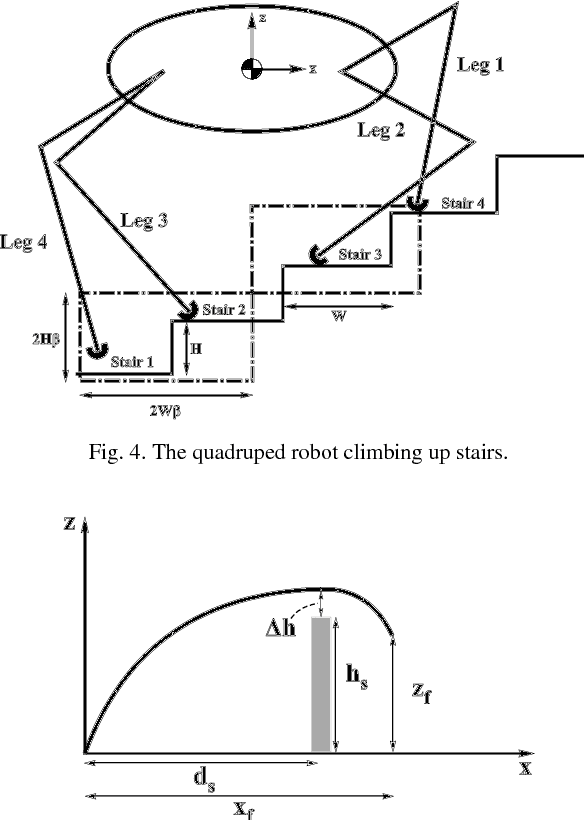
Synthesizing a stable gait that enables a quadruped robot to climb stairs is the focus of this paper. To this end, first a stable transition from initial to desired configuration is made based on the minimum number of steps and maximum use of the leg workspace to prepare the robot for the movement. Next, swing leg and body trajectories are planned for a successful stair- climbing gait. Afterwards, a stable spinning gait is proposed to change the orientation of the body. We simulate our gait planning algorithms on a model of quadruped robot. The results show that the robot is able to climb up stairs, rotate about its yaw axis, and climb down stairs while its stability is guaranteed.
Switching between Limit Cycles in a Model of Running Using Exponentially Stabilizing Discrete Control Lyapunov Function
Jul 07, 2018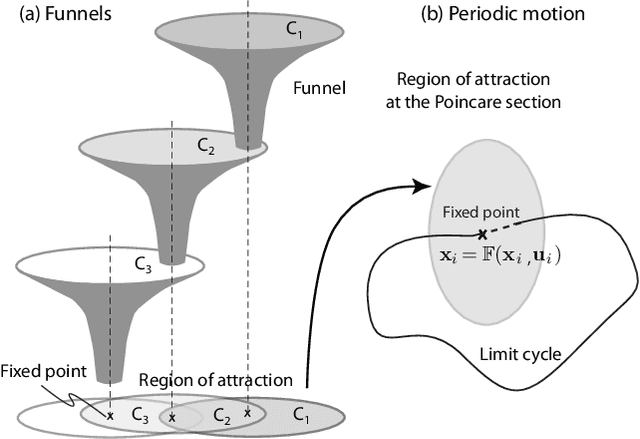
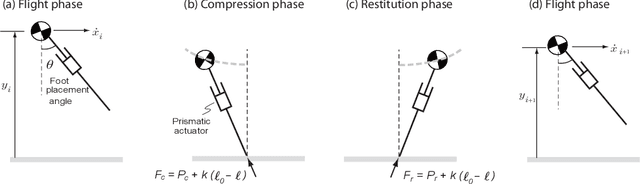
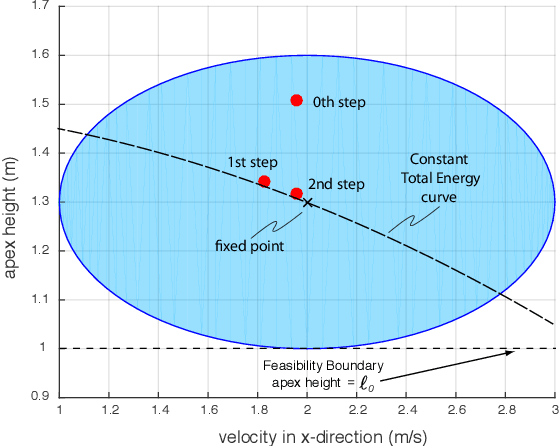
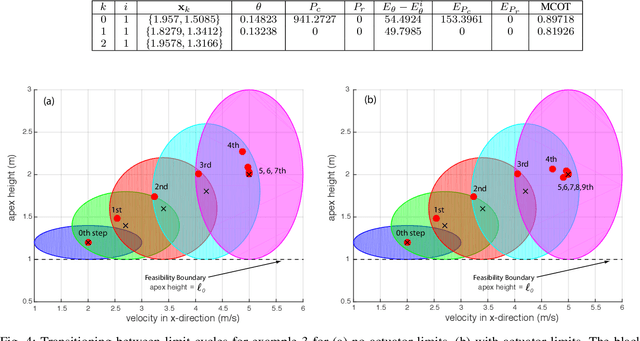
This paper considers the problem of switching between two periodic motions, also known as limit cycles, to create agile running motions. For each limit cycle, we use a control Lyapunov function to estimate the region of attraction at the apex of the flight phase. We switch controllers at the apex, only if the current state of the robot is within the region of attraction of the subsequent limit cycle. If the intersection between two limit cycles is the null set, then we construct additional limit cycles till we are able to achieve sufficient overlap of the region of attraction between sequential limit cycles. Additionally, we impose an exponential convergence condition on the control Lyapunov function that allows us to rapidly transition between limit cycles. Using the approach we demonstrate switching between 5 limit cycles in about 5 steps with the speed changing from 2 m/s to 5 m/s.