 Add to Chrome
 Add to Firefox
 Add to Edge
Memory Is Communication: The Frontier Between Remembering and Signaling
Aug 17, 2026
A bounded agent may obtain information for a decision from its own past, from peers, or from both sources. Retaining task-relevant history can reduce later communication, while a peer message can supply what memory lacks. Under limits on both resources, how should an agent allocate its information budget? Given a fixed task and decision rule, the memory and message rate pairs attaining a performance threshold form an achievable region under specified rules for using history and peer observations. We call its efficient boundary the remembering--signaling frontier. Across conditions where history permits the same maximum reduction in task loss, we hypothesize that a bounded agent will need less peer communication when it obtains a larger loss reduction from history. In preliminary referential games, target repetition coincided with shorter successful messages, while predictability from a hidden cyclic rule did not shorten them. Experiments varying memory and message rates can estimate the frontier and test this prediction across cooperative tasks.

Toward Personal Intelligence Through Cooperative Observation
Aug 17, 2026A personal AI system needs a model of the user's goals, constraints, and ongoing commitments to plan and act on their behalf, and the quality of that model is bounded by what the system can observe. Broader observation does not by itself improve assistance because a bounded system must select and compress information for the task at hand. We argue that this observation bottleneck has a cooperative structure: the system builds a partial model of the user's changing life, the user evaluates its actions, and the user's consent and control shape what it can observe next. Useful and inspectable behavior can give users a reason to maintain or expand the observation channel, while failures can lead them to correct, narrow, revoke, or abandon it. We use the term cooperative observation for this feedback loop among usefulness, trust, and future access, and propose it as a framework for personal intelligence. We report a preliminary single-subject account from Organizm, a prototype used over six months, and outline evaluation directions for measuring how observation quality shapes personal AI.
From Signals to Structure: How Memory Architecture Drives Language Emergence in LLM Agents
Jun 30, 2026How do two agents invent a shared language from scratch? In a Lewis signaling game, a sender and receiver must coordinate on a code using only their interaction history. We study five memory architectures across varying channel configurations with LLM agents and find that memory architecture matters more than channel capacity. Agents with a persistent private notebook benefit from surplus channel capacity and avoid the high-capacity collapse seen in stateless agents, achieving the most reliable coordination ($0.867 \pm 0.023$ at capacity = 25). Stateless agents peak at moderate capacity and then degrade as the vocabulary grows beyond what a rolling context window can track The notebook externalizes learned conventions, freeing agents from having to re-derive codes each round. An information bottleneck-inspired argument predicts an optimal capacity equal to the number of objects. Instead, the bottleneck (capacity = 8) proves to be a fragility point, and surplus capacity is generally better. We show that channel capacity alone cannot predict coordination; memory architecture determines whether agents turn interaction history into stable conventions, and both dimensions are needed to understand how signals become language.
Toward a Theory of Hierarchical Memory for Language Agents
Mar 23, 2026Many recent long-context and agentic systems address context-length limitations by adding hierarchical memory: they extract atomic units from raw data, build multi-level representatives by grouping and compression, and traverse this structure to retrieve content under a token budget. Despite recurring implementations, there is no shared formalism for comparing design choices. We propose a unifying theory in terms of three operators. Extraction ($α$) maps raw data to atomic information units; coarsening ($C = (π, ρ)$) partitions units and assigns a representative to each group; and traversal ($τ$) selects which units to include in context given a query and budget. We identify a self-sufficiency spectrum for the representative function $ρ$ and show how it constrains viable retrieval strategies (a coarsening-traversal coupling). Finally, we instantiate the decomposition on eleven existing systems spanning document hierarchies, conversational memory, and agent execution traces, showcasing its generality.
Synchronous vs Asynchronous Reinforcement Learning in a Real World Robot
Mar 17, 2025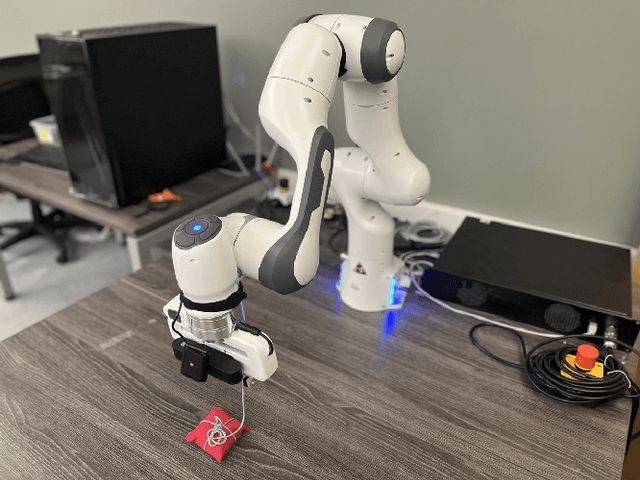

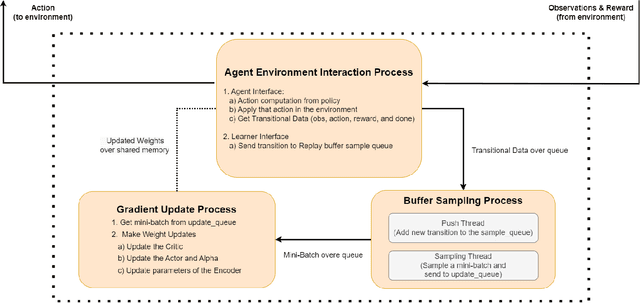
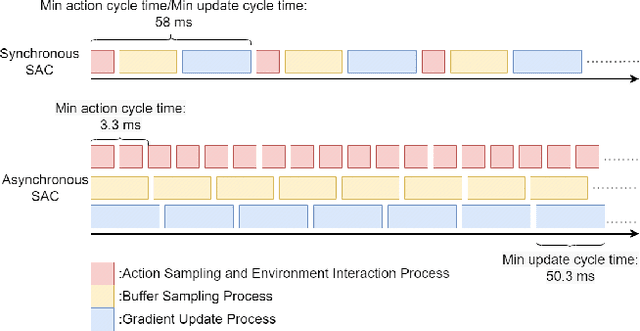
In recent times, reinforcement learning (RL) with physical robots has attracted the attention of a wide range of researchers. However, state-of-the-art RL algorithms do not consider that physical environments do not wait for the RL agent to make decisions or updates. RL agents learn by periodically conducting computationally expensive gradient updates. When decision-making and gradient update tasks are carried out sequentially by the RL agent in a physical robot, it significantly increases the agent's response time. In a rapidly changing environment, this increased response time may be detrimental to the performance of the learning agent. Asynchronous RL methods, which separate the computation of decision-making and gradient updates, are a potential solution to this problem. However, only a few comparisons between asynchronous and synchronous RL have been made with physical robots. For this reason, the exact performance benefits of using asynchronous RL methods over synchronous RL methods are still unclear. In this study, we provide a performance comparison between asynchronous and synchronous RL using a physical robotic arm called Franka Emika Panda. Our experiments show that the agents learn faster and attain significantly more returns using asynchronous RL. Our experiments also demonstrate that the learning agent with a faster response time performs better than the agent with a slower response time, even if the agent with a slower response time performs a higher number of gradient updates.