 Add to Chrome
 Add to Firefox
 Add to Edge
Dijkstra as an Oracle for Online Stochastic Shortest Path Navigation with Provable Guarantees
Aug 18, 2026
Mobile robots that operate in side by side with humans and critical facilities must reach their goals at low cost, despite often unknown true traversal costs of the map apriori and imperfect actuation. Planners that solve the underlying stochastic shortest path problem exactly, such as value iteration, require computation that grows with the diameter of the map, whereas Dijkstra's algorithm is fast but is usually considered inexact once transitions are stochastic. This study shows that Dijkstra's algorithm can remain an exact planning engine under a condition that is much weaker than the causality condition often invoked in the literature, namely nonnegativity of a reduced cost defined on the determinized map. Building on this characterization, an online learner DORA (Dijkstra Oracle Reduced-cost Algorithm) is proposed for robot navigation that calls a shortest path oracle a fixed number of times per episode, never estimates a transition kernel, and adds a logarithmic survival weight when the probability of contact with a dynamic obstacle must stay within a budget. In the numerical experiments involving three other benchmarks that cover grid world navigation, directional drilling, and drone surveillance, the learner matches optimistic value iteration that is given the true transition kernel while performing 4.5 to 19.3 times less planner work, reduces contacts during learning by a factor of seventeen relative to determinize and replan, and keeps the contact rate within budgets that span two orders of magnitude. These results indicate that shortest path search supports safe and efficient online navigation and path planning tasks.

Integrating High-Level Requirements to Low-Level Tests with Machine-Readable V&V Specifications
Jul 20, 2026Modern software teams have mature tools for low-level testing, such as pytest, JUnit, and Jest, which make it inexpensive to write unit tests and run them on every commit. Systems engineering, in parallel, has developed rigorous principles for design verification and validation (V&V), which has worked very well across engineering discipline to align user expecations and requirements with developers' deliverables. In practice, however, the two rarely connect, and the link between users' high-level requirements and the low-level tests that machines actually run is maintained by hand, if at all. This gap is increasingly costly for AI-enabled and cyber-physical systems, for which regulators now ask for traceable evidence that high-level requirements are met, while raw test results provide little of the structure such evidence requires. We introduce VNVSpec, an open-source framework that makes V&V specifications machine-readable and executable. With this framework, users state high-level requirements directly or import them from catalogs derived from published standards. Then, the framework checks requirement quality, supports decomposition into module-level requirements with explicit metrics and acceptance criteria, links these requirements to test results through a traceability graph, and compiles the collected evidence into verdicts and audit-ready reports. We evaluate the framework by self-application, in which it is continuously assessed in CI against its own specification of 36 requirements verified by 449 tests, completed within limited time which scales linearly and thus can handle up to 10,000 requirements. We also discuss how the framework extends to testing black-box AI models and AI coding agents. The framework, its full test suite, the catalogs, and the benchmark scripts are available at https://github.com/ai-vnv/vnvspec.
Use of AI Tools: Guidelines to Maintain Academic Integrity in Computing Colleges
Apr 13, 2026The rapid adoption of AI tools such as ChatGPT has significantly transformed academic practices, offering considerable benefits for both students and faculty in computing disciplines. These tools have been shown to enhance learning efficiency, academic self-efficacy, and confidence. However, their increasing use also raises pressing concerns regarding the preservation of academic integrity -- an essential pillar of the educational process. This paper explores the implications of widespread AI tool usage within computing colleges, with a particular focus on how to align their use with the principles of academic honesty. We begin by classifying common assessment techniques employed in computing education and examine how each may be impacted by AI-assisted tools. Building on this foundation, we propose a set of general guidelines applicable across various assessment formats to help instructors responsibly integrate AI tools into their pedagogy. Furthermore, we provide targeted, assessment-specific recommendations designed to uphold educational objectives while mitigating risks of academic misconduct. These guidelines serve as a practical framework for instructors aiming to balance the pedagogical advantages of AI tools with the imperative of maintaining academic integrity in computing education. Finally, we introduce a formal model that provides a structured mathematical framework for evaluating student assessments in the presence of AI-assisted tools.
Agents for Agents: An Interrogator-Based Secure Framework for Autonomous Internet of Underwater Things
Apr 05, 2026Autonomous underwater vehicles (AUVs) and sensor nodes increasingly support decentralized sensing and coordination in the Internet of Underwater Things (IoUT), yet most deployments rely on static trust once authentication is established, leaving long-duration missions vulnerable to compromised or behaviorally deviating agents. In this paper, an interrogator based structure is presented that incorporates the idea of behavioral trust monitoring into underwater multi-agent operation without interfering with autonomy. Privileged interrogator module is a passive communication metadata analyzer that uses a lightweight transformer model to calculate dynamic trust scores, which are used to authorize the forwarding of mission critical data. Suspicious agents cause proportional monitoring and conditional restrictions, which allow fast containment and maintain network continuity. The evidence of trust is stored in a permissioned blockchain consortium which offers identity management which is not tampered and is decentralized without causing the overhead of public consensus mechanisms. Simulation based analysis shows that the evaluation of the result compares to a relative improvement of 21.7% in the detection accuracy compared to the static trust baselines with limited energy overhead. These findings suggest that behavior driven validation has the capability of reinforcing underwater coordination without compromising scalability and deployment.
Governance-Constrained Agentic AI: Blockchain-Enforced Human Oversight for Safety-Critical Wildfire Monitoring
Apr 05, 2026The AI-based sensing and autonomous monitoring have become the main components of wildfire early detection, but current systems do not provide adaptive inter-agent coordination, structurally defined human control, and cryptographically verifiable responsibility. Purely autonomous alert dissemination in the context of safety critical disasters poses threats of false alarming, governance failure and lack of trust in the system. This paper provides a blockchain-based governance-conscious agentic AI architecture of trusted wildfire early warning. The monitoring of wildfires is modeled as a constrained partially observable Markov decision process (POMDP) that accounts for the detection latency, false alarms reduction and resource consumption with clear governance constraints. Hierarchical multi-agent coordination means dynamic risk-adaptive reallocation of unmanned aerial vehicles (UAVs). With risk-adaptive policies, a permissioned blockchain layer sets mandatory human-authorization as a state-transition invariant as a smart contract. We build formal assurances such as integrity of alerts, human control, non-repudiation and limited detection latency assumptions of Byzantine fault. Security analysis shows that it is resistant to alert injections, replays, and tampering attacks. High-fidelity simulation environment experimental evaluation of governance enforcement demonstrates that it presents limited operational overhead and decreases false public alerts and maintains adaptive detection performance. This work is a step towards a principled design paradigm of reliable AI systems by incorporating accountability into the agentic control loop of disaster intelligence systems that demand safety in their application.
A Blockchain-Monitored Agentic AI Architecture for Trusted Perception-Reasoning-Action Pipelines
Dec 24, 2025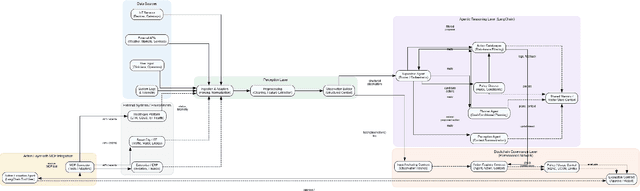
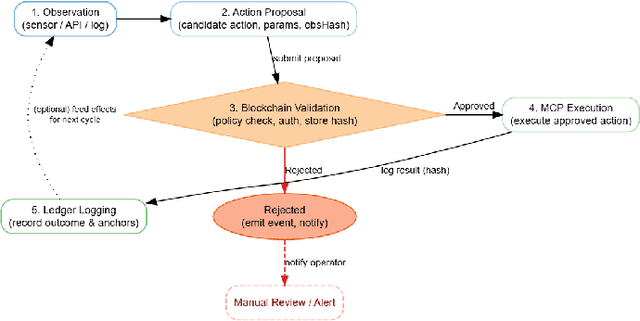
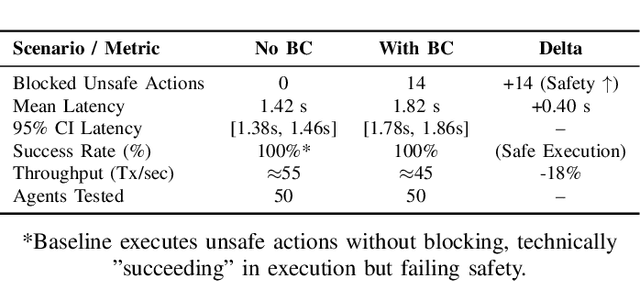
The application of agentic AI systems in autonomous decision-making is growing in the areas of healthcare, smart cities, digital forensics, and supply chain management. Even though these systems are flexible and offer real-time reasoning, they also raise concerns of trust and oversight, and integrity of the information and activities upon which they are founded. The paper suggests a single architecture model comprising of LangChain-based multi-agent system with a permissioned blockchain to guarantee constant monitoring, policy enforcement, and immutable auditability of agentic action. The framework relates the perception conceptualization-action cycle to a blockchain layer of governance that verifies the inputs, evaluates recommended actions, and documents the outcomes of the execution. A Hyperledger Fabric-based system, action executors MCP-integrated, and LangChain agent are introduced and experiments of smart inventory management, traffic-signal control, and healthcare monitoring are done. The results suggest that blockchain-security verification is efficient in preventing unauthorized practices, offers traceability throughout the whole decision-making process, and maintains operational latency within reasonable ranges. The suggested framework provides a universal system of implementing high-impact agentic AI applications that are autonomous yet responsible.
FinAgent: An Agentic AI Framework Integrating Personal Finance and Nutrition Planning
Dec 24, 2025The issue of limited household budgets and nutritional demands continues to be a challenge especially in the middle-income environment where food prices fluctuate. This paper introduces a price aware agentic AI system, which combines personal finance management with diet optimization. With household income and fixed expenditures, medical and well-being status, as well as real-time food costs, the system creates nutritionally sufficient meals plans at comparatively reasonable prices that automatically adjust to market changes. The framework is implemented in a modular multi-agent architecture, which has specific agents (budgeting, nutrition, price monitoring, and health personalization). These agents share the knowledge base and use the substitution graph to ensure that the nutritional quality is maintained at a minimum cost. Simulations with a representative Saudi household case study show a steady 12-18\% reduction in costs relative to a static weekly menu, nutrient adequacy of over 95\% and high performance with price changes of 20-30%. The findings indicate that the framework can locally combine affordability with nutritional adequacy and provide a viable avenue of capacity-building towards sustainable and fair diet planning in line with Sustainable Development Goals on Zero Hunger and Good Health.