 Add to Chrome
 Add to Firefox
 Add to Edge
Knee-xRAI: An Explainable AI Framework for Automatic Kellgren-Lawrence Grading of Knee Osteoarthritis
Apr 25, 2026
Radiographic grading of knee osteoarthritis (KOA) with the Kellgren-Lawrence (KL) system is limited by inter-reader variability and the opacity of current deep learning approaches, which predict KL grades directly from images without decomposing structural features. We present Knee-xRAI, a modular framework that independently quantifies the three cardinal radiographic features of KOA (joint space narrowing [JSN], osteophytes, and subchondral sclerosis) and integrates them into an explainable KL grade classification. The pipeline combines U-Net++ segmentation for contour-based JSN measurement, an SE-ResNet-50 network for per-site osteophyte grading (OARSI scale), and a hybrid texture-CNN classifier for binary sclerosis quantification. The resulting 50-dimensional structured feature vector feeds two complementary classification paths. An XGBoost path supports SHAP-based feature attribution. A ConvNeXt hybrid path combines the structured vector with a full-image encoder for enhanced predictive performance. Evaluated on 8,260 radiographs from an OAI-derived dataset, the JSN module achieved a Dice coefficient of 0.8909 and an mJSW intraclass correlation of 0.8674 against manual annotations. The ConvNeXt hybrid path reached a test quadratic weighted kappa (QWK) of 0.8436 and AUC of 0.9017. The transparent XGBoost path achieved a test QWK of 0.6294 with full feature-level audit capability. Ablation confirmed JSN as the dominant predictor (QWK = 0.6103 alone), with osteophyte features providing consistent incremental gain (+0.0183) and sclerosis contributing marginally. Inference-time ablation of Path B confirmed the structured pathway contributes materially beyond the image encoder, with QWK drops of 0.098 (feature zeroing) and 0.284 (feature-image permutation). Knee-xRAI explicitly quantifies all three KL-defining radiographic features within a single auditable pipeline.

Enhanced Importance Sampling through Latent Space Exploration in Normalizing Flows
Jan 06, 2025


Importance sampling is a rare event simulation technique used in Monte Carlo simulations to bias the sampling distribution towards the rare event of interest. By assigning appropriate weights to sampled points, importance sampling allows for more efficient estimation of rare events or tails of distributions. However, importance sampling can fail when the proposal distribution does not effectively cover the target distribution. In this work, we propose a method for more efficient sampling by updating the proposal distribution in the latent space of a normalizing flow. Normalizing flows learn an invertible mapping from a target distribution to a simpler latent distribution. The latent space can be more easily explored during the search for a proposal distribution, and samples from the proposal distribution are recovered in the space of the target distribution via the invertible mapping. We empirically validate our methodology on simulated robotics applications such as autonomous racing and aircraft ground collision avoidance.
Using LLM for Real-Time Transcription and Summarization of Doctor-Patient Interactions into ePuskesmas in Indonesia
Sep 25, 2024
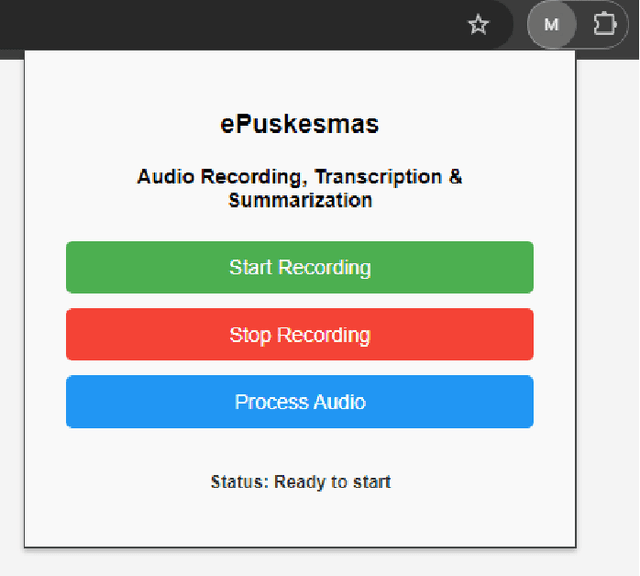
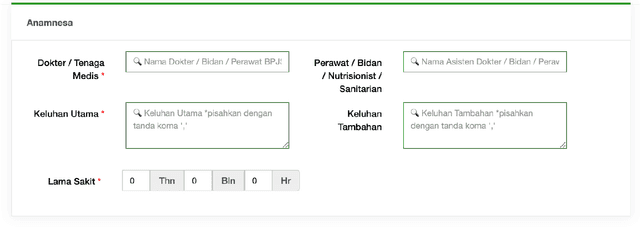
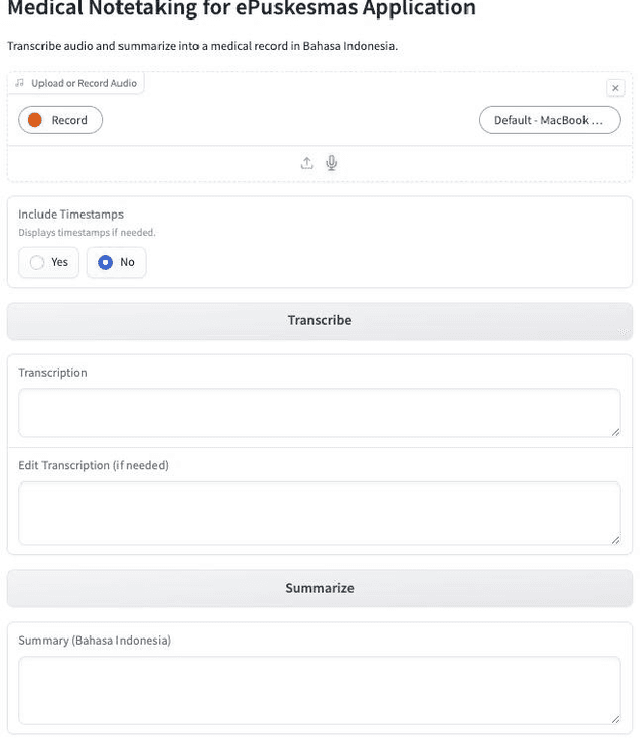
One of the key issues contributing to inefficiency in Puskesmas is the time-consuming nature of doctor-patient interactions. Doctors need to conduct thorough consultations, which include diagnosing the patient's condition, providing treatment advice, and transcribing detailed notes into medical records. In regions with diverse linguistic backgrounds, doctors often have to ask clarifying questions, further prolonging the process. While diagnosing is essential, transcription and summarization can often be automated using AI to improve time efficiency and help doctors enhance care quality and enable early diagnosis and intervention. This paper proposes a solution using a localized large language model (LLM) to transcribe, translate, and summarize doctor-patient conversations. We utilize the Whisper model for transcription and GPT-3 to summarize them into the ePuskemas medical records format. This system is implemented as an add-on to an existing web browser extension, allowing doctors to fill out patient forms while talking. By leveraging this solution for real-time transcription, translation, and summarization, doctors can improve the turnaround time for patient care while enhancing the quality of records, which become more detailed and insightful for future visits. This innovation addresses challenges like overcrowded facilities and the administrative burden on healthcare providers in Indonesia. We believe this solution will help doctors save time, provide better care, and produce more accurate medical records, representing a significant step toward modernizing healthcare and ensuring patients receive timely, high-quality care, even in resource-constrained settings.
Toward an Integrated Decision Making Framework for Optimized Stroke Diagnosis with DSA and Treatment under Uncertainty
Jul 24, 2024This study addresses the challenge of stroke diagnosis and treatment under uncertainty, a critical issue given the rapid progression and severe consequences of stroke conditions such as aneurysms, arteriovenous malformations (AVM), and occlusions. Current diagnostic methods, including Digital Subtraction Angiography (DSA), face limitations due to high costs and its invasive nature. To overcome these challenges, we propose a novel approach using a Partially Observable Markov Decision Process (POMDP) framework. Our model integrates advanced diagnostic tools and treatment approaches with a decision-making algorithm that accounts for the inherent uncertainties in stroke diagnosis. Our approach combines noisy observations from CT scans, Siriraj scores, and DSA reports to inform the subsequent treatment options. We utilize the online solver DESPOT, which employs tree-search methods and particle filters, to simulate potential future scenarios and guide our strategies. The results indicate that our POMDP framework balances diagnostic and treatment objectives, striking a tradeoff between the need for precise stroke identification via invasive procedures like DSA and the constraints of limited healthcare resources that necessitate more cost-effective strategies, such as in-hospital or at-home observation, by relying only relying on simulation rollouts and not imposing any prior knowledge. Our study offers a significant contribution by presenting a systematic framework that optimally integrates diagnostic and treatment processes for stroke and accounting for various uncertainties, thereby improving care and outcomes in stroke management.