 Add to Chrome
 Add to Firefox
 Add to Edge
How DDAIR you? Disambiguated Data Augmentation for Intent Recognition
Jan 16, 2026
Large Language Models (LLMs) are effective for data augmentation in classification tasks like intent detection. In some cases, they inadvertently produce examples that are ambiguous with regard to untargeted classes. We present DDAIR (Disambiguated Data Augmentation for Intent Recognition) to mitigate this problem. We use Sentence Transformers to detect ambiguous class-guided augmented examples generated by LLMs for intent recognition in low-resource scenarios. We identify synthetic examples that are semantically more similar to another intent than to their target one. We also provide an iterative re-generation method to mitigate such ambiguities. Our findings show that sentence embeddings effectively help to (re)generate less ambiguous examples, and suggest promising potential to improve classification performance in scenarios where intents are loosely or broadly defined.

Benchmark Underestimates the Readiness of Multi-lingual Dialogue Agents
May 28, 2024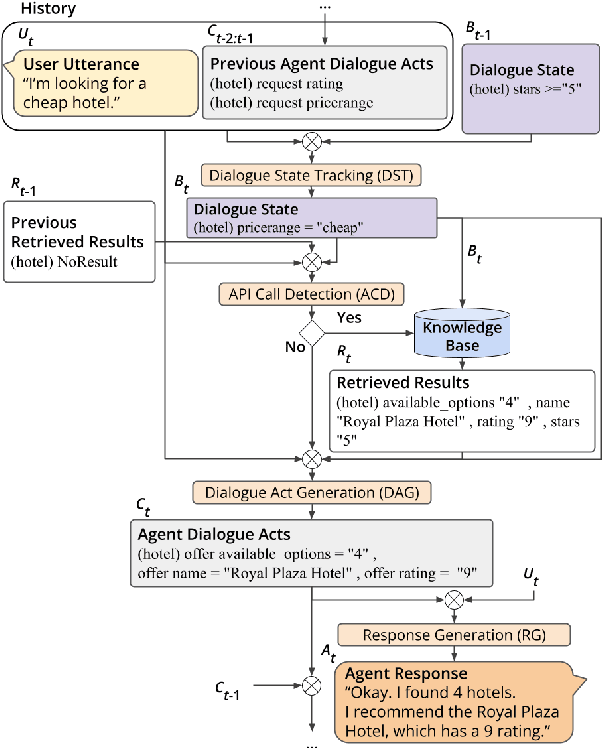


Creating multilingual task-oriented dialogue (TOD) agents is challenging due to the high cost of training data acquisition. Following the research trend of improving training data efficiency, we show for the first time, that in-context learning is sufficient to tackle multilingual TOD. To handle the challenging dialogue state tracking (DST) subtask, we break it down to simpler steps that are more compatible with in-context learning where only a handful of few-shot examples are used. We test our approach on the multilingual TOD dataset X-RiSAWOZ, which has 12 domains in Chinese, English, French, Korean, Hindi, and code-mixed Hindi-English. Our turn-by-turn DST accuracy on the 6 languages range from 55.6% to 80.3%, seemingly worse than the SOTA results from fine-tuned models that achieve from 60.7% to 82.8%; our BLEU scores in the response generation (RG) subtask are also significantly lower than SOTA. However, after manual evaluation of the validation set, we find that by correcting gold label errors and improving dataset annotation schema, GPT-4 with our prompts can achieve (1) 89.6%-96.8% accuracy in DST, and (2) more than 99% correct response generation across different languages. This leads us to conclude that current automatic metrics heavily underestimate the effectiveness of in-context learning.