 Add to Chrome
 Add to Firefox
 Add to Edge
SurakshaEval: An Indic Safety Benchmark for Multilingual LLMs
Aug 08, 2026
Existing safety evaluation datasets for large language models (LLMs) predominantly focus on English and Western contexts, often overlooking the linguistic diversity and culturally grounded safety risks present in other languages. To address this gap, we introduce SurakshaEval, a novel safety benchmark composed of human-written prompts spanning real-world scenarios, explicitly designed for ten major Indian languages - Assamese, Bengali, Gujarati, Hindi, Kannada, Malayalam, Marathi, Punjabi, Tamil, and Telugu, along with English. SurakshaEval includes both generic prompts common across India and region- and language-specific prompts that capture localized sociocultural sensitivities. We benchmark a broad range of state-of-the-art LLMs on SurakshaEval, establish baseline safety performance, and identify recurring failure modes, including over-refusal, missed detection of implicit bias, and insufficient contextual awareness in regionally sensitive settings. Our results show that even strong multilingual LLMs struggle to reliably meet nuanced safety requirements when operating in Indic languages, particularly in native scripts. These findings highlight the urgent need for safety evaluation frameworks that incorporate region-specific data and structured assessment protocols, enabling the development and deployment of AI systems that operate securely, ethically, and in alignment with diverse societal values. Our code and data are available at https://github.com/debobanerjee/SurakshaEval. Warning: This paper contains text that may be offensive or unsafe.

Benchmark Underestimates the Readiness of Multi-lingual Dialogue Agents
May 28, 2024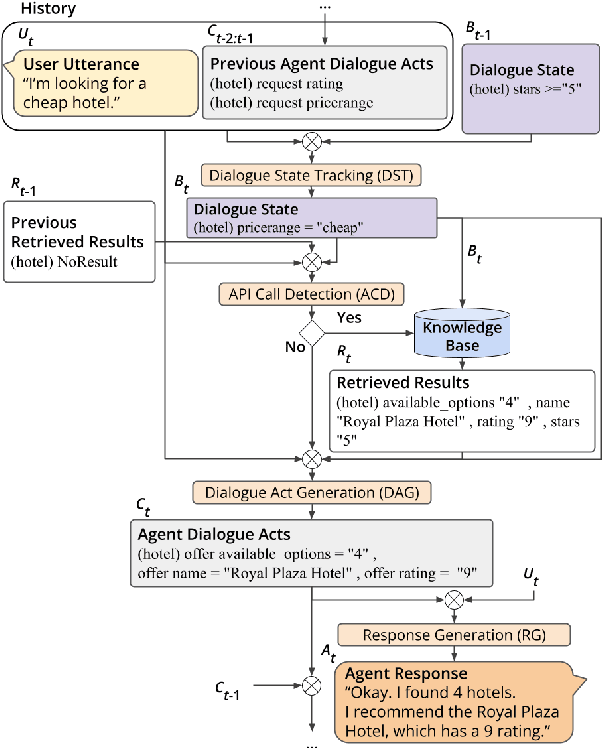


Creating multilingual task-oriented dialogue (TOD) agents is challenging due to the high cost of training data acquisition. Following the research trend of improving training data efficiency, we show for the first time, that in-context learning is sufficient to tackle multilingual TOD. To handle the challenging dialogue state tracking (DST) subtask, we break it down to simpler steps that are more compatible with in-context learning where only a handful of few-shot examples are used. We test our approach on the multilingual TOD dataset X-RiSAWOZ, which has 12 domains in Chinese, English, French, Korean, Hindi, and code-mixed Hindi-English. Our turn-by-turn DST accuracy on the 6 languages range from 55.6% to 80.3%, seemingly worse than the SOTA results from fine-tuned models that achieve from 60.7% to 82.8%; our BLEU scores in the response generation (RG) subtask are also significantly lower than SOTA. However, after manual evaluation of the validation set, we find that by correcting gold label errors and improving dataset annotation schema, GPT-4 with our prompts can achieve (1) 89.6%-96.8% accuracy in DST, and (2) more than 99% correct response generation across different languages. This leads us to conclude that current automatic metrics heavily underestimate the effectiveness of in-context learning.