 Add to Chrome
 Add to Firefox
 Add to Edge
What Are We Actually Decoding? Source Attribution for Non-Invasive Brain-to-Language Retrieval
May 23, 2026
In non-invasive neural language decoding, results can be inflated by sources that are not stimulus-evoked neural evidence: decoder priors, embedding-based metrics, and non-neural structural nuisances such as signal duration. The methodological challenge is therefore attribution: a reported gain is more informative when it can be traced to a specific source. We recast stimulus-locked MEG-to-audio retrieval as an auditing framework that separates apparent performance into three sources - structural shortcuts, window-level stimulus-locked evidence, and cross-window contextual aggregation - and provides a diagnostic for each. Signal-blind Gaussian noise reaches 66.3% Rank@1 (R@1) under variable-length decoding but collapses to near chance once fixed-duration windows and stimulus-identity splits are enforced, isolating structural leakage. Under these controls, fixed-window retrieval recovers measurable MEG-audio discriminability, while an oracle sentence-bucket diagnostic shows that 95.7% of Top-1 errors select the wrong sentence, localising the residual bottleneck to sentence-level competition. We audit this contextual source with Group Context Bias (GCB), an inference-time additive logit bias that pools sentence-consistent evidence across windows while leaving the base retrieval scores and candidate pool fixed. Used as a score-space intervention, GCB makes the contextual source measurable: R@1 shifts from 44% to 52% on Gwilliams and from 22% to 29% on MOUS under the same fixed setting. GCB is auditable under this design: its effect collapses under random-grouping perturbations and vanishes when local evidence is attenuated in MEG or is near chance in EEG, supporting its use as a controlled source-attribution intervention. These results suggest that brain-to-language performance should be source-attributed, not merely reported.

MindAlign: Bridging EEG, Vision, and Language for Zero-Shot Visual Decoding
May 23, 2026Visual decoding from brain signals is a key challenge at the intersection of computer vision and neuroscience, requiring methods that bridge neural representations and computational models of vision. We introduce a tri-modal contrastive framework for EEG-based visual decoding that aligns EEG, visual, and textual representations within a unified latent space. Our approach follows a two-stage design. First, we pre-train an EEG encoder via masked reconstruction on unlabeled trials, learning spatio-temporal regularities that transfer robustly to downstream tasks. Second, we jointly align EEG, image, and LLM-generated textual descriptions through contrastive learning, where text supervision acts as a semantic regularizer that injects linguistic structure into the shared space without overwhelming the primary EEG-image signal. The encoder integrates subject-specific adaptation, graph-attention over channels, and temporal-spatial convolutional embeddings. On the Things-EEG2 200-way zero-shot benchmark, our framework achieves 54.1% Top-1 and 83.4% Top-5 accuracy, substantially exceeding the strongest prior baseline (32.4% / 64.0%), with paired Wilcoxon tests confirming significance (p < 0.01) over all in-subject baselines. We validate generalization on Things-MEG. Analysis reveals that compact embedding geometries (CN-CLIP) outperform much larger backbones, and that decoding aligns with established neurophysiology of visual processing. This work is a critical step towards robust, semantically-grounded visual decoding from non-invasive temporal neural signals. The source code is publicly available in https://github.com/anon-eeg/eeg_image_decoding.
SWIM: Short-Window CNN Integrated with Mamba for EEG-Based Auditory Spatial Attention Decoding
Sep 30, 2024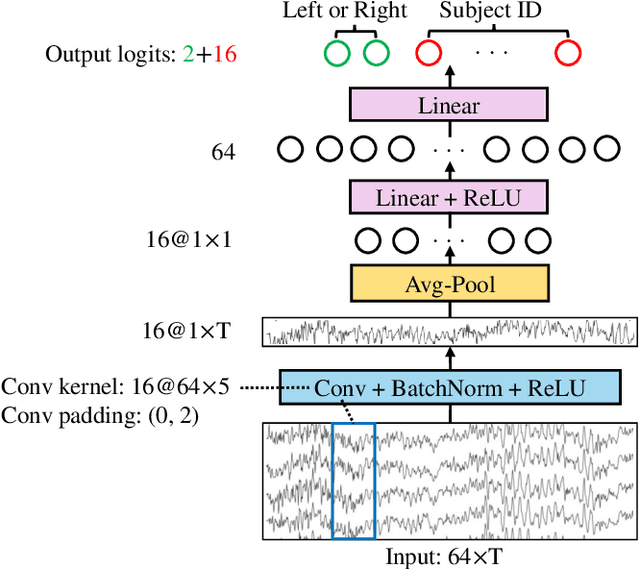
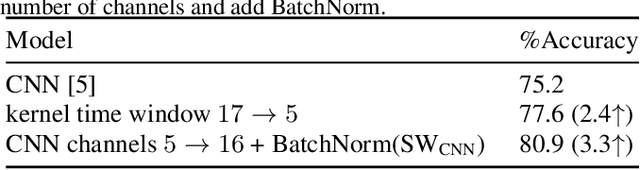
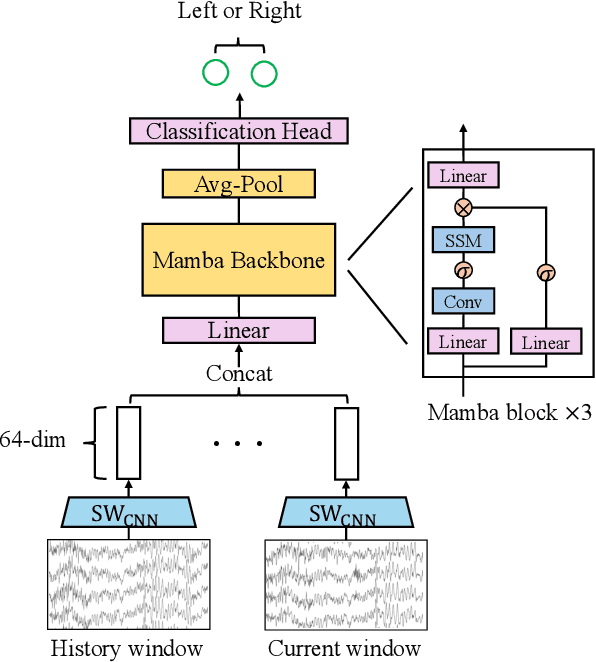
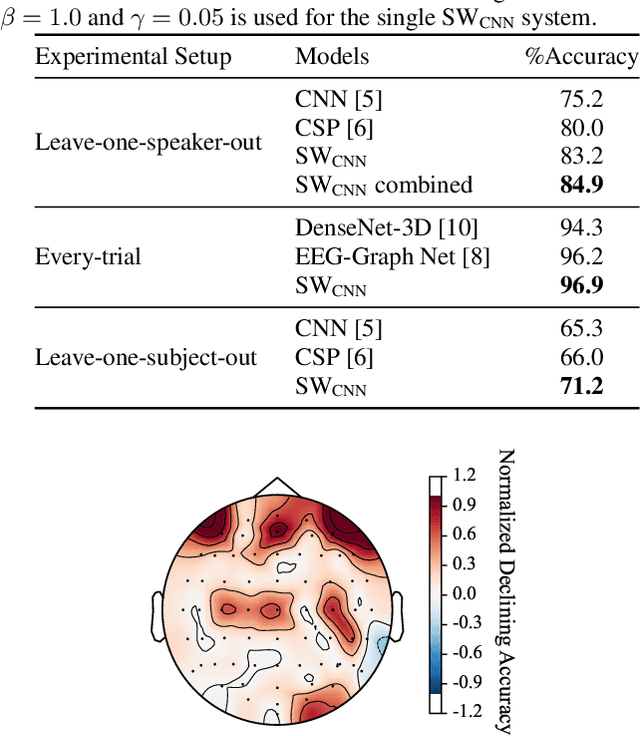
In complex auditory environments, the human auditory system possesses the remarkable ability to focus on a specific speaker while disregarding others. In this study, a new model named SWIM, a short-window convolution neural network (CNN) integrated with Mamba, is proposed for identifying the locus of auditory attention (left or right) from electroencephalography (EEG) signals without relying on speech envelopes. SWIM consists of two parts. The first is a short-window CNN (SW$_\text{CNN}$), which acts as a short-term EEG feature extractor and achieves a final accuracy of 84.9% in the leave-one-speaker-out setup on the widely used KUL dataset. This improvement is due to the use of an improved CNN structure, data augmentation, multitask training, and model combination. The second part, Mamba, is a sequence model first applied to auditory spatial attention decoding to leverage the long-term dependency from previous SW$_\text{CNN}$ time steps. By joint training SW$_\text{CNN}$ and Mamba, the proposed SWIM structure uses both short-term and long-term information and achieves an accuracy of 86.2%, which reduces the classification errors by a relative 31.0% compared to the previous state-of-the-art result. The source code is available at https://github.com/windowso/SWIM-ASAD.