 Add to Chrome
 Add to Firefox
 Add to Edge
Cloak of Invisibility: Real-Time Privacy-Preserving Volumetric Video Streaming
Aug 12, 2026
Volumetric video streaming turns privacy into a 3D, multi-view problem. Unlike ordinary video, where sensitive content can often be redacted frame by frame, RGB-D volumetric pipelines capture people, rooms, and personal objects from multiple cameras and fuse them into a shared 3D representation. A private object missed in one view, or only partially removed before fusion, can therefore reappear in the reconstructed scene. This creates a privacy challenge for 3D telepresence, education, entertainment, and immersive applications: private content should be removed before raw visual and geometric data leave the camera side, while the public part of the scene should remain useful for real-time reconstruction. Existing volumetric streaming systems mainly optimize reconstruction, data movement, and latency, while privacy-preserving vision methods are designed for single-camera, single-frame images and do not directly address calibrated multi-view RGB-D fusion. We present InViStream, a real-time "privacy-from-source" system designed for this setting. InViStream addresses three challenges in volumetric capture: private objects may appear differently across views, RGB masking alone can leave geometric privacy leakage in depth, and public/private instances of the same class must be separated consistently before cloud-side fusion. To address these challenges, InViStream combines object detection with depth-aware masking, propagates public/private decisions across calibrated views, and fuses only sanitized point clouds. We evaluate InViStream on synthetic and real RGB-D scenes, including offices, conference rooms, living rooms, and settings with multiple public and private people and objects. InViStream achieves synthetic Dice/Recall of 0.799/0.891 and real Dice/Recall of 0.792/0.908, with synthetic SSIM above 0.98 and real-time streaming above 30 FPS.

2-Factor Retrieval for Improved Human-AI Decision Making in Radiology
Nov 30, 2024Human-machine teaming in medical AI requires us to understand to what degree a trained clinician should weigh AI predictions. While previous work has shown the potential of AI assistance at improving clinical predictions, existing clinical decision support systems either provide no explainability of their predictions or use techniques like saliency and Shapley values, which do not allow for physician-based verification. To address this gap, this study compares previously used explainable AI techniques with a newly proposed technique termed '2-factor retrieval (2FR)', which is a combination of interface design and search retrieval that returns similarly labeled data without processing this data. This results in a 2-factor security blanket where: (a) correct images need to be retrieved by the AI; and (b) humans should associate the retrieved images with the current pathology under test. We find that when tested on chest X-ray diagnoses, 2FR leads to increases in clinician accuracy, with particular improvements when clinicians are radiologists and have low confidence in their decision. Our results highlight the importance of understanding how different modes of human-AI decision making may impact clinician accuracy in clinical decision support systems.
Thermal Imaging and Radar for Remote Sleep Monitoring of Breathing and Apnea
Jul 16, 2024Polysomnography (PSG), the current gold standard method for monitoring and detecting sleep disorders, is cumbersome and costly. At-home testing solutions, known as home sleep apnea testing (HSAT), exist. However, they are contact-based, a feature which limits the ability of some patient populations to tolerate testing and discourages widespread deployment. Previous work on non-contact sleep monitoring for sleep apnea detection either estimates respiratory effort using radar or nasal airflow using a thermal camera, but has not compared the two or used them together. We conducted a study on 10 participants, ages 34 - 78, with suspected sleep disorders using a hardware setup with a synchronized radar and thermal camera. We show the first comparison of radar and thermal imaging for sleep monitoring, and find that our thermal imaging method outperforms radar significantly. Our thermal imaging method detects apneas with an accuracy of 0.99, a precision of 0.68, a recall of 0.74, an F1 score of 0.71, and an intra-class correlation of 0.70; our radar method detects apneas with an accuracy of 0.83, a precision of 0.13, a recall of 0.86, an F1 score of 0.22, and an intra-class correlation of 0.13. We also present a novel proposal for classifying obstructive and central sleep apnea by leveraging a multimodal setup. This method could be used accurately detect and classify apneas during sleep with non-contact sensors, thereby improving diagnostic capacities in patient populations unable to tolerate current technology.
Solutions to Deepfakes: Can Camera Hardware, Cryptography, and Deep Learning Verify Real Images?
Jul 04, 2024
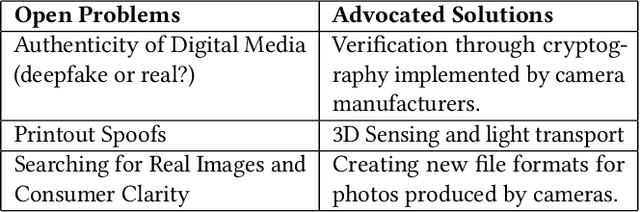
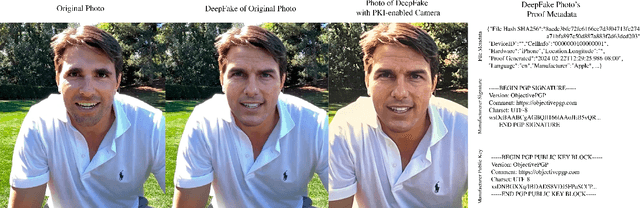
The exponential progress in generative AI poses serious implications for the credibility of all real images and videos. There will exist a point in the future where 1) digital content produced by generative AI will be indistinguishable from those created by cameras, 2) high-quality generative algorithms will be accessible to anyone, and 3) the ratio of all synthetic to real images will be large. It is imperative to establish methods that can separate real data from synthetic data with high confidence. We define real images as those that were produced by the camera hardware, capturing a real-world scene. Any synthetic generation of an image or alteration of a real image through generative AI or computer graphics techniques is labeled as a synthetic image. To this end, this document aims to: present known strategies in detection and cryptography that can be employed to verify which images are real, weight the strengths and weaknesses of these strategies, and suggest additional improvements to alleviate shortcomings.
CG3D: Compositional Generation for Text-to-3D via Gaussian Splatting
Nov 29, 2023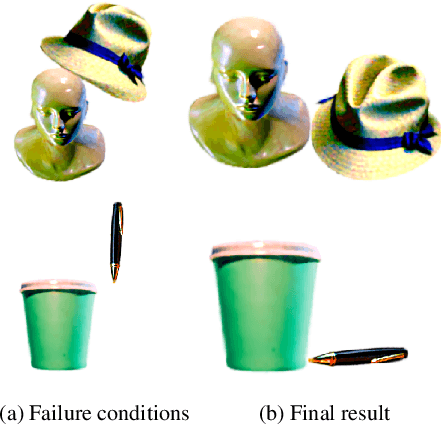
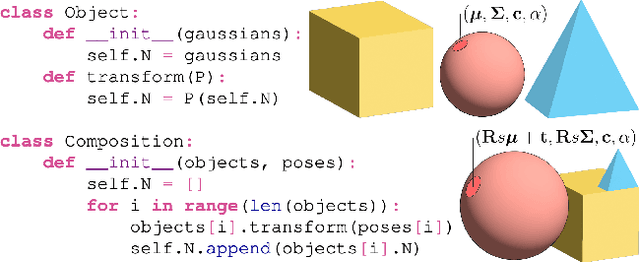
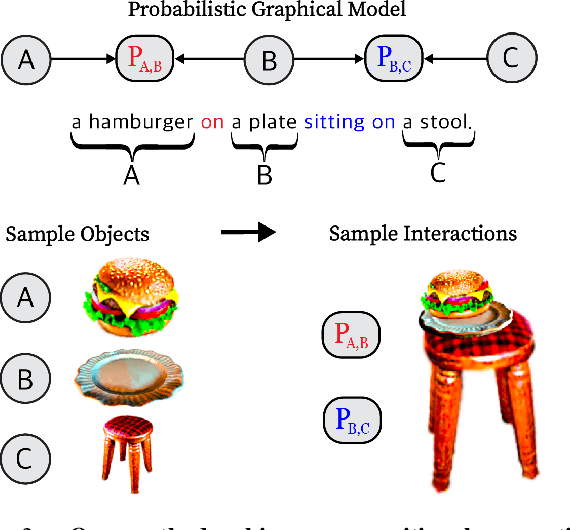
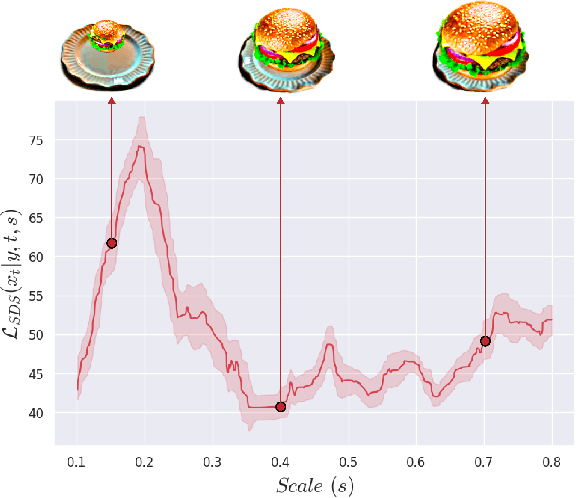
With the onset of diffusion-based generative models and their ability to generate text-conditioned images, content generation has received a massive invigoration. Recently, these models have been shown to provide useful guidance for the generation of 3D graphics assets. However, existing work in text-conditioned 3D generation faces fundamental constraints: (i) inability to generate detailed, multi-object scenes, (ii) inability to textually control multi-object configurations, and (iii) physically realistic scene composition. In this work, we propose CG3D, a method for compositionally generating scalable 3D assets that resolves these constraints. We find that explicit Gaussian radiance fields, parameterized to allow for compositions of objects, possess the capability to enable semantically and physically consistent scenes. By utilizing a guidance framework built around this explicit representation, we show state of the art results, capable of even exceeding the guiding diffusion model in terms of object combinations and physics accuracy.
Making Thermal Imaging More Equitable and Accurate: Resolving Solar Loading Biases
Apr 18, 2023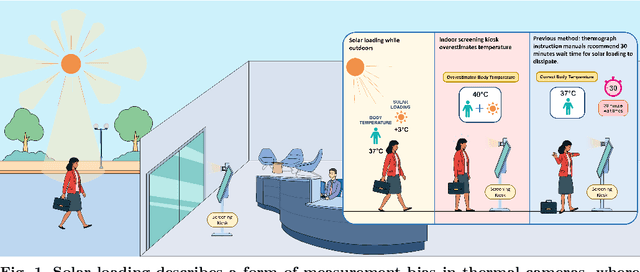


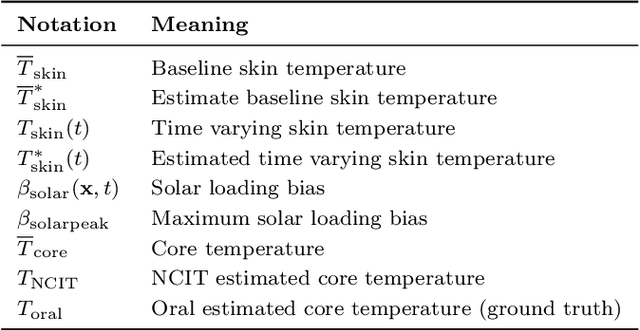
Thermal cameras and thermal point detectors are used to measure the temperature of human skin. These are important devices that are used everyday in clinical and mass screening settings, particularly in an epidemic. Unfortunately, despite the wide use of thermal sensors, the temperature estimates from thermal sensors do not work well in uncontrolled scene conditions. Previous work has studied the effect of wind and other environment factors on skin temperature, but has not considered the heating effect from sunlight, which is termed solar loading. Existing device manufacturers recommend that a subject who has been outdoors in sun re-acclimate to an indoor environment after a waiting period. The waiting period, up to 30 minutes, is insufficient for a rapid screening tool. Moreover, the error bias from solar loading is greater for darker skin tones since melanin absorbs solar radiation. This paper explores two approaches to address this problem. The first approach uses transient behavior of cooling to more quickly extrapolate the steady state temperature. A second approach explores the spatial modulation of solar loading, to propose single-shot correction with a wide-field thermal camera. A real world dataset comprising of thermal point, thermal image, subjective, and objective measurements of melanin is collected with statistical significance for the effect size observed. The single-shot correction scheme is shown to eliminate solar loading bias in the time of a typical frame exposure (33ms).