 Add to Chrome
 Add to Firefox
 Add to Edge
Minimal Prompt Perturbations Lead to Code Vulnerabilities: Prompt Fragility and Hidden-State Signals in Coding LLMs
May 28, 2026
LLM-based coding assistants are seeing rapid adoption, offering substantial gains in developer productivity. As organizations increasingly ship code these agents produce, the security of that code becomes critical. Prior work has shown that minor prompt perturbations degrade the functional correctness of LLM-generated code, but whether they also compromise code security has remained unstudied. We apply token-level mutations to prompts across three models and five programming languages, and show that mutations as small as a single-character change can flip generated code from secure to vulnerable. Probing the models' hidden states reveals that this fragility is partially encoded in prompt representations, but unevenly so. Input-handling vulnerabilities, where the model omits validation or sanitization, are more predictable (mean AUC 0.753) than secure-defaults vulnerabilities, where insecure code stems from one local choice such as a weak algorithm or unsafe parameter (mean AUC 0.674). These results show that the threat model for LLM-assisted coding extends beyond prompt injection to ordinary prompt variation, and indicate that input-handling flaws can be caught before generation while secure-defaults flaws require intervention during decoding.

From Model to Breach: Towards Actionable LLM-Generated Vulnerabilities Reporting
Nov 06, 2025As the role of Large Language Models (LLM)-based coding assistants in software development becomes more critical, so does the role of the bugs they generate in the overall cybersecurity landscape. While a number of LLM code security benchmarks have been proposed alongside approaches to improve the security of generated code, it remains unclear to what extent they have impacted widely used coding LLMs. Here, we show that even the latest open-weight models are vulnerable in the earliest reported vulnerability scenarios in a realistic use setting, suggesting that the safety-functionality trade-off has until now prevented effective patching of vulnerabilities. To help address this issue, we introduce a new severity metric that reflects the risk posed by an LLM-generated vulnerability, accounting for vulnerability severity, generation chance, and the formulation of the prompt that induces vulnerable code generation - Prompt Exposure (PE). To encourage the mitigation of the most serious and prevalent vulnerabilities, we use PE to define the Model Exposure (ME) score, which indicates the severity and prevalence of vulnerabilities a model generates.
Getting Your Indices in a Row: Full-Text Search for LLM Training Data for Real World
Oct 10, 2025The performance of Large Language Models (LLMs) is determined by their training data. Despite the proliferation of open-weight LLMs, access to LLM training data has remained limited. Even for fully open LLMs, the scale of the data makes it all but inscrutable to the general scientific community, despite potentially containing critical data scraped from the internet. In this paper, we present the full-text indexing pipeline for the Apertus LLM training data. Leveraging Elasticsearch parallel indices and the Alps infrastructure, a state-of-the-art, highly energy-efficient arm64 supercluster, we were able to index 8.6T tokens out of 15.2T used to train the Apertus LLM family, creating both a critical LLM safety tool and effectively an offline, curated, open web search engine. Our contribution is threefold. First, we demonstrate that Elasticsearch can be successfully ported onto next-generation arm64-based infrastructure. Second, we demonstrate that full-text indexing at the scale of modern LLM training datasets and the entire open web is feasible and accessible. Finally, we demonstrate that such indices can be used to ensure previously inaccessible jailbreak-agnostic LLM safety. We hope that our findings will be useful to other teams attempting large-scale data indexing and facilitate the general transition towards greener computation.
Apertus: Democratizing Open and Compliant LLMs for Global Language Environments
Sep 17, 2025
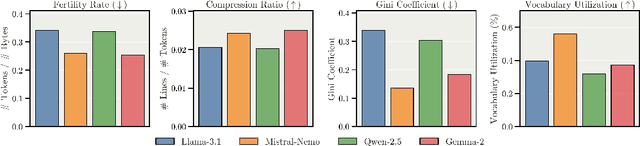

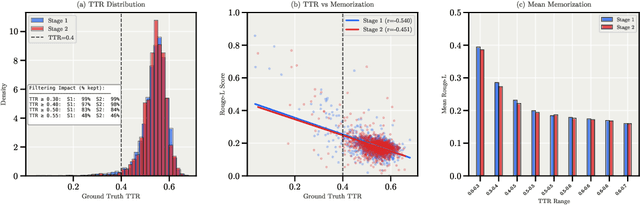
We present Apertus, a fully open suite of large language models (LLMs) designed to address two systemic shortcomings in today's open model ecosystem: data compliance and multilingual representation. Unlike many prior models that release weights without reproducible data pipelines or regard for content-owner rights, Apertus models are pretrained exclusively on openly available data, retroactively respecting robots.txt exclusions and filtering for non-permissive, toxic, and personally identifiable content. To mitigate risks of memorization, we adopt the Goldfish objective during pretraining, strongly suppressing verbatim recall of data while retaining downstream task performance. The Apertus models also expand multilingual coverage, training on 15T tokens from over 1800 languages, with ~40% of pretraining data allocated to non-English content. Released at 8B and 70B scales, Apertus approaches state-of-the-art results among fully open models on multilingual benchmarks, rivalling or surpassing open-weight counterparts. Beyond model weights, we release all scientific artifacts from our development cycle with a permissive license, including data preparation scripts, checkpoints, evaluation suites, and training code, enabling transparent audit and extension.