 Add to Chrome
 Add to Firefox
 Add to Edge
Reconfiguration of supernumerary robotic limbs for human augmentation
Mar 31, 2026
Wearable robots aim to seamlessly adapt to humans and their environment with personalized interactions. Existing supernumerary robotic limbs (SRLs), which enhance the physical capabilities of humans with additional extremities, have thus far been developed primarily for task-specific applications in structured industrial settings, limiting their adaptability to dynamic and unstructured environments. Here, we introduce a novel reconfigurable SRL framework grounded in a quantitative analysis of human augmentation to guide the development of more adaptable SRLs for diverse scenarios. This framework captures how SRL configuration shapes workspace extension and human-robot collaboration. We define human augmentation ratios to evaluate collaborative, visible extended, and non-visible extended workspaces, enabling systematic selection of SRL placement, morphology, and autonomy for a given task. Using these metrics, we demonstrate how quantitative augmentation analysis can guide the reconfiguration and control of SRLs to better match task requirements. We validate the proposed approach through experiments with a reconfigurable SRL composed of origami-inspired modular elements. Our results suggest that reconfigurable SRLs, informed by quantitative human augmentation analysis, offer a new perspective for providing adaptable human augmentation and assistance in everyday environments.

Interactive Surgical Liver Phantom for Cholecystectomy Training
Sep 05, 2024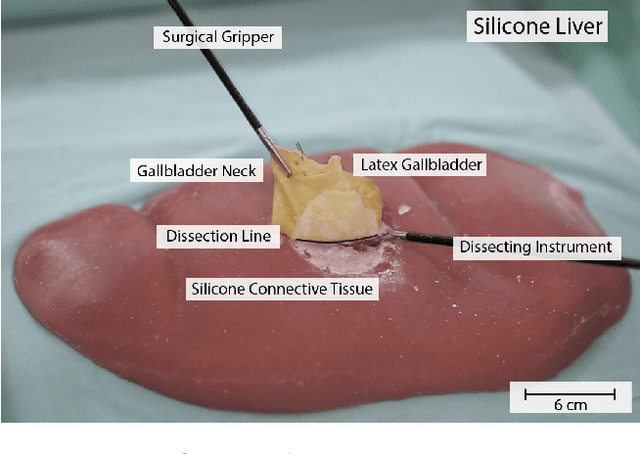
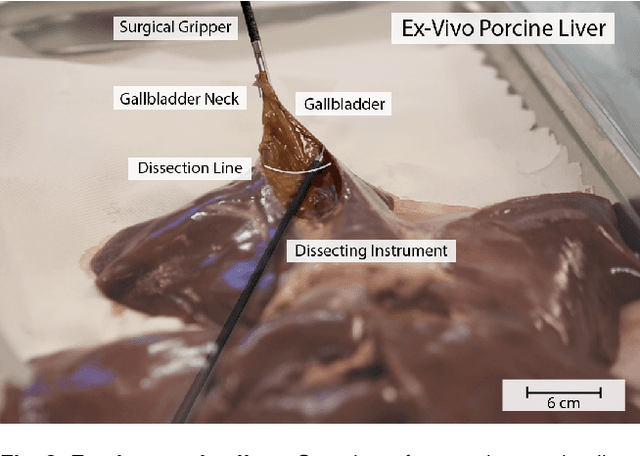
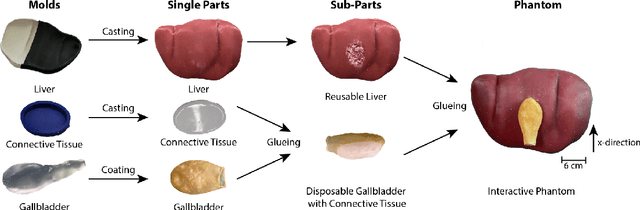
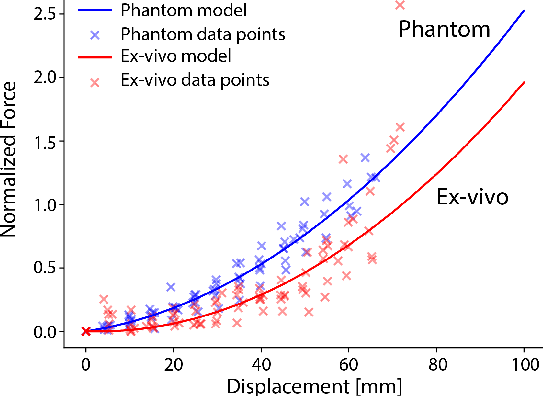
Training and prototype development in robot-assisted surgery requires appropriate and safe environments for the execution of surgical procedures. Current dry lab laparoscopy phantoms often lack the ability to mimic complex, interactive surgical tasks. This work presents an interactive surgical phantom for the cholecystectomy. The phantom enables the removal of the gallbladder during cholecystectomy by allowing manipulations and cutting interactions with the synthetic tissue. The force-displacement behavior of the gallbladder is modelled based on retraction demonstrations. The force model is compared to the force model of ex-vivo porcine gallbladders and evaluated on its ability to estimate retraction forces.