 Add to Chrome
 Add to Firefox
 Add to Edge
Autoregressive latent diffusion for 3D molecule generation
Jul 10, 2026
Three-dimensional (3D) molecule generation has been dominated by diffusion models, which achieve strong generation quality but typically require the molecular size to be specified a priori. Recent autoregressive approaches have substantially narrowed the performance gap while naturally supporting variable-length generation and conditioning on partial molecular context. However, balancing unconditional and context-conditioned generation remains challenging. We introduce KRONOS, a latent autoregressive diffusion framework that generates molecules in the latent space of a pre-trained autoencoder, jointly modeling molecular graph topology and geometry, while retaining the flexibility of autoregressive generation. We further introduce a mixed training strategy inspired by Fill-in-the Middle (FIM) paradigm, enabling both unconditional and fragment-conditioned molecular generation within a single left-to-right autoregressive model. Experiments on QM9 and GEOM-Drugs demonstrate that KRONOS achieves leading unconditional generation performance among autoregressive methods, while remaining competitive with diffusion models. Moreover, fragment-conditioned generation is achieved with negligible impact on unconditional generation performance, demonstrating that both generation paradigms can be supported within a single architecture.

NMIRacle: Multi-modal Generative Molecular Elucidation from IR and NMR Spectra
Dec 17, 2025Molecular structure elucidation from spectroscopic data is a long-standing challenge in Chemistry, traditionally requiring expert interpretation. We introduce NMIRacle, a two-stage generative framework that builds upon recent paradigms in AI-driven spectroscopy with minimal assumptions. In the first stage, NMIRacle learns to reconstruct molecular structures from count-aware fragment encodings, which capture both fragment identities and their occurrences. In the second stage, a spectral encoder maps input spectroscopic measurements (IR, 1H-NMR, 13C-NMR) into a latent embedding that conditions the pre-trained generator. This formulation bridges fragment-level chemical modeling with spectral evidence, yielding accurate molecular predictions. Empirical results show that NMIRacle outperforms existing baselines on molecular elucidation, while maintaining robust performance across increasing levels of molecular complexity.
Learned Force Fields Are Ready For Ground State Catalyst Discovery
Sep 26, 2022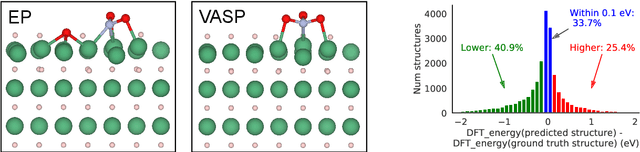
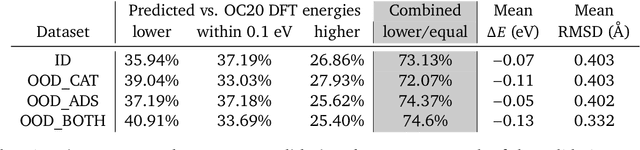
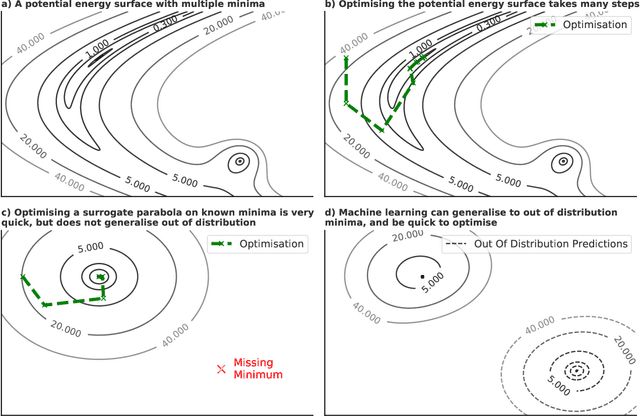
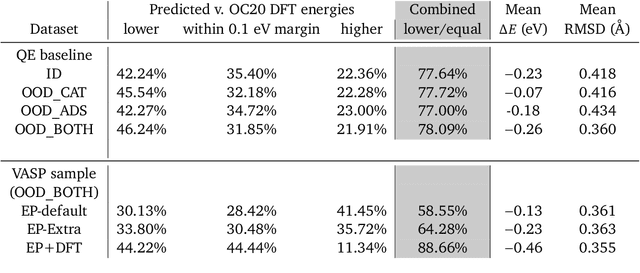
We present evidence that learned density functional theory (``DFT'') force fields are ready for ground state catalyst discovery. Our key finding is that relaxation using forces from a learned potential yields structures with similar or lower energy to those relaxed using the RPBE functional in over 50\% of evaluated systems, despite the fact that the predicted forces differ significantly from the ground truth. This has the surprising implication that learned potentials may be ready for replacing DFT in challenging catalytic systems such as those found in the Open Catalyst 2020 dataset. Furthermore, we show that a force field trained on a locally harmonic energy surface with the same minima as a target DFT energy is also able to find lower or similar energy structures in over 50\% of cases. This ``Easy Potential'' converges in fewer steps than a standard model trained on true energies and forces, which further accelerates calculations. Its success illustrates a key point: learned potentials can locate energy minima even when the model has high force errors. The main requirement for structure optimisation is simply that the learned potential has the correct minima. Since learned potentials are fast and scale linearly with system size, our results open the possibility of quickly finding ground states for large systems.