 Add to Chrome
 Add to Firefox
 Add to Edge
An Experimental Comparison of the Most Popular Approaches to Fake News Detection
Mar 26, 2026
In recent years, fake news detection has received increasing attention in public debate and scientific research. Despite advances in detection techniques, the production and spread of false information have become more sophisticated, driven by Large Language Models (LLMs) and the amplification power of social media. We present a critical assessment of 12 representative fake news detection approaches, spanning traditional machine learning, deep learning, transformers, and specialized cross-domain architectures. We evaluate these methods on 10 publicly available datasets differing in genre, source, topic, and labeling rationale. We address text-only English fake news detection as a binary classification task by harmonizing labels into "Real" and "Fake" to ensure a consistent evaluation protocol. We acknowledge that label semantics vary across datasets and that harmonization inevitably removes such semantic nuances. Each dataset is treated as a distinct domain. We conduct in-domain, multi-domain and cross-domain experiments to simulate real-world scenarios involving domain shift and out-of-distribution data. Fine-tuned models perform well in-domain but struggle to generalize. Cross-domain architectures can reduce this gap but are data-hungry, while LLMs offer a promising alternative through zero- and few-shot learning. Given inherent dataset confounds and possible pre-training exposure, results should be interpreted as robustness evaluations within this English, text-only protocol.

Enhancing Debunking Effectiveness through LLM-based Personality Adaptation
Mar 10, 2026This study proposes a novel methodology for generating personalized fake news debunking messages by prompting Large Language Models (LLMs) with persona-based inputs aligned to the Big Five personality traits: Extraversion, Agreeableness, Conscientiousness, Neuroticism, and Openness. Our approach guides LLMs to transform generic debunking content into personalized versions tailored to specific personality profiles. To assess the effectiveness of these transformations, we employ a separate LLM as an automated evaluator simulating corresponding personality traits, thereby eliminating the need for costly human evaluation panels. Our results show that personalized messages are generally seen as more persuasive than generic ones. We also find that traits like Openness tend to increase persuadability, while Neuroticism can lower it. Differences between LLM evaluators suggest that using multiple models provides a clearer picture. Overall, this work demonstrates a practical way to create more targeted debunking messages exploiting LLMs, while also raising important ethical questions about how such technology might be used.
All-in-one: Understanding and Generation in Multimodal Reasoning with the MAIA Benchmark
Feb 24, 2025We introduce MAIA (Multimodal AI Assessment), a native-Italian benchmark designed for fine-grained investigation of the reasoning abilities of visual language models on videos. MAIA differs from other available video benchmarks for its design, its reasoning categories, the metric it uses and the language and culture of the videos. It evaluates Vision Language Models (VLMs) on two aligned tasks: a visual statement verification task, and an open-ended visual question-answering task, both on the same set of video-related questions. It considers twelve reasoning categories that aim to disentangle language and vision relations by highlight when one of two alone encodes sufficient information to solve the tasks, when they are both needed and when the full richness of the short video is essential instead of just a part of it. Thanks to its carefully taught design, it evaluates VLMs' consistency and visually grounded natural language comprehension and generation simultaneously through an aggregated metric. Last but not least, the video collection has been carefully selected to reflect the Italian culture and the language data are produced by native-speakers.
ExpliCa: Evaluating Explicit Causal Reasoning in Large Language Models
Feb 21, 2025Large Language Models (LLMs) are increasingly used in tasks requiring interpretive and inferential accuracy. In this paper, we introduce ExpliCa, a new dataset for evaluating LLMs in explicit causal reasoning. ExpliCa uniquely integrates both causal and temporal relations presented in different linguistic orders and explicitly expressed by linguistic connectives. The dataset is enriched with crowdsourced human acceptability ratings. We tested LLMs on ExpliCa through prompting and perplexity-based metrics. We assessed seven commercial and open-source LLMs, revealing that even top models struggle to reach 0.80 accuracy. Interestingly, models tend to confound temporal relations with causal ones, and their performance is also strongly influenced by the linguistic order of the events. Finally, perplexity-based scores and prompting performance are differently affected by model size.
Prompting Encoder Models for Zero-Shot Classification: A Cross-Domain Study in Italian
Jul 30, 2024
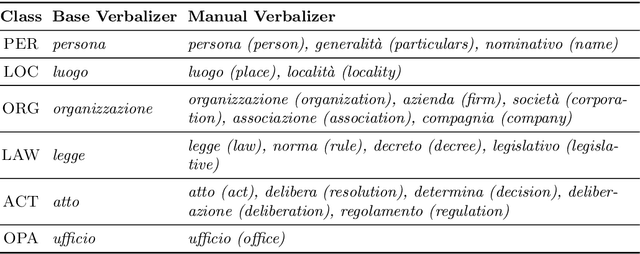


Addressing the challenge of limited annotated data in specialized fields and low-resource languages is crucial for the effective use of Language Models (LMs). While most Large Language Models (LLMs) are trained on general-purpose English corpora, there is a notable gap in models specifically tailored for Italian, particularly for technical and bureaucratic jargon. This paper explores the feasibility of employing smaller, domain-specific encoder LMs alongside prompting techniques to enhance performance in these specialized contexts. Our study concentrates on the Italian bureaucratic and legal language, experimenting with both general-purpose and further pre-trained encoder-only models. We evaluated the models on downstream tasks such as document classification and entity typing and conducted intrinsic evaluations using Pseudo-Log-Likelihood. The results indicate that while further pre-trained models may show diminished robustness in general knowledge, they exhibit superior adaptability for domain-specific tasks, even in a zero-shot setting. Furthermore, the application of calibration techniques and in-domain verbalizers significantly enhances the efficacy of encoder models. These domain-specialized models prove to be particularly advantageous in scenarios where in-domain resources or expertise are scarce. In conclusion, our findings offer new insights into the use of Italian models in specialized contexts, which may have a significant impact on both research and industrial applications in the digital transformation era.