 Add to Chrome
 Add to Firefox
 Add to Edge
Room-Mediated Co-occurrence for Zero-Shot Object-Centric Semantic Navigation via Frontier Scoring
Jul 28, 2026
Zero-shot ObjectNav methods increasingly use vision-language priors, but direct object-object similarity in the latent space is often a weak proxy for spatial co-occurrence. We present an analytical, training-free semantic navigation pipeline that mediates object relationships through a compact room lexicon. Each object label is mapped to a CLIP-derived Room Probability Vector (RPV), and object-target co-occurrence is computed from RPV distribution overlap. These scores are projected onto a value map using geodesic flood-fill propagation (Fast Marching Method), with adaptive signal decay, and are used to rank frontiers by semantic score for navigation. Together, these components form an integrated, training-free, object-centric pipeline for open-vocabulary zero-shot navigation. Results show that our object-centric approach improves Success Rate (SR) and Success by weighted inverse Path Length (SPL) by a relative 3% and 1.3%, respectively, compared to image-holistic baselines on the HM3D dataset validation split, while preserving interpretability and open-vocabulary flexibility. Code is available at: uts-ri.github.io/RPV-SemNav.

Semantic keypoint extraction for scanned animals using multi-depth-camera systems
Nov 16, 2022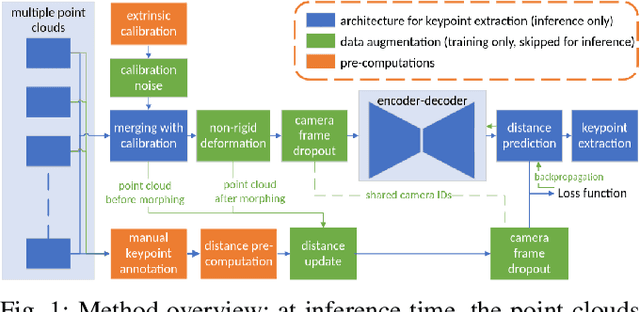
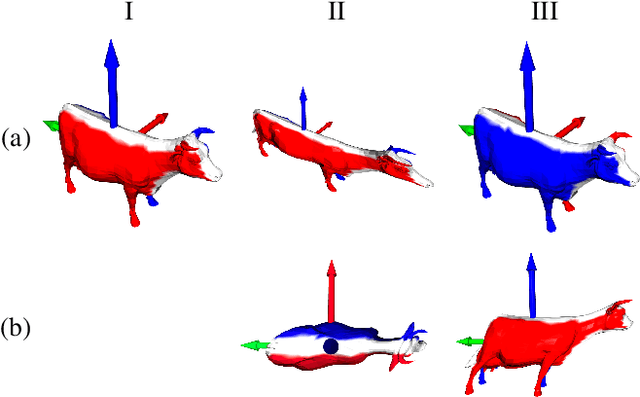
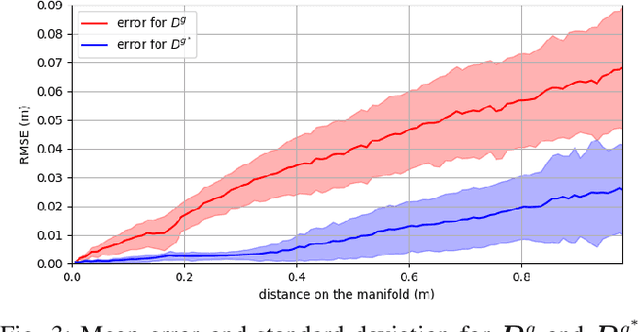
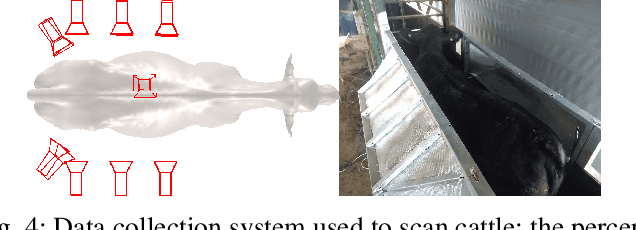
Keypoint annotation in point clouds is an important task for 3D reconstruction, object tracking and alignment, in particular in deformable or moving scenes. In the context of agriculture robotics, it is a critical task for livestock automation to work toward condition assessment or behaviour recognition. In this work, we propose a novel approach for semantic keypoint annotation in point clouds, by reformulating the keypoint extraction as a regression problem of the distance between the keypoints and the rest of the point cloud. We use the distance on the point cloud manifold mapped into a radial basis function (RBF), which is then learned using an encoder-decoder architecture. Special consideration is given to the data augmentation specific to multi-depth-camera systems by considering noise over the extrinsic calibration and camera frame dropout. Additionally, we investigate computationally efficient non-rigid deformation methods that can be applied to animal point clouds. Our method is tested on data collected in the field, on moving beef cattle, with a calibrated system of multiple hardware-synchronised RGB-D cameras.
Minimally Invasive Social Navigation
May 08, 2020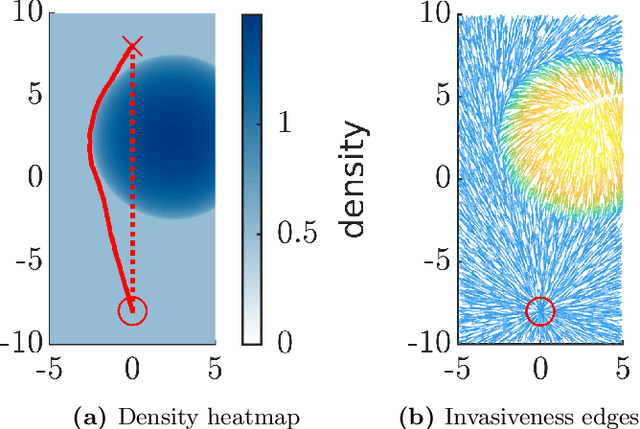
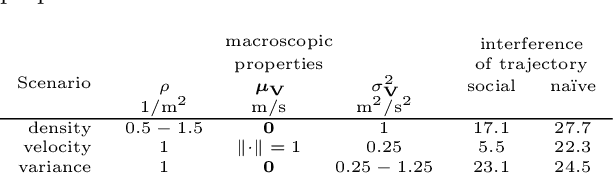
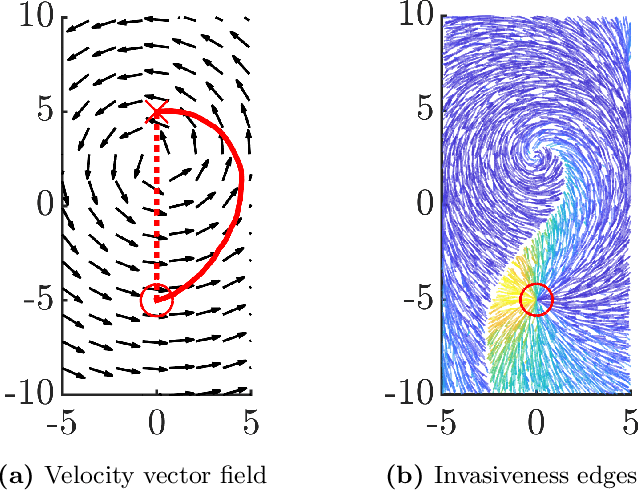
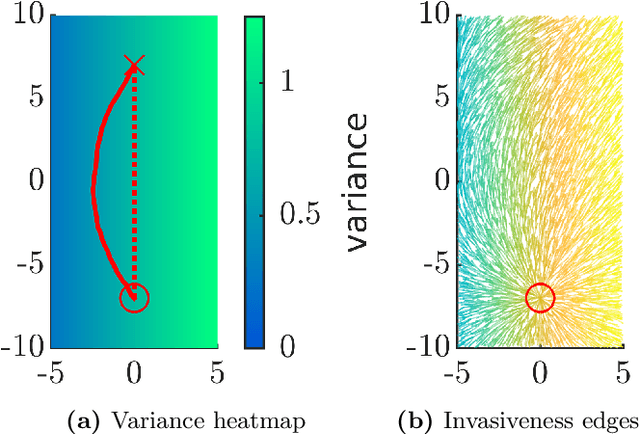
Integrating mobile robots into human society involves the fundamental problem of navigation in crowds. This problem has been studied by considering the behaviour of humans at the level of individuals, but this representation limits the computational efficiency of motion planning algorithms. We explore the idea of representing a crowd as a flow field, and propose a formal definition of path quality based on the concept of invasiveness; a robot should attempt to navigate in a way that is minimally invasive to humans in its environment. We develop an algorithmic framework for path planning based on this definition and present experimental results that indicate its effectiveness. These results open new algorithmic questions motivated by the flow field representation of crowds and are a necessary step on the path to end-to-end implementations.