 Add to Chrome
 Add to Firefox
 Add to Edge
Annotation-Efficient Vision-Language Model Adaptation to the Polish Language Using the LLaVA Framework
Feb 17, 2026
Most vision-language models (VLMs) are trained on English-centric data, limiting their performance in other languages and cultural contexts. This restricts their usability for non-English-speaking users and hinders the development of multimodal systems that reflect diverse linguistic and cultural realities. In this work, we reproduce and adapt the LLaVA-Next methodology to create a set of Polish VLMs. We rely on a fully automated pipeline for translating and filtering existing multimodal datasets, and complement this with synthetic Polish data for OCR and culturally specific tasks. Despite relying almost entirely on automatic translation and minimal manual intervention to the training data, our approach yields strong results: we observe a +9.5% improvement over LLaVA-1.6-Vicuna-13B on a Polish-adapted MMBench, along with higher-quality captions in generative evaluations, as measured by human annotators in terms of linguistic correctness. These findings highlight that large-scale automated translation, combined with lightweight filtering, can effectively bootstrap high-quality multimodal models for low-resource languages. Some challenges remain, particularly in cultural coverage and evaluation. To facilitate further research, we make our models and evaluation dataset publicly available.

PLLuM: A Family of Polish Large Language Models
Nov 05, 2025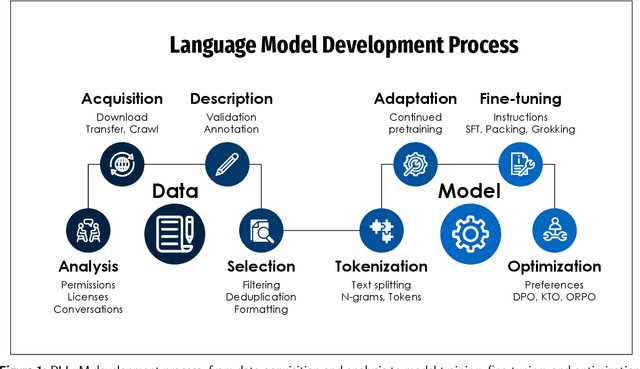
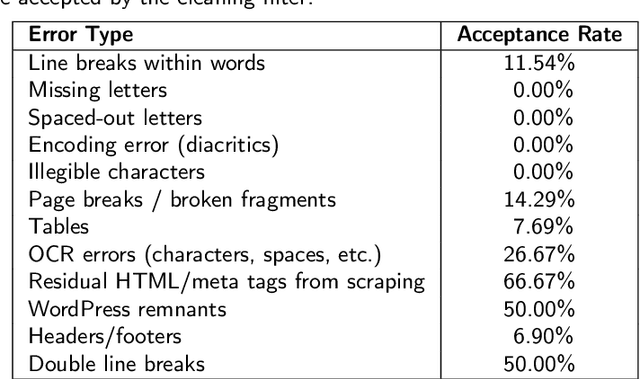
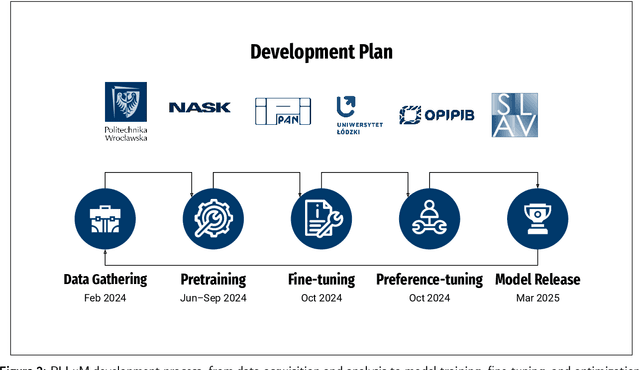

Large Language Models (LLMs) play a central role in modern artificial intelligence, yet their development has been primarily focused on English, resulting in limited support for other languages. We present PLLuM (Polish Large Language Model), the largest open-source family of foundation models tailored specifically for the Polish language. Developed by a consortium of major Polish research institutions, PLLuM addresses the need for high-quality, transparent, and culturally relevant language models beyond the English-centric commercial landscape. We describe the development process, including the construction of a new 140-billion-token Polish text corpus for pre-training, a 77k custom instructions dataset, and a 100k preference optimization dataset. A key component is a Responsible AI framework that incorporates strict data governance and a hybrid module for output correction and safety filtering. We detail the models' architecture, training procedures, and alignment techniques for both base and instruction-tuned variants, and demonstrate their utility in a downstream task within public administration. By releasing these models publicly, PLLuM aims to foster open research and strengthen sovereign AI technologies in Poland.