 Add to Chrome
 Add to Firefox
 Add to Edge
Optimizing Multilingual LLMs via Federated Learning: A Study of Client Language Composition
Mar 25, 2026
Federated Learning (FL) of Large Language Models (LLMs) in multilingual environments presents significant challenges stemming from heterogeneous language distributions across clients and disparities in language resource availability. To address these challenges, we extended the FederatedScope-LLM framework to support multilingual instruction-tuning experiments with LLMs. We also introduced a novel client-specific early stopping mechanism, Local Dynamic Early Stopping (LDES-FL), which allows clients to pause and resume local training based on client-side validation performance, enhancing training efficiency and sustainability. Through a series of experiments, we studied how client language composition - from fully monolingual to increasingly multilingual clients - affects multilingual quality, fairness and training cost. Monolingual local fine-tuning remains the most effective for single-language specialization, whereas federated training is better suited to learning a single balanced multilingual model. In FL, increasing within-client multilinguality leads to stronger and fairer global models, narrows the gap to centralized multilingual fine-tuning, and yields the largest gains for lower-resource languages, albeit at the cost of more optimization steps. Overall, our results identify client language composition as a key design variable in multilingual FL, shaping performance, fairness and efficiency

The power of Prompts: Evaluating and Mitigating Gender Bias in MT with LLMs
Jul 26, 2024This paper studies gender bias in machine translation through the lens of Large Language Models (LLMs). Four widely-used test sets are employed to benchmark various base LLMs, comparing their translation quality and gender bias against state-of-the-art Neural Machine Translation (NMT) models for English to Catalan (En $\rightarrow$ Ca) and English to Spanish (En $\rightarrow$ Es) translation directions. Our findings reveal pervasive gender bias across all models, with base LLMs exhibiting a higher degree of bias compared to NMT models. To combat this bias, we explore prompting engineering techniques applied to an instruction-tuned LLM. We identify a prompt structure that significantly reduces gender bias by up to 12% on the WinoMT evaluation dataset compared to more straightforward prompts. These results significantly reduce the gender bias accuracy gap between LLMs and traditional NMT systems.
SpeechAlign: a Framework for Speech Translation Alignment Evaluation
Sep 20, 2023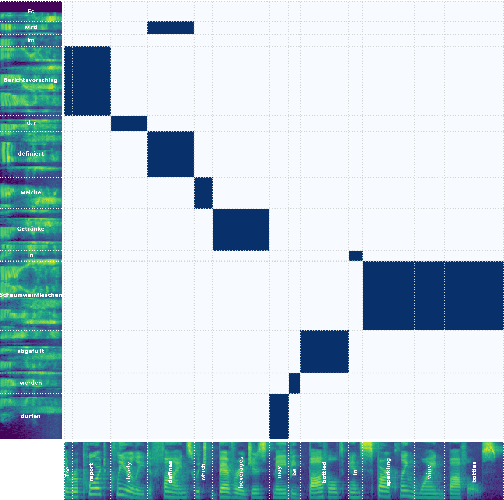
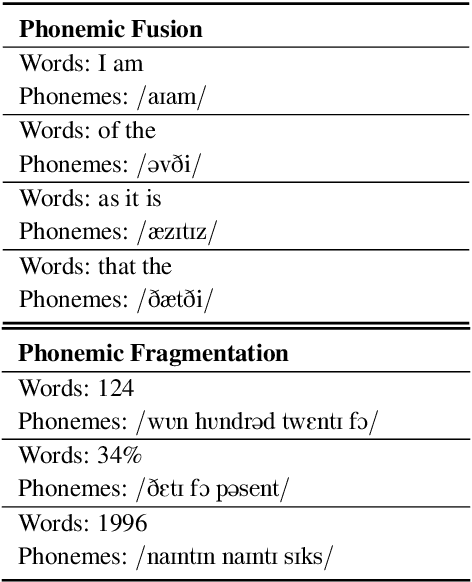
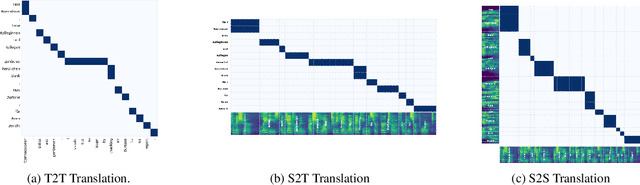
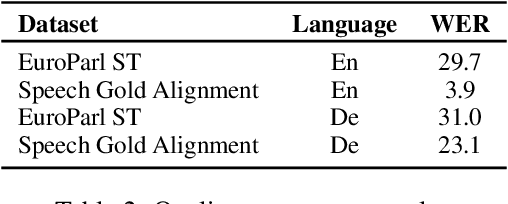
Speech-to-Speech and Speech-to-Text translation are currently dynamic areas of research. To contribute to these fields, we present SpeechAlign, a framework to evaluate the underexplored field of source-target alignment in speech models. Our framework has two core components. First, to tackle the absence of suitable evaluation datasets, we introduce the Speech Gold Alignment dataset, built upon a English-German text translation gold alignment dataset. Secondly, we introduce two novel metrics, Speech Alignment Error Rate (SAER) and Time-weighted Speech Alignment Error Rate (TW-SAER), to evaluate alignment quality in speech models. By publishing SpeechAlign we provide an accessible evaluation framework for model assessment, and we employ it to benchmark open-source Speech Translation models.