 Add to Chrome
 Add to Firefox
 Add to Edge
Gradient-Based Speech-to-Text Alignment for Any ASR Model: From CTC to Speech LLMs
Jul 07, 2026
Speech-to-text alignment means finding the temporal boundaries of each word in the audio. Some models provide such an alignment directly and others do not. Connectionist temporal classification (CTC) and transducer models have an alignment by construction, whereas attention-based encoder-decoders (AED) and speech large language models (LLMs) do not, and their word timings are usually read off the attention weights instead. All of these signals live on the encoder frame grid, which bounds their temporal precision. We study a generic gradient-based alignment that applies to any differentiable ASR model. We take the gradient of each teacher-forced token log probability with respect to the input, reduce it to a per-frame saliency, and decode the resulting matrix into word boundaries with a single dynamic-programming pass. The method needs no training, no model modification and no alignment heads, works across all model families including the speech LLMs, and aligns on the input grid rather than on the coarser encoder grid. We evaluate it on sixteen models from four families, on read (TIMIT) and spontaneous (Buckeye) speech, each against the model's own native or attention-based alignment. We find that the gradient yields a usable alignment for every model, that it is usually somewhat behind a strong native aligner but better where the native alignment is weak, as for the streaming models, and that its main disadvantage is the cost of one backward pass per token.

Revisiting the Relation Between Language Model Perplexity and ASR Word Error Rate for Modern End-to-End Speech Recognition
Jul 06, 2026Language model (LM) perplexity (PPL) has historically been used as a proxy for automatic speech recognition (ASR) word error rate (WER), with prior work reporting an approximately linear relation in log-log space. Modern end-to-end ASR systems challenge this assumption because they already contain internal language modeling capacity, are often evaluated without external language models, and can now be combined with neural LMs and large language models (LLMs) through different recognition strategies. This paper revisits the relation between PPL and WER for modern ASR systems. We study whether external LMs still improve current end-to-end ASR systems, whether the PPL-WER relation remains linear in log-log space, how encoder context length affects this relation, and how LLM perplexities fit into the trend observed for standard neural LMs. We further investigate internal language modeling (ILM) in attention-based encoder-decoder systems and show that ILM subtraction changes the observed PPL-WER relation, indicating that the decoder's internal LM must be considered when interpreting the effect of external LM quality.
Diffusion Language Models for Speech Recognition
Apr 15, 2026Diffusion language models have recently emerged as a leading alternative to standard language models, due to their ability for bidirectional attention and parallel text generation. In this work, we explore variants for their use in speech recognition. Specifically, we introduce a comprehensive guide to incorporating masked diffusion language models (MDLM) and uniform-state diffusion models (USDMs) for rescoring ASR hypotheses. Additionally, we design a new joint-decoding method that combines CTC and USDM by integrating the framewise probability distributions derived from CTC with the labelwise probability distributions computed by USDM at each decoding step, thereby generating new candidates that combine strong language knowledge from USDM and acoustic information from CTC. Our findings reveal that USDM, as well as MDLM, can significantly improve the accuracy of recognized text. We publish all our code and recipes.
LLMs and Speech: Integration vs. Combination
Mar 16, 2026In this work, we study how to best utilize pre-trained LLMs for automatic speech recognition. Specifically, we compare the tight integration of an acoustic model (AM) with the LLM ("speech LLM") to the traditional way of combining AM and LLM via shallow fusion. For tight integration, we provide ablations on the effect of different label units, fine-tuning strategies, LLM sizes and pre-training data, attention interfaces, encoder downsampling, text prompts, and length normalization. Additionally, we investigate joint recognition with a CTC model to mitigate hallucinations of speech LLMs and present effective optimizations for this joint recognition. For shallow fusion, we investigate the effect of fine-tuning the LLM on the transcriptions using different label units, and we compare rescoring AM hypotheses to single-pass recognition with label-wise or delayed fusion of AM and LLM scores. We train on Librispeech and Loquacious and evaluate our models on the HuggingFace ASR leaderboard.
Reproducing and Dissecting Denoising Language Models for Speech Recognition
Dec 15, 2025Denoising language models (DLMs) have been proposed as a powerful alternative to traditional language models (LMs) for automatic speech recognition (ASR), motivated by their ability to use bidirectional context and adapt to a specific ASR model's error patterns. However, the complexity of the DLM training pipeline has hindered wider investigation. This paper presents the first independent, large-scale empirical study of DLMs. We build and release a complete, reproducible pipeline to systematically investigate the impact of key design choices. We evaluate dozens of configurations across multiple axes, including various data augmentation techniques (e.g., SpecAugment, dropout, mixup), different text-to-speech systems, and multiple decoding strategies. Our comparative analysis in a common subword vocabulary setting demonstrates that DLMs outperform traditional LMs, but only after a distinct compute tipping point. While LMs are more efficient at lower budgets, DLMs scale better with longer training, mirroring behaviors observed in diffusion language models. However, we observe smaller improvements than those reported in prior character-based work, which indicates that the DLM's performance is conditional on factors such as the vocabulary. Our analysis reveals that a key factor for improving performance is to condition the DLM on richer information from the ASR's hypothesis space, rather than just a single best guess. To this end, we introduce DLM-sum, a novel method for decoding from multiple ASR hypotheses, which consistently outperforms the previously proposed DSR decoding method. We believe our findings and public pipeline provide a crucial foundation for the community to better understand, improve, and build upon this promising class of models. The code is publicly available at https://github.com/rwth-i6/2025-denoising-lm/.
Dynamic Acoustic Model Architecture Optimization in Training for ASR
Jun 16, 2025Architecture design is inherently complex. Existing approaches rely on either handcrafted rules, which demand extensive empirical expertise, or automated methods like neural architecture search, which are computationally intensive. In this paper, we introduce DMAO, an architecture optimization framework that employs a grow-and-drop strategy to automatically reallocate parameters during training. This reallocation shifts resources from less-utilized areas to those parts of the model where they are most beneficial. Notably, DMAO only introduces negligible training overhead at a given model complexity. We evaluate DMAO through experiments with CTC on LibriSpeech, TED-LIUM-v2 and Switchboard datasets. The results show that, using the same amount of training resources, our proposed DMAO consistently improves WER by up to 6% relatively across various architectures, model sizes, and datasets. Furthermore, we analyze the pattern of parameter redistribution and uncover insightful findings.
The Conformer Encoder May Reverse the Time Dimension
Oct 01, 2024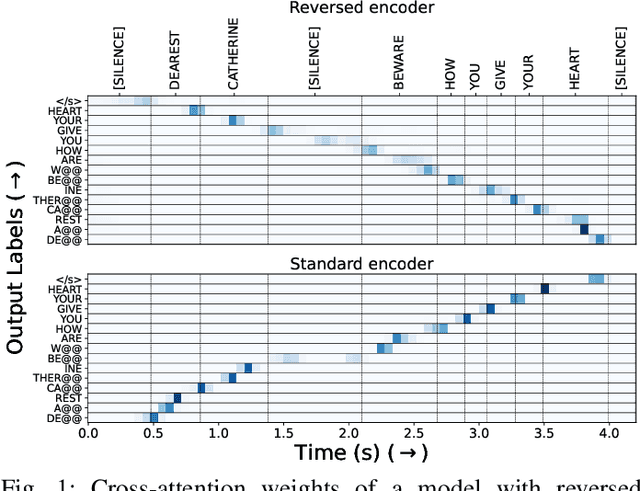
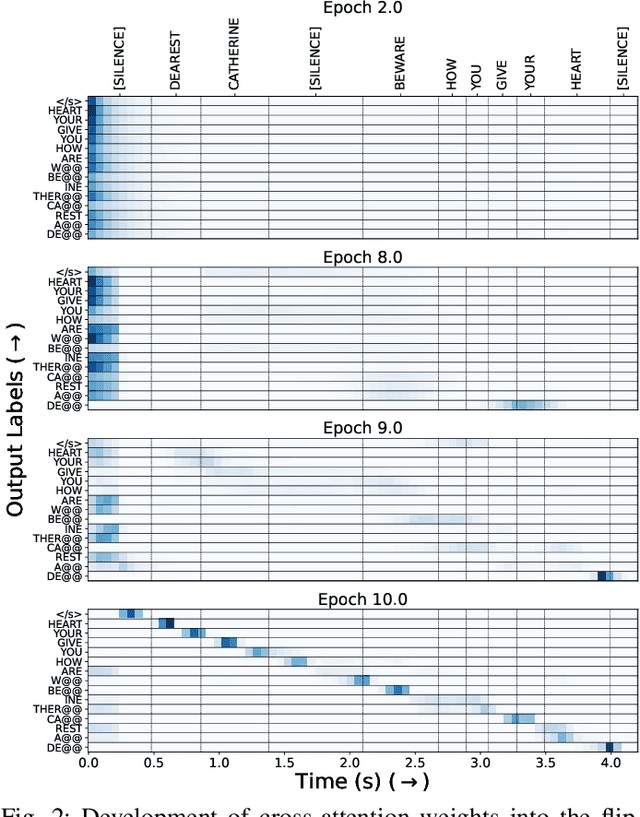
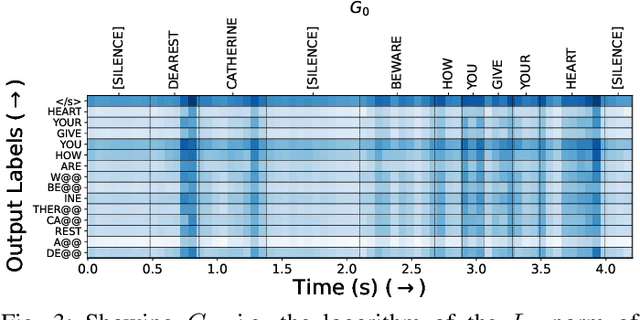
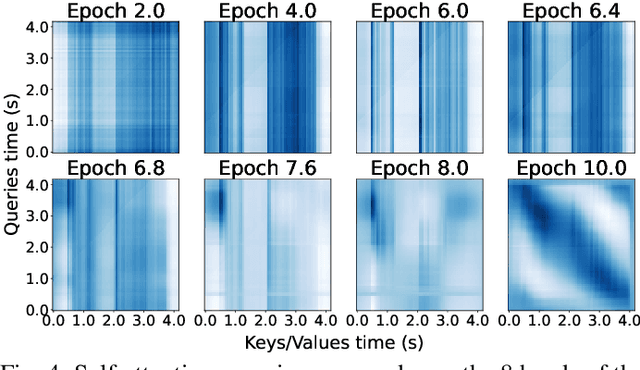
We sometimes observe monotonically decreasing cross-attention weights in our Conformer-based global attention-based encoder-decoder (AED) models. Further investigation shows that the Conformer encoder internally reverses the sequence in the time dimension. We analyze the initial behavior of the decoder cross-attention mechanism and find that it encourages the Conformer encoder self-attention to build a connection between the initial frames and all other informative frames. Furthermore, we show that, at some point in training, the self-attention module of the Conformer starts dominating the output over the preceding feed-forward module, which then only allows the reversed information to pass through. We propose several methods and ideas of how this flipping can be avoided. Additionally, we investigate a novel method to obtain label-frame-position alignments by using the gradients of the label log probabilities w.r.t. the encoder input frames.
Chunked Attention-based Encoder-Decoder Model for Streaming Speech Recognition
Sep 15, 2023


We study a streamable attention-based encoder-decoder model in which either the decoder, or both the encoder and decoder, operate on pre-defined, fixed-size windows called chunks. A special end-of-chunk (EOC) symbol advances from one chunk to the next chunk, effectively replacing the conventional end-of-sequence symbol. This modification, while minor, situates our model as equivalent to a transducer model that operates on chunks instead of frames, where EOC corresponds to the blank symbol. We further explore the remaining differences between a standard transducer and our model. Additionally, we examine relevant aspects such as long-form speech generalization, beam size, and length normalization. Through experiments on Librispeech and TED-LIUM-v2, and by concatenating consecutive sequences for long-form trials, we find that our streamable model maintains competitive performance compared to the non-streamable variant and generalizes very well to long-form speech.
Monotonic segmental attention for automatic speech recognition
Oct 26, 2022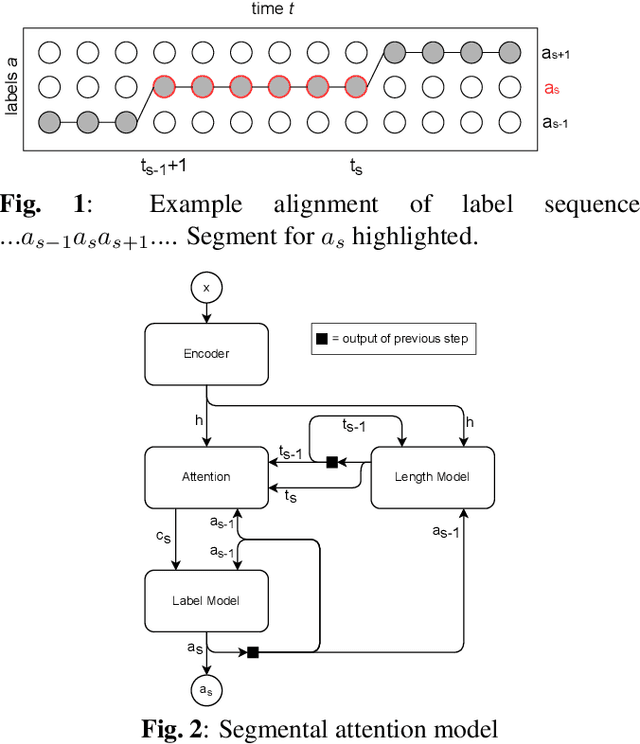
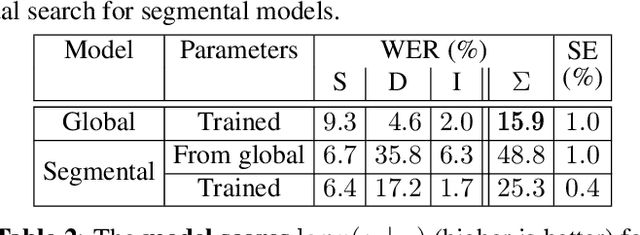
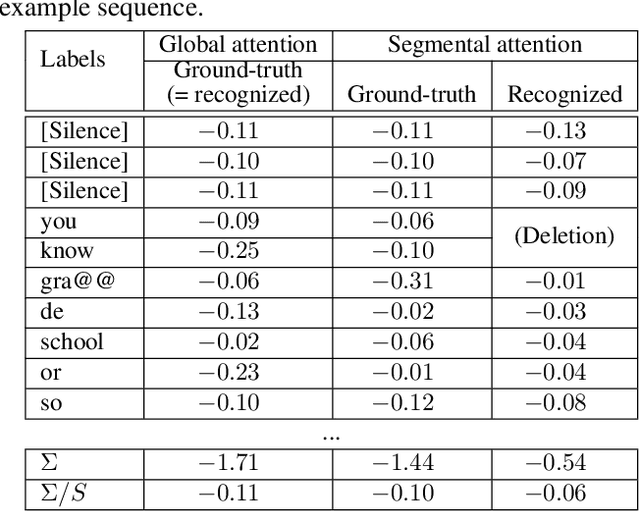
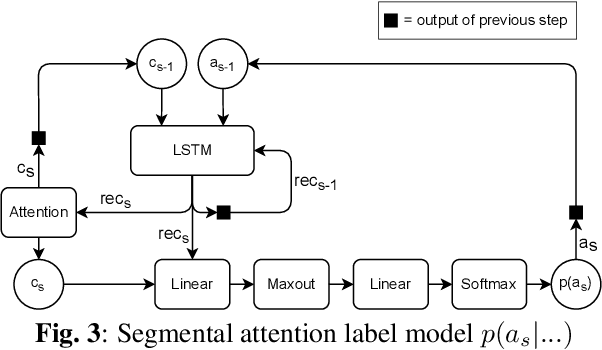
We introduce a novel segmental-attention model for automatic speech recognition. We restrict the decoder attention to segments to avoid quadratic runtime of global attention, better generalize to long sequences, and eventually enable streaming. We directly compare global-attention and different segmental-attention modeling variants. We develop and compare two separate time-synchronous decoders, one specifically taking the segmental nature into account, yielding further improvements. Using time-synchronous decoding for segmental models is novel and a step towards streaming applications. Our experiments show the importance of a length model to predict the segment boundaries. The final best segmental-attention model using segmental decoding performs better than global-attention, in contrast to other monotonic attention approaches in the literature. Further, we observe that the segmental model generalizes much better to long sequences of up to several minutes.
Why does CTC result in peaky behavior?
Jun 03, 2021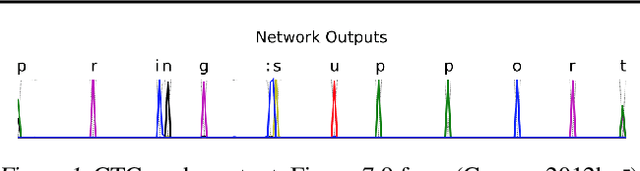
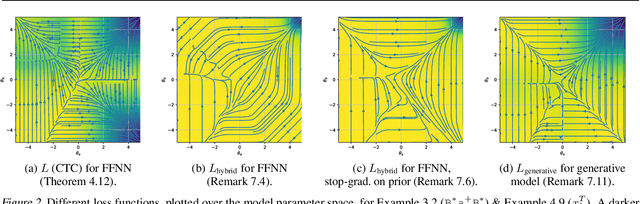

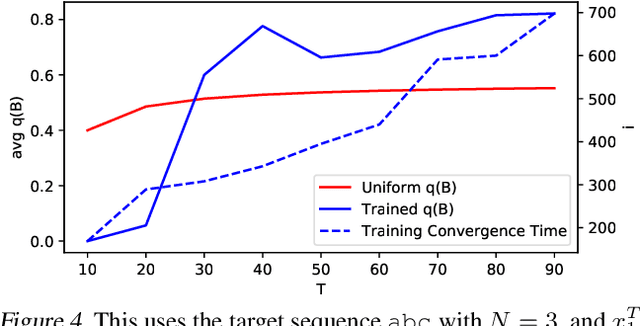
The peaky behavior of CTC models is well known experimentally. However, an understanding about why peaky behavior occurs is missing, and whether this is a good property. We provide a formal analysis of the peaky behavior and gradient descent convergence properties of the CTC loss and related training criteria. Our analysis provides a deep understanding why peaky behavior occurs and when it is suboptimal. On a simple example which should be trivial to learn for any model, we prove that a feed-forward neural network trained with CTC from uniform initialization converges towards peaky behavior with a 100% error rate. Our analysis further explains why CTC only works well together with the blank label. We further demonstrate that peaky behavior does not occur on other related losses including a label prior model, and that this improves convergence.