 Add to Chrome
 Add to Firefox
 Add to Edge
Bases of Steerable Kernels for Equivariant CNNs: From 2D Rotations to the Lorentz Group
Mar 12, 2026
We present an alternative way of solving the steerable kernel constraint that appears in the design of steerable equivariant convolutional neural networks. We find explicit real and complex bases which are ready to use, for different symmetry groups and for feature maps of arbitrary tensor type. A major advantage of this method is that it bypasses the need to numerically or analytically compute Clebsch-Gordan coefficients and works directly with the representations of the input and output feature maps. The strategy is to find a basis of kernels that respect a simpler invariance condition at some point $x_0$, and then \textit{steer} it with the defining equation of steerability to move to some arbitrary point $x=g\cdot x_0$. This idea has already been mentioned in the literature before, but not advanced in depth and with some generality. Here we describe how it works with minimal technical tools to make it accessible for a general audience.

Denoising Hamiltonian Network for Physical Reasoning
Mar 10, 2025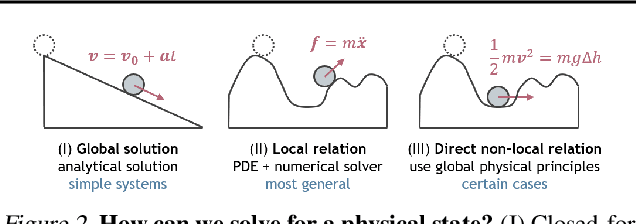
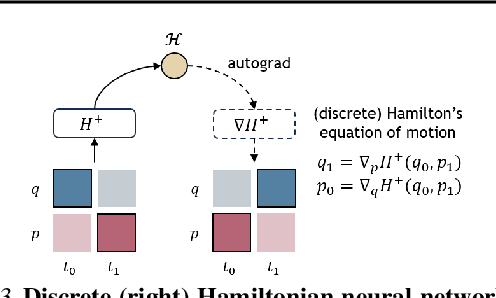
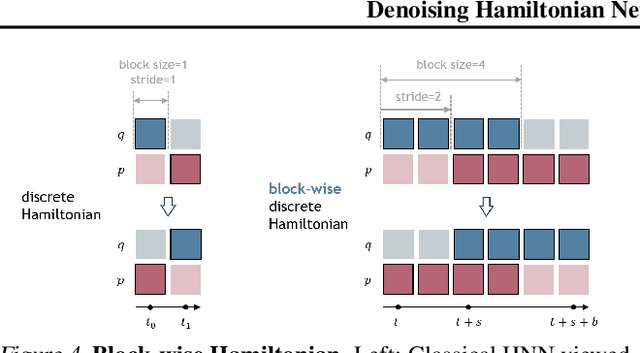
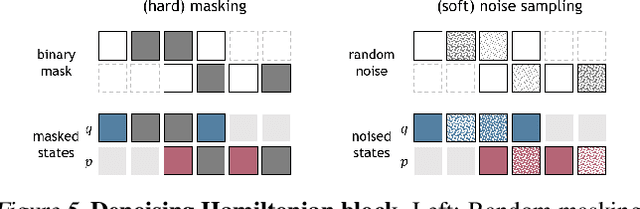
Machine learning frameworks for physical problems must capture and enforce physical constraints that preserve the structure of dynamical systems. Many existing approaches achieve this by integrating physical operators into neural networks. While these methods offer theoretical guarantees, they face two key limitations: (i) they primarily model local relations between adjacent time steps, overlooking longer-range or higher-level physical interactions, and (ii) they focus on forward simulation while neglecting broader physical reasoning tasks. We propose the Denoising Hamiltonian Network (DHN), a novel framework that generalizes Hamiltonian mechanics operators into more flexible neural operators. DHN captures non-local temporal relationships and mitigates numerical integration errors through a denoising mechanism. DHN also supports multi-system modeling with a global conditioning mechanism. We demonstrate its effectiveness and flexibility across three diverse physical reasoning tasks with distinct inputs and outputs.