 Add to Chrome
 Add to Firefox
 Add to Edge
Graph Neural Assisted Actor-Critic for Latency-Efficient Edge Vision System
Aug 17, 2026
UAV on-board vision systems are widely used for different activities, including monitoring in no-fly zones. In this case, the vision-equipped UAV streams a video to a ground server where an operator assists its activities. The latency of video transmission has a profound impact on the effectiveness of the operator assistance. However, most techniques available for video transmission still incur significant latency costs. In this paper, we propose a graph convolutional neural network-assisted (GCN-Assisted A2C) deep reinforcement learning (DRL) system model to find the optimal pixel-correlated area of a suspicious object. We combine the Lagrangian dual form with gradient descent to prevent lack of convergence and over- and under-penalization constraint violation during latency optimization. The proposed system model sends a sub-group pixel-correlated area of the frame from the UAV to the server rather than the transmission of the whole video frame. The proposed framework utilizes the GCN model to explore hidden representations of feature-correlated groups of pixels. Moreover, the GCN supervises the A2C model, which selects a subgroup to enhance transmission latency, thus supervising the training of UAV actions in A2C. Experimental results show that GCN-assisted A2C reduces video frame transmission latency together with false detection rate in UAV vision systems over other DRL and state-of-the-art models.

3D Weighted Geometric Graph Neural Networks for Sheep Facial Pain Assessment
Aug 11, 2026Deep learning systems perform mainly within the 2D for a single image domain and take the face as a single-dimension representation, losing sight of the 3D anatomy of sheep and cross-landmark spatial relationships that are intrinsic to the clinically proven Sheep Pain Facial Expression Scale (SPFES). This paper presents the \textbf{3D Sheep Pain Facial Expression System (3D-SPFES)}, a novel, monocular depth-aware geometric graph neural network system that integrates each SPFES facial landmark, such as the ears, eyes, and nose, into 3D Euclidean space estimated from a single RGB camera by using VideoDepthAnything, thus preventing the need for specialized depth hardware. Each landmark node includes a feature vector containing its 3D spatial coordinates, estimated surface normal, and facial attribute class embedding. Edges linked to nodes are assigned weights based on an aggregate metric that combines both Euclidean distance and surface co-planarity in a 3D space. A Weighted Geometric Graph Neural Network (WG-GNN) studies this graph using $\mathcal{K} = 3$ geometry-aware message-passing layers enhanced by a scaled dot-product attention method that selectively enhances anatomically relevant inter-landmark messages. The resultant node embeddings are combined into $\mathcal{O} = 3$ pain-level clusters and integrated into a Normalized Pain Score (NPS) within the range of $[0, 100%]$ a confidence-weighted, SPFES-derived scoring method.
Fusion Flow-enhanced Graph Pooling Residual Networks for Unmanned Aerial Vehicles Surveillance in Day and Night Dual Visions
Jul 17, 2024
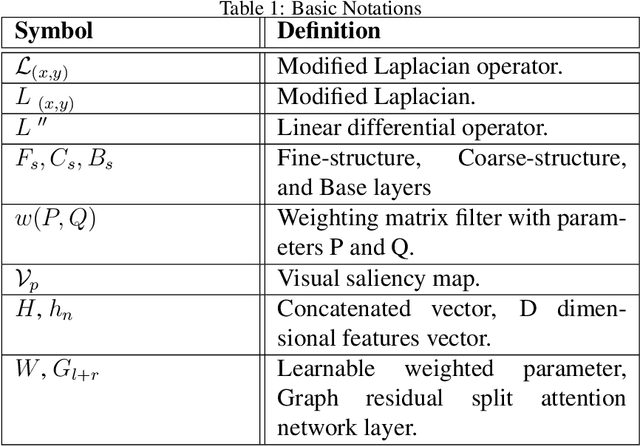
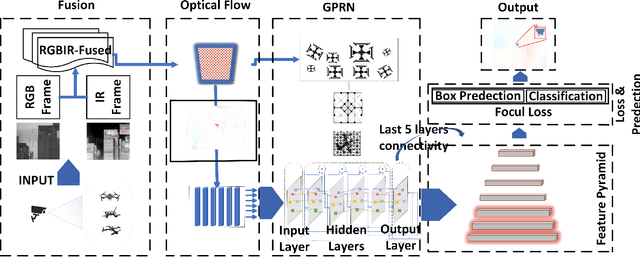
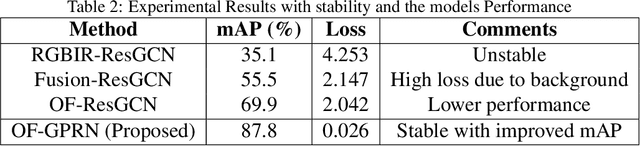
Recognizing unauthorized Unmanned Aerial Vehicles (UAVs) within designated no-fly zones throughout the day and night is of paramount importance, where the unauthorized UAVs pose a substantial threat to both civil and military aviation safety. However, recognizing UAVs day and night with dual-vision cameras is nontrivial, since red-green-blue (RGB) images suffer from a low detection rate under an insufficient light condition, such as on cloudy or stormy days, while black-and-white infrared (IR) images struggle to capture UAVs that overlap with the background at night. In this paper, we propose a new optical flow-assisted graph-pooling residual network (OF-GPRN), which significantly enhances the UAV detection rate in day and night dual visions. The proposed OF-GPRN develops a new optical fusion to remove superfluous backgrounds, which improves RGB/IR imaging clarity. Furthermore, OF-GPRN extends optical fusion by incorporating a graph residual split attention network and a feature pyramid, which refines the perception of UAVs, leading to a higher success rate in UAV detection. A comprehensive performance evaluation is conducted using a benchmark UAV catch dataset. The results indicate that the proposed OF-GPRN elevates the UAV mean average precision (mAP) detection rate to 87.8%, marking a 17.9% advancement compared to the residual graph neural network (ResGCN)-based approach.
DriftNet: Aggressive Driving Behavior Classification using 3D EfficientNet Architecture
Apr 18, 2020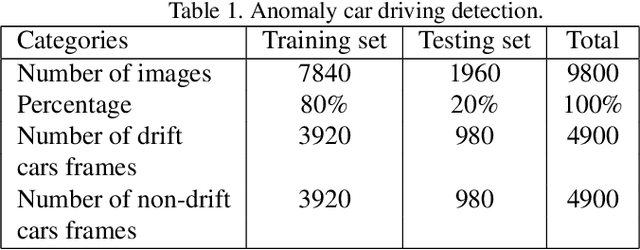
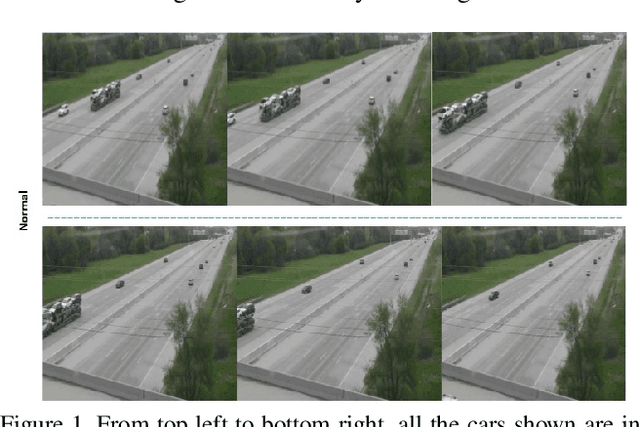
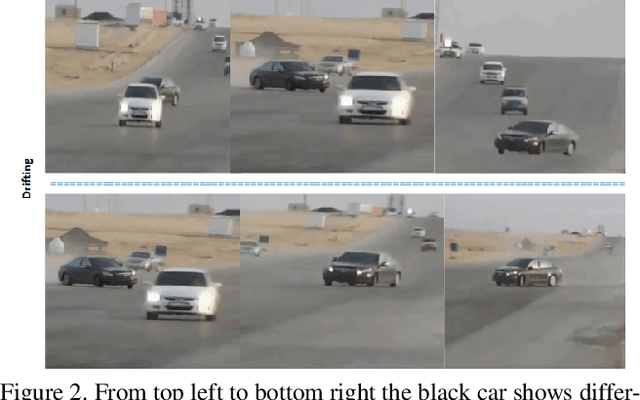
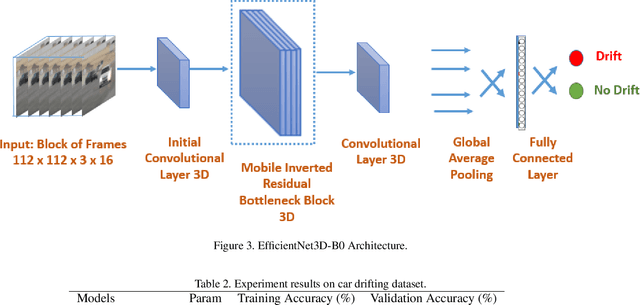
Aggressive driving (i.e., car drifting) is a dangerous behavior that puts human safety and life into a significant risk. This behavior is considered as an anomaly concerning the regular traffic in public transportation roads. Recent techniques in deep learning proposed new approaches for anomaly detection in different contexts such as pedestrian monitoring, street fighting, and threat detection. In this paper, we propose a new anomaly detection framework applied to the detection of aggressive driving behavior. Our contribution consists in the development of a 3D neural network architecture, based on the state-of-the-art EfficientNet 2D image classifier, for the aggressive driving detection in videos. We propose an EfficientNet3D CNN feature extractor for video analysis, and we compare it with existing feature extractors. We also created a dataset of car drifting in Saudi Arabian context https://www.youtube.com/watch?v=vLzgye1-d1k . To the best of our knowledge, this is the first work that addresses the problem of aggressive driving behavior using deep learning.