 Add to Chrome
 Add to Firefox
 Add to Edge
Multi-Stage Evolutionary Model Merging with Meta Data Driven Curriculum Learning for Sentiment-Specialized Large Language Modeling
Jan 11, 2026
The emergence of large language models (LLMs) has significantly transformed natural language processing (NLP), enabling more generalized models to perform various tasks with minimal training. However, traditional sentiment analysis methods, which focus on individual tasks such as sentiment classification or aspect-based analysis, are not practical for real-world applications that usually require handling multiple tasks. While offering flexibility, LLMs in sentiment-specific tasks often fall short of the required accuracy. Techniques like fine-tuning and evolutionary model merging help integrate models into a unified framework, which can improve the learning performance while reducing computational costs. The use of task meta-data and curriculum learning to optimize learning processes remains underexplored, while sentiment analysis is a critical task in NLP that requires high accuracy and scalability across multiple subtasks. In this study, we propose a hybrid learning model called Multi-stage Evolutionary Model Merging with Meta data driven Curriculum Learning (MEM-MCL), to enhance the sentiment analysis in large language modeling. In particular, expert models are created through instruction tuning for specific sentiment tasks and then merged using evolutionary algorithms to form a unified model. The merging process is optimized with weak data to enhance performance across tasks. The curriculum learning is incorporated to provide a learning sequence based on task difficulty, improving knowledge extraction from LLMs. Experiment results demonstrate that the proposed MEM-MCL model outperforms conventional LLMs in a majority of sentiment analysis tasks, achieving superior results across various subtasks.

CIEGAD: Cluster-Conditioned Interpolative and Extrapolative Framework for Geometry-Aware and Domain-Aligned Data Augmentation
Dec 11, 2025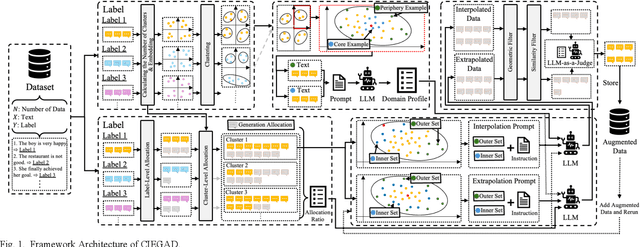
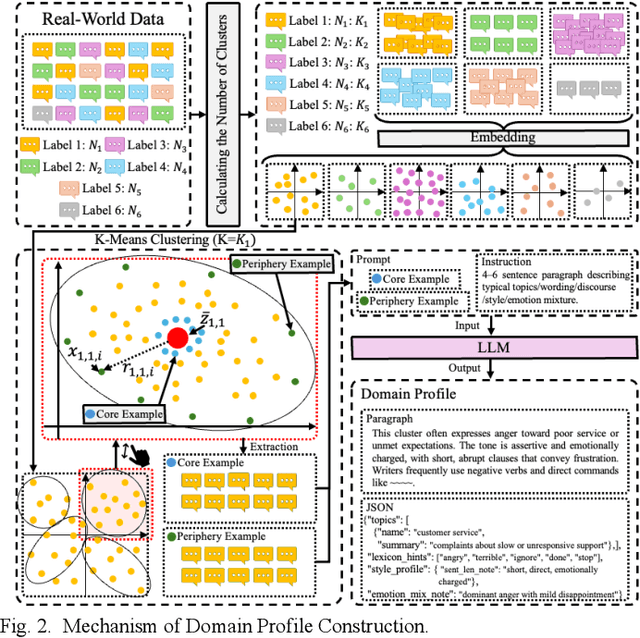
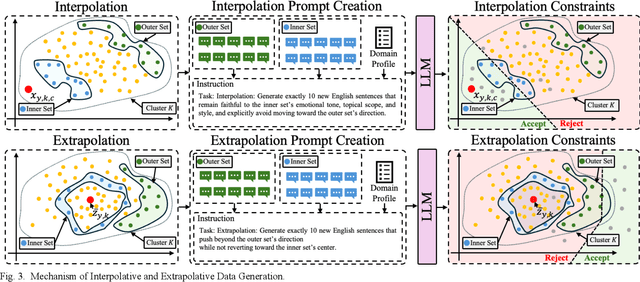
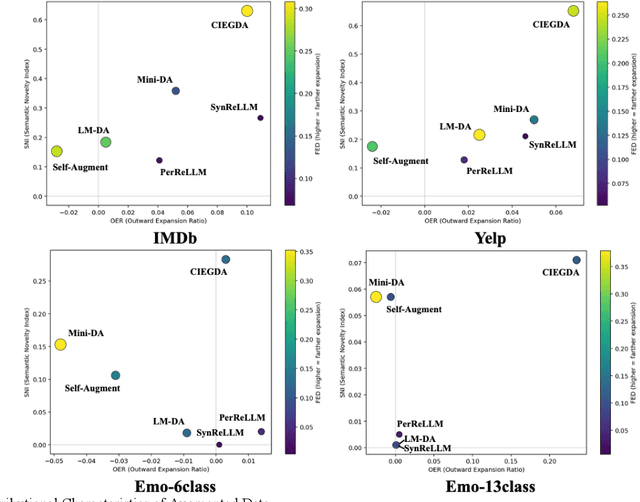
In practical deep learning deployment, the scarcity of data and the imbalance of label distributions often lead to semantically uncovered regions within the real-world data distribution, hindering model training and causing misclassification near class boundaries as well as unstable behaviors in peripheral areas. Although recent large language models (LLMs) show promise for data augmentation, an integrated framework that simultaneously achieves directional control of generation, domain alignment, and quality control has not yet been fully established. To address these challenges, we propose a Cluster-conditioned Interpolative and Extrapolative framework for Geometry-Aware and Domain-aligned data augmentation (CIEGAD), which systematically complements both in-distribution and out-of-distribution semantically uncovered regions. CIEGAD constructs domain profiles through cluster conditioning, allocates generation with a hierarchical frequency-geometric allocation integrating class frequency and geometric indicators, and finely controls generation directions via the coexistence of interpolative and extrapolative synthesis. It further performs quality control through geometry-constrained filtering combined with an LLM-as-a-Judge mechanism. Experiments on multiple classification tasks demonstrate that CIEGAD effectively extends the periphery of real-world data distributions while maintaining high alignment between generated and real-world data as well as semantic diversity. In particular, for long-tailed and multi-class classification tasks, CIEGAD consistently improves F1 and recall, validating the triple harmony of distributional consistency, diversity, and quality. These results indicate that CIEGAD serves as a practically oriented data augmentation framework that complements underrepresented regions while preserving alignment with real-world data.
389.3-Tb/s 1017-km C-band Transmission over Field-Installed 12-Coupled-Core Fiber Cable with >12-Tb/s Spatial MIMO Channels
Dec 10, 2025We demonstrate 4.65-THz WDM/SDM transmission of 140-Gbaud PS-QAM signals over field-installed 12-coupled-core fiber cable with standard cladding diameter, achieving a record 0.455 Pb/s coupled-core capacity in a field environment. We also demonstrate 0.389 Pb/s over-1000-km transmission of spatial MIMO channels with >12 Tb/s/wavelength net bitrate.
133-Tbps 1040-km (13$\times$80 km) Lumped-Amplified Transmission Over 22 THz in S-to-U-Band Using Hybrid Multiband Repeater with PPLN-Based Optical Parametric Amplifiers and EDFAs
Dec 10, 2025We demonstrated 22.05-THz four-band long-haul transmission with a S-to-U-band lumped repeater consisting of PPLN-based optical parametric amplifiers and EDFAs over an 80-km-span SMF link. The achieved net bitrate was 133.06 Tbps at 1040 km with the 25.5-dBm fibre launch power designed by accounting for ISRS.
Programmable Photonic Unitary Processor Enables Parametrized Differentiable Long-Haul Spatial Division Multiplexed Transmission
May 23, 2025The explosive growth of global data traffic demands scalable and energy-efficient optical communication systems. Spatial division multiplexing (SDM) using multicore or multimode fibers is a promising solution to overcome the capacity limit of single-mode fibers. However, long-haul SDM transmission faces significant challenges due to modal dispersion, which imposes heavy computational loads on digital signal processing (DSP) for signal equalization. Here, we propose parameterized SDM transmission, where programmable photonic unitary processors are installed at intermediate nodes. Instead of relying on conventional digital equalization only on the receiver side, our approach enables direct optimization of the SDM transmission channel itself by the programmable unitary processor, which reduces digital post-processing loads. We introduce a gradient-based optimization algorithm using a differentiable SDM transmission model to determine the optimal unitary transformation. As a key enabler, we first implemented telecom-grade programmable photonic unitary processor, achieving a low-loss (2.1 dB fiber-to-fiber), wideband (full C-band), polarization-independent, and high-fidelity (R2>96% across the C-band) operation. We experimentally demonstrate 1300-km transmission using a three-mode fiber, achieving strong agreement between simulation and experiment. The optimized photonic processor significantly reduces modal dispersion and post-processing complexity. Our results establish a scalable framework for integrating photonic computation into the optical layer, enabling more efficient, high-capacity optical networks.