 Add to Chrome
 Add to Firefox
 Add to Edge
Net 582-Gb/s C-band and 4$\times$526-Gb/s O-band IMDD Transmis-sion Using Ultra-broadband InP-DHBT-based Electrical Mixer
Dec 23, 2025
We successfully transmitted a net 582-Gb/s probabilistically shaped PAM12 C-band signal over 11-km dispersion-shifted fibre and net 4$\times$526-Gb/s uniform PAM8 O-band signals over 2-km four-core fibre using a single-carrier 216-GBd IMDD system based on a 150-GHz bandwidth InP-DHBT electrical mixer and a thin-film lithium-niobate modulator.

133-Tbps 1040-km (13$\times$80 km) Lumped-Amplified Transmission Over 22 THz in S-to-U-Band Using Hybrid Multiband Repeater with PPLN-Based Optical Parametric Amplifiers and EDFAs
Dec 10, 2025We demonstrated 22.05-THz four-band long-haul transmission with a S-to-U-band lumped repeater consisting of PPLN-based optical parametric amplifiers and EDFAs over an 80-km-span SMF link. The achieved net bitrate was 133.06 Tbps at 1040 km with the 25.5-dBm fibre launch power designed by accounting for ISRS.
Iterative Decoder of Channel-polarized Multilevel Coding for Data Center Networks
Mar 26, 2025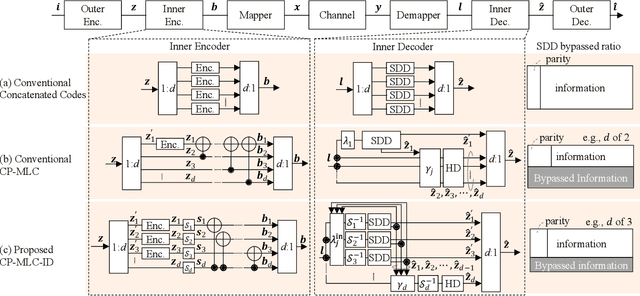
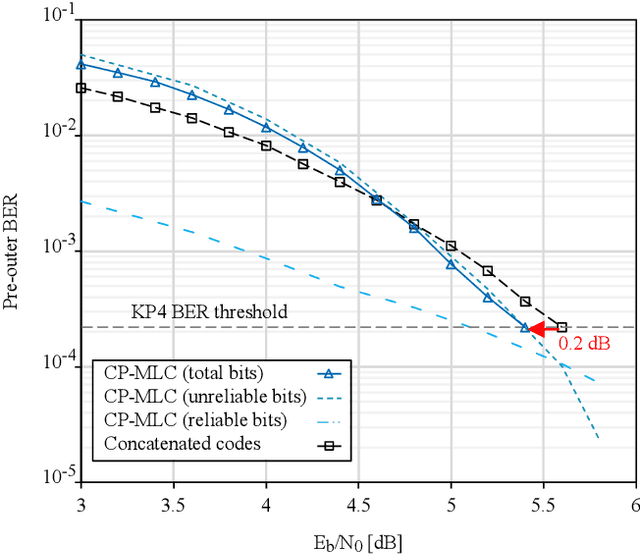
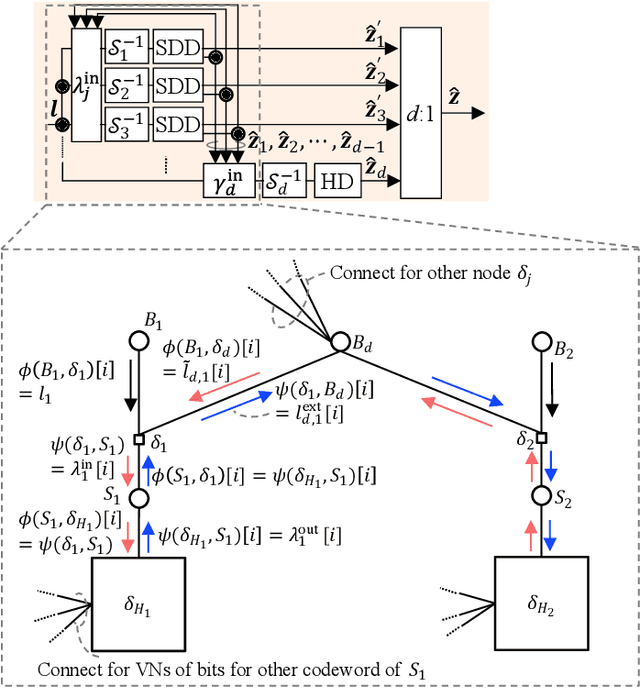
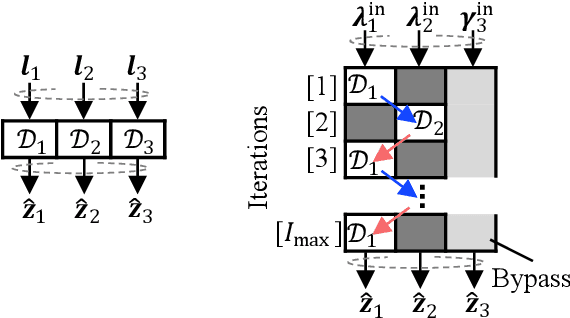
Data center networks (DCNs) require a low-cost, low-power optical transceiver to handle increased traffic from generative artificial intelligence, video streaming services, and more. Improving the required signal-to-noise ratio (RSNR) by digital signal processing such as forward error correction (FEC) mitigates the requirements for electrical and optical components. The optical transceivers in DCNs exploit a low-complexity soft-decision (SD) FEC, consisting of short block-length linear error-correcting codes and a low-complexity SD decoder (SDD), such as a Chase decoder and ordered statistical decoding. The low complexity SDD efficiently approaches a maximum likelihood decoding (MLD). However, the decoding performance of MLD is limited by its finite block length. In this paper, we describe the detail of our proposed channel-polarized multilevel coding with iterative decoding (CP-MLC-ID), which improves the decoding performance. The 19.5$\%$-OH CP-MLC-ID 128-bit extended Bose-Chaudhuri-Hocquenghem (eBCH) and KP4 codes outperform the concatenated eBCH and KP4 codes with a net coding gain of 0.25 and 0.40 dB for the same and double the number of SDDs, respectively. We also investigate the dependency of the decoding performance on the size of a bit interleaver. The performance degradation of CP-MLC-ID using an 8-bit interleaver is about 0.1 dB compared to using the large-bit interleaver. Our results indicate that even a weak connection by exclusive-OR between codewords improves the decoding performance, compared to simple concatenated codes in the DCNs.