 Add to Chrome
 Add to Firefox
 Add to Edge
When Relations Break: Analyzing Relation Hallucination in Vision-Language Model Under Rotation and Noise
May 06, 2026
Vision-language models (VLMs) achieve strong multimodal performance but remain prone to relation hallucination, which requires accurate reasoning over inter-object interactions. We study the impact of visual perturbations, specifically rotation and noise, and show that even mild distortions significantly degrade relational reasoning across models and datasets. We further evaluate prompt-based augmentation and preprocessing strategies (orientation correction and denoising), finding that while they offer partial improvements, they do not fully resolve hallucinations. Our results reveal a gap between perceptual robustness and relational understanding, highlighting the need for more robust, geometry-aware VLMs.

Evaluating Large Language Models on Rare Disease Diagnosis: A Case Study using House M.D
Nov 14, 2025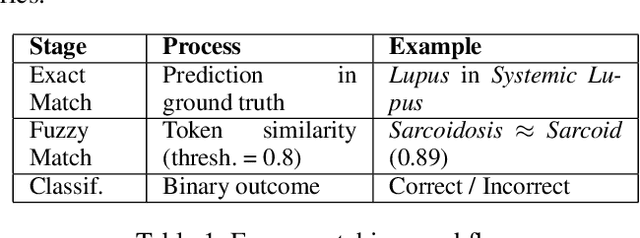
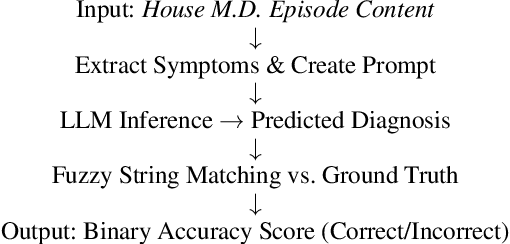
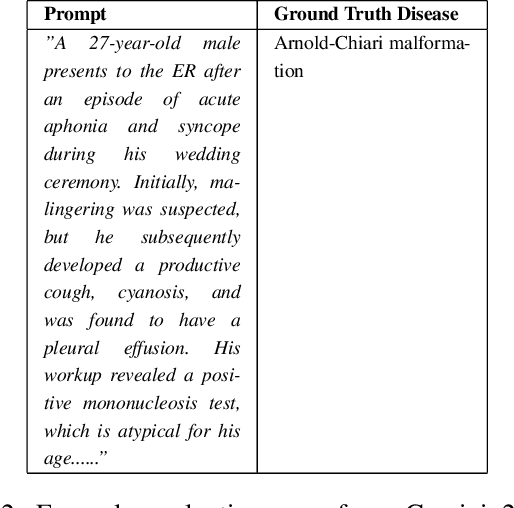
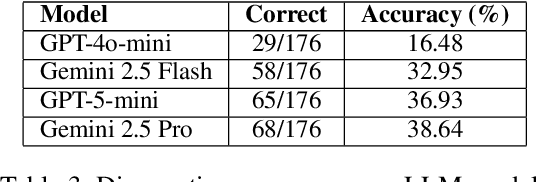
Large language models (LLMs) have demonstrated capabilities across diverse domains, yet their performance on rare disease diagnosis from narrative medical cases remains underexplored. We introduce a novel dataset of 176 symptom-diagnosis pairs extracted from House M.D., a medical television series validated for teaching rare disease recognition in medical education. We evaluate four state-of-the-art LLMs such as GPT 4o mini, GPT 5 mini, Gemini 2.5 Flash, and Gemini 2.5 Pro on narrative-based diagnostic reasoning tasks. Results show significant variation in performance, ranging from 16.48% to 38.64% accuracy, with newer model generations demonstrating a 2.3 times improvement. While all models face substantial challenges with rare disease diagnosis, the observed improvement across architectures suggests promising directions for future development. Our educationally validated benchmark establishes baseline performance metrics for narrative medical reasoning and provides a publicly accessible evaluation framework for advancing AI-assisted diagnosis research.