 Add to Chrome
 Add to Firefox
 Add to Edge
Attention Deficits in Language Models: Causal Explanations for Procedural Hallucinations
Feb 22, 2026
Large language models can follow complex procedures yet fail at a seemingly trivial final step: reporting a value they themselves computed moments earlier. We study this phenomenon as \emph{procedural hallucination}: failure to execute a verifiable, prompt-grounded specification even when the correct value is present in context. In long-context binding tasks with a known single-token candidate set, we find that many errors are readout-stage routing failures. Specifically, failures decompose into Stage~2A (gating) errors, where the model does not enter answer mode, and Stage~2B (binding) errors, where it enters answer mode but selects the wrong candidate (often due to recency bias). In the hard regime, Stage~2B accounts for most errors across model families in our tasks (Table~1). On Stage~2B error trials, a linear probe on the final-layer residual stream recovers the correct value far above chance (e.g., 74\% vs.\ 2\% on Qwen2.5-3B; Table~2), indicating that the answer is encoded but not used. We formalize ``present but not used'' via available vs.\ used mutual information and pseudo-prior interventions, yielding output-computable diagnostics and information-budget certificates. Finally, an oracle checkpointing intervention that restates the true binding near the query can nearly eliminate Stage~2B failures at long distance (e.g., Qwen2.5-3B $0/400 \rightarrow 399/400$ at $k = 1024$; Table~8).

Beyond the Score: Uncertainty-Calibrated LLMs for Automated Essay Assessment
Sep 19, 2025
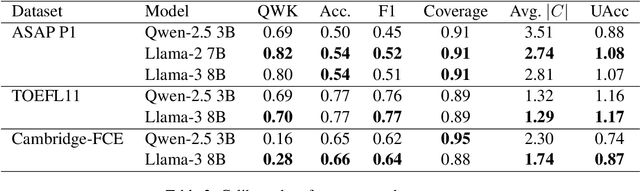
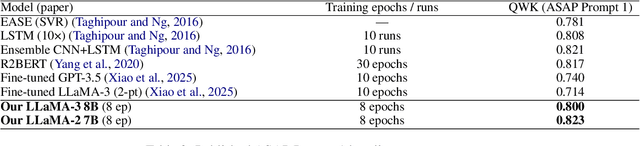
Automated Essay Scoring (AES) systems now reach near human agreement on some public benchmarks, yet real-world adoption, especially in high-stakes examinations, remains limited. A principal obstacle is that most models output a single score without any accompanying measure of confidence or explanation. We address this gap with conformal prediction, a distribution-free wrapper that equips any classifier with set-valued outputs and formal coverage guarantees. Two open-source large language models (Llama-3 8B and Qwen-2.5 3B) are fine-tuned on three diverse corpora (ASAP, TOEFL11, Cambridge-FCE) and calibrated at a 90 percent risk level. Reliability is assessed with UAcc, an uncertainty-aware accuracy that rewards models for being both correct and concise. To our knowledge, this is the first work to combine conformal prediction and UAcc for essay scoring. The calibrated models consistently meet the coverage target while keeping prediction sets compact, indicating that open-source, mid-sized LLMs can already support teacher-in-the-loop AES; we discuss scaling and broader user studies as future work.