 Add to Chrome
 Add to Firefox
 Add to Edge
Are Arabic Benchmarks Reliable? QIMMA's Quality-First Approach to LLM Evaluation
Apr 03, 2026
We present QIMMA, a quality-assured Arabic LLM leaderboard that places systematic benchmark validation at its core. Rather than aggregating existing resources as-is, QIMMA applies a multi-model assessment pipeline combining automated LLM judgment with human review to surface and resolve systematic quality issues in well-established Arabic benchmarks before evaluation. The result is a curated, multi-domain, multi-task evaluation suite of over 52k samples, grounded predominantly in native Arabic content; code evaluation tasks are the sole exception, as they are inherently language-agnostic. Transparent implementation via LightEval, EvalPlus and public release of per-sample inference outputs make QIMMA a reproducible and community-extensible foundation for Arabic NLP evaluation.

Maximizing the Potential of Synthetic Data: Insights from Random Matrix Theory
Oct 11, 2024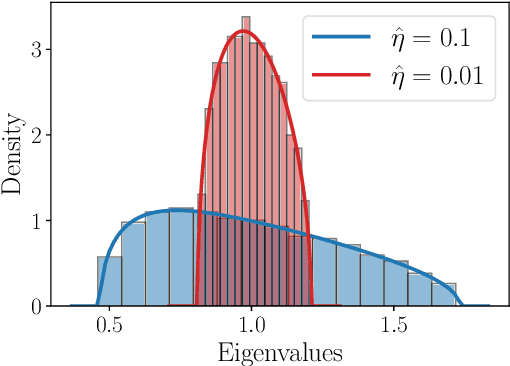


Synthetic data has gained attention for training large language models, but poor-quality data can harm performance (see, e.g., Shumailov et al. (2023); Seddik et al. (2024)). A potential solution is data pruning, which retains only high-quality data based on a score function (human or machine feedback). Previous work Feng et al. (2024) analyzed models trained on synthetic data as sample size increases. We extend this by using random matrix theory to derive the performance of a binary classifier trained on a mix of real and pruned synthetic data in a high dimensional setting. Our findings identify conditions where synthetic data could improve performance, focusing on the quality of the generative model and verification strategy. We also show a smooth phase transition in synthetic label noise, contrasting with prior sharp behavior in infinite sample limits. Experiments with toy models and large language models validate our theoretical results.
Alignment with Preference Optimization Is All You Need for LLM Safety
Sep 12, 2024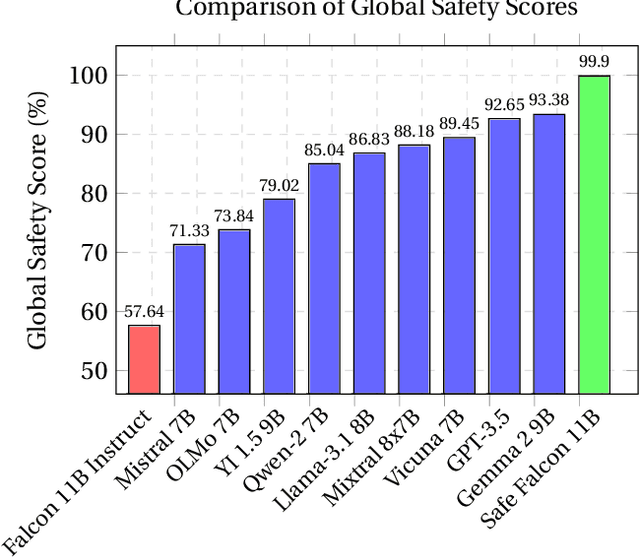
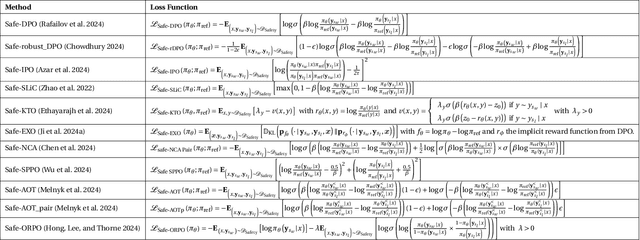
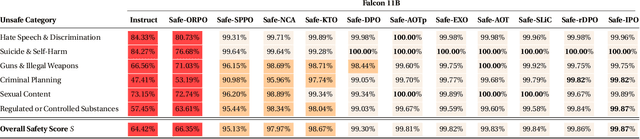
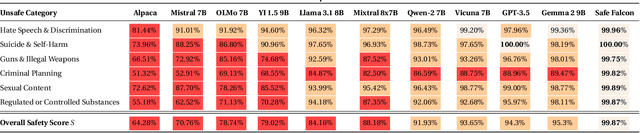
We demonstrate that preference optimization methods can effectively enhance LLM safety. Applying various alignment techniques to the Falcon 11B model using safety datasets, we achieve a significant boost in global safety score (from $57.64\%$ to $99.90\%$) as measured by LlamaGuard 3 8B, competing with state-of-the-art models. On toxicity benchmarks, average scores in adversarial settings dropped from over $0.6$ to less than $0.07$. However, this safety improvement comes at the cost of reduced general capabilities, particularly in math, suggesting a trade-off. We identify noise contrastive alignment (Safe-NCA) as an optimal method for balancing safety and performance. Our study ultimately shows that alignment techniques can be sufficient for building safe and robust models.