 Add to Chrome
 Add to Firefox
 Add to Edge
IHBench: Evaluating Post-Interruption Recovery in Voice Agents with Structured Workflows
Jun 17, 2026
Voice agents deployed in structured workflows (customer service, healthcare scheduling, account management) must handle frequent user interruptions while maintaining progress through multi-step procedures. Existing benchmarks for speech-capable models focus on the timing of interruptions: barge-in detection, endpointing, and turn-taking dynamics. They leave unmeasured what happens after the interruption: does the agent resume the workflow at the correct step? Does it address the user's interjection? Does it avoid re-delivering content the user already heard? We introduce IHBench (Interruption Handling Benchmark), a benchmark that evaluates post-interruption recovery in voice agents executing state-machine-driven workflows across 10 enterprise domains. Six interruption types are injected at controlled points mid-utterance, with per-interruption evaluation rubrics generated alongside the data. Each interruption is scored on two axes: task fulfillment and recovery quality. We evaluate 27 audio-language model configurations from OpenAI, Google, and the open-weight community. Models vary widely, and recovery quality depends strongly on the interruption type. Across our experiments, closed-weight models are consistently more robust to interruptions than open-weight ones: they win far more often on task fulfillment, degrade roughly 3.3x more slowly as conversations grow longer, and show no audio-versus-text modality gap, whereas the open-weight models lose ground on all three. A human study validates the LLM judge against human annotators, and a cross-benchmark analysis against AudioMultiChallenge indicates that recovery quality is a largely distinct capability axis.

ProactBench: Beyond What The User Asked For
May 09, 2026Most LLM benchmarks score how well a model responds to explicit requests. They leave unmeasured a different conversational ability: noticing and acting on needs the user has implied but not said. We call this \emph{conversational proactivity}. ProactBench decomposes it into three phase-tied types: \textsc{Emergent}, inference from a single disclosed anchor; \textsc{Critical}, synthesis across multiple anchors; and \textsc{Recovery}, grounded forward-looking value after task completion. We operationalise the benchmark with three agents: a Planner, a User Agent, and an Assistant Model. Their information asymmetries defend against style-confounded scoring, rubric leakage, external-context contamination, and information dumps. The released corpus contains 198 curated dialogues with 624 trigger points across 24 communication styles drawn from a psychometric inventory and audited by an independent LLM judge. Across 16 frontier and open-weight models, \textsc{Recovery} is both difficult and weakly predicted by six standard benchmarks, making it a useful new evaluation signal.
Geometry-Aware Diffusion Models for Multiview Scene Inpainting
Feb 18, 2025In this paper, we focus on 3D scene inpainting, where parts of an input image set, captured from different viewpoints, are masked out. The main challenge lies in generating plausible image completions that are geometrically consistent across views. Most recent work addresses this challenge by combining generative models with a 3D radiance field to fuse information across viewpoints. However, a major drawback of these methods is that they often produce blurry images due to the fusion of inconsistent cross-view images. To avoid blurry inpaintings, we eschew the use of an explicit or implicit radiance field altogether and instead fuse cross-view information in a learned space. In particular, we introduce a geometry-aware conditional generative model, capable of inpainting multi-view consistent images based on both geometric and appearance cues from reference images. A key advantage of our approach over existing methods is its unique ability to inpaint masked scenes with a limited number of views (i.e., few-view inpainting), whereas previous methods require relatively large image sets for their 3D model fitting step. Empirically, we evaluate and compare our scene-centric inpainting method on two datasets, SPIn-NeRF and NeRFiller, which contain images captured at narrow and wide baselines, respectively, and achieve state-of-the-art 3D inpainting performance on both. Additionally, we demonstrate the efficacy of our approach in the few-view setting compared to prior methods.
LAP: An Attention-Based Module for Faithful Interpretation and Knowledge Injection in Convolutional Neural Networks
Jan 27, 2022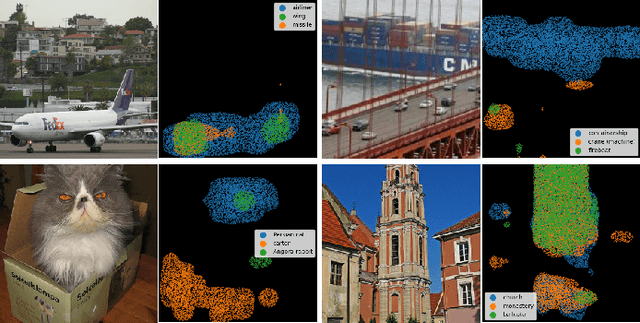
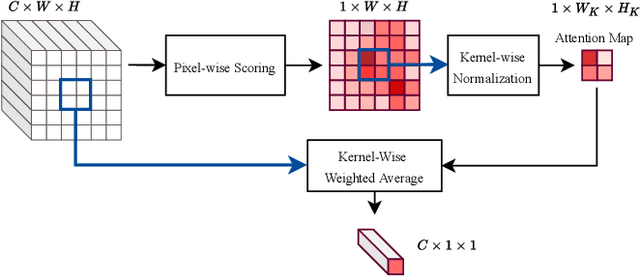
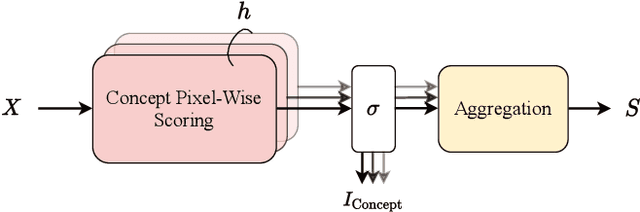
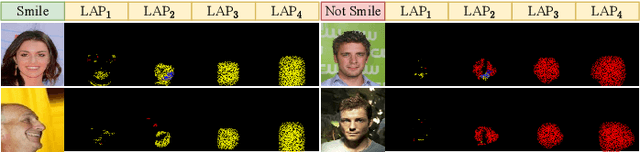
Despite the state-of-the-art performance of deep convolutional neural networks, they are susceptible to bias and malfunction in unseen situations. The complex computation behind their reasoning is not sufficiently human-understandable to develop trust. External explainer methods have tried to interpret the network decisions in a human-understandable way, but they are accused of fallacies due to their assumptions and simplifications. On the other side, the inherent self-interpretability of models, while being more robust to the mentioned fallacies, cannot be applied to the already trained models. In this work, we propose a new attention-based pooling layer, called Local Attention Pooling (LAP), that accomplishes self-interpretability and the possibility for knowledge injection while improving the model's performance. Moreover, several weakly-supervised knowledge injection methodologies are provided to enhance the process of training. We verified our claims by evaluating several LAP-extended models on three different datasets, including Imagenet. The proposed framework offers more valid human-understandable and more faithful-to-the-model interpretations than the commonly used white-box explainer methods.