 Add to Chrome
 Add to Firefox
 Add to Edge
TopicRNN: A Recurrent Neural Network with Long-Range Semantic Dependency
Feb 27, 2017
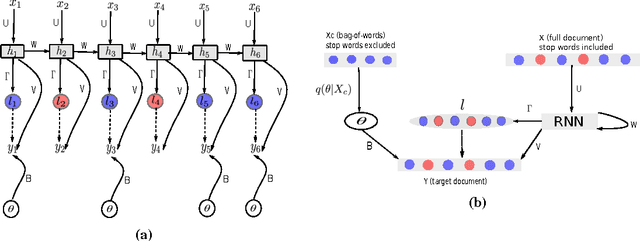
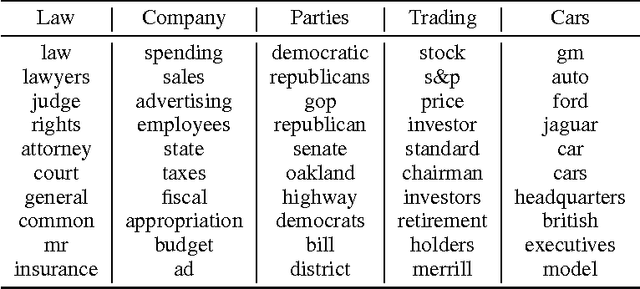
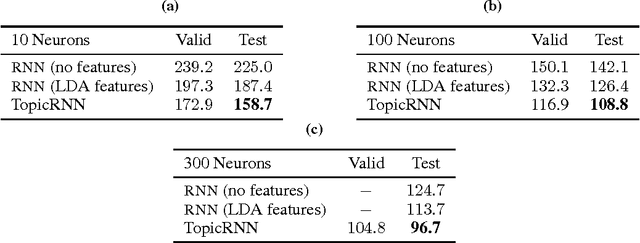
In this paper, we propose TopicRNN, a recurrent neural network (RNN)-based language model designed to directly capture the global semantic meaning relating words in a document via latent topics. Because of their sequential nature, RNNs are good at capturing the local structure of a word sequence - both semantic and syntactic - but might face difficulty remembering long-range dependencies. Intuitively, these long-range dependencies are of semantic nature. In contrast, latent topic models are able to capture the global underlying semantic structure of a document but do not account for word ordering. The proposed TopicRNN model integrates the merits of RNNs and latent topic models: it captures local (syntactic) dependencies using an RNN and global (semantic) dependencies using latent topics. Unlike previous work on contextual RNN language modeling, our model is learned end-to-end. Empirical results on word prediction show that TopicRNN outperforms existing contextual RNN baselines. In addition, TopicRNN can be used as an unsupervised feature extractor for documents. We do this for sentiment analysis on the IMDB movie review dataset and report an error rate of $6.28\%$. This is comparable to the state-of-the-art $5.91\%$ resulting from a semi-supervised approach. Finally, TopicRNN also yields sensible topics, making it a useful alternative to document models such as latent Dirichlet allocation.

Edward: A library for probabilistic modeling, inference, and criticism
Feb 01, 2017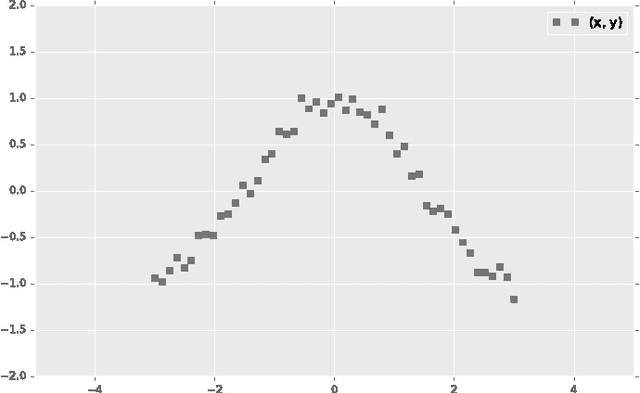
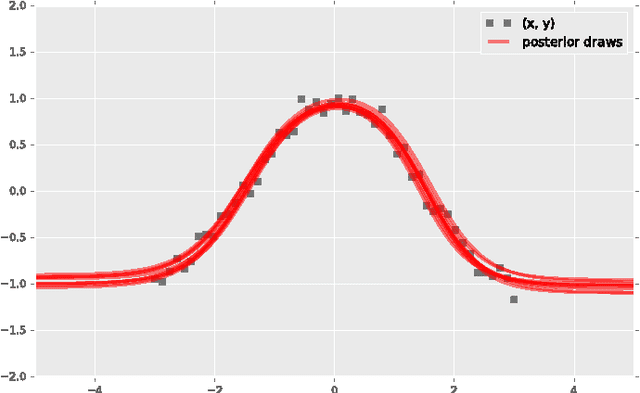
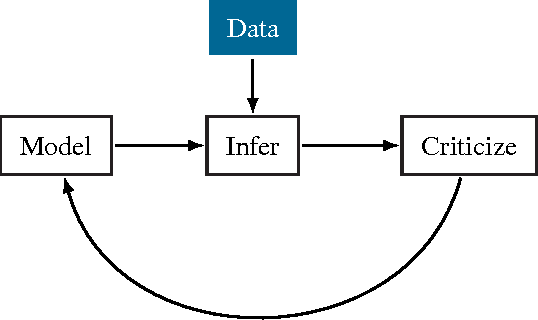
Probabilistic modeling is a powerful approach for analyzing empirical information. We describe Edward, a library for probabilistic modeling. Edward's design reflects an iterative process pioneered by George Box: build a model of a phenomenon, make inferences about the model given data, and criticize the model's fit to the data. Edward supports a broad class of probabilistic models, efficient algorithms for inference, and many techniques for model criticism. The library builds on top of TensorFlow to support distributed training and hardware such as GPUs. Edward enables the development of complex probabilistic models and their algorithms at a massive scale.