 Add to Chrome
 Add to Firefox
 Add to Edge
Shield-Loco: Shielding Locomotion Policies with Predictive Safety Filtering
Jun 05, 2026
Reinforcement learning (RL) policies enable dynamic legged locomotion but lack mechanisms to avoid violations of safety constraints that are absent during training. Large-scale offline safe learning is impractical for covering all edge cases. Existing safety frameworks either rely on reduced-order models that cannot reason about whole-body behaviors or require conservative recovery controllers that degrade task performance. We propose a predictive safety filter that post-hoc filters the nominal contact locations fed to the RL policy. When a collision is predicted, a sampling-based optimizer asynchronously searches for safer contact sequences using a full-physics model, while a learned value function bootstraps long-horizon returns. Our three algorithmic components (geometric projection of sampled contacts, momentum-augmented updates, and replica-exchange) make the optimization tractable in a discontinuous contact landscape. We validate the filter on a quadruped robot in dense, cluttered environments, both in simulation and in the real world, showing substantial reductions in safety violations with minimal deviation from the nominal input.

Data-Driven Physics Embedded Dynamics with Predictive Control and Reinforcement Learning for Quadrupeds
Mar 15, 2026State of the art quadrupedal locomotion approaches integrate Model Predictive Control (MPC) with Reinforcement Learning (RL), enabling complex motion capabilities with planning and terrain adaptive behaviors. However, they often face compounding errors over long horizons and have limited interpretability due to the absence of physical inductive biases. We address these issues by integrating Lagrangian Neural Networks (LNNs) into an RL MPC framework, enabling physically consistent dynamics learning. At deployment, our inverse dynamics infinite horizon MPC scheme avoids costly matrix inversions, improving computational efficiency by up to 4x with minimal loss of task performance. We validate our framework through multiple ablations of the proposed LNN and its variants. We show improved sample efficiency, reduced long-horizon error, and faster real time planning compared to unstructured neural dynamics. Lastly, we also test our framework on the Unitree Go1 robot to show real world viability.
VIP-Loco: A Visually Guided Infinite Horizon Planning Framework for Legged Locomotion
Mar 15, 2026Perceptive locomotion for legged robots requires anticipating and adapting to complex, dynamic environments. Model Predictive Control (MPC) serves as a strong baseline, providing interpretable motion planning with constraint enforcement, but struggles with high-dimensional perceptual inputs and rapidly changing terrain. In contrast, model-free Reinforcement Learning (RL) adapts well across visually challenging scenarios but lacks planning. To bridge this gap, we propose VIP-Loco, a framework that integrates vision-based scene understanding with RL and planning. During training, an internal model maps proprioceptive states and depth images into compact kinodynamic features used by the RL policy. At deployment, the learned models are used within an infinite-horizon MPC formulation, combining adaptability with structured planning. We validate VIP-Loco in simulation on challenging locomotion tasks, including slopes, stairs, crawling, tilting, gap jumping, and climbing, across three robot morphologies: a quadruped (Unitree Go1), a biped (Cassie), and a wheeled-biped (TronA1-W). Through ablations and comparisons with state-of-the-art methods, we show that VIP-Loco unifies planning and perception, enabling robust, interpretable locomotion in diverse environments.
PIP-Loco: A Proprioceptive Infinite Horizon Planning Framework for Quadrupedal Robot Locomotion
Sep 17, 2024A core strength of Model Predictive Control (MPC) for quadrupedal locomotion has been its ability to enforce constraints and provide interpretability of the sequence of commands over the horizon. However, despite being able to plan, MPC struggles to scale with task complexity, often failing to achieve robust behavior on rapidly changing surfaces. On the other hand, model-free Reinforcement Learning (RL) methods have outperformed MPC on multiple terrains, showing emergent motions but inherently lack any ability to handle constraints or perform planning. To address these limitations, we propose a framework that integrates proprioceptive planning with RL, allowing for agile and safe locomotion behaviors through the horizon. Inspired by MPC, we incorporate an internal model that includes a velocity estimator and a Dreamer module. During training, the framework learns an expert policy and an internal model that are co-dependent, facilitating exploration for improved locomotion behaviors. During deployment, the Dreamer module solves an infinite-horizon MPC problem, adapting actions and velocity commands to respect the constraints. We validate the robustness of our training framework through ablation studies on internal model components and demonstrate improved robustness to training noise. Finally, we evaluate our approach across multi-terrain scenarios in both simulation and hardware.
Reducing Onboard Processing Time for Path Planning in Dynamically Evolving Polygonal Maps
May 08, 2023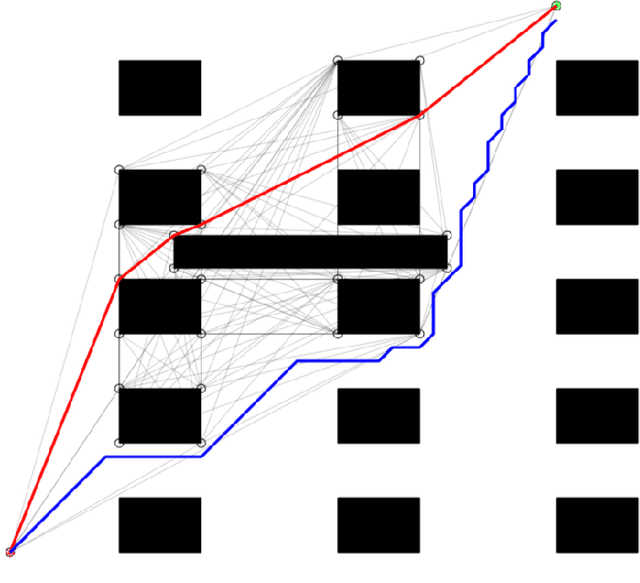
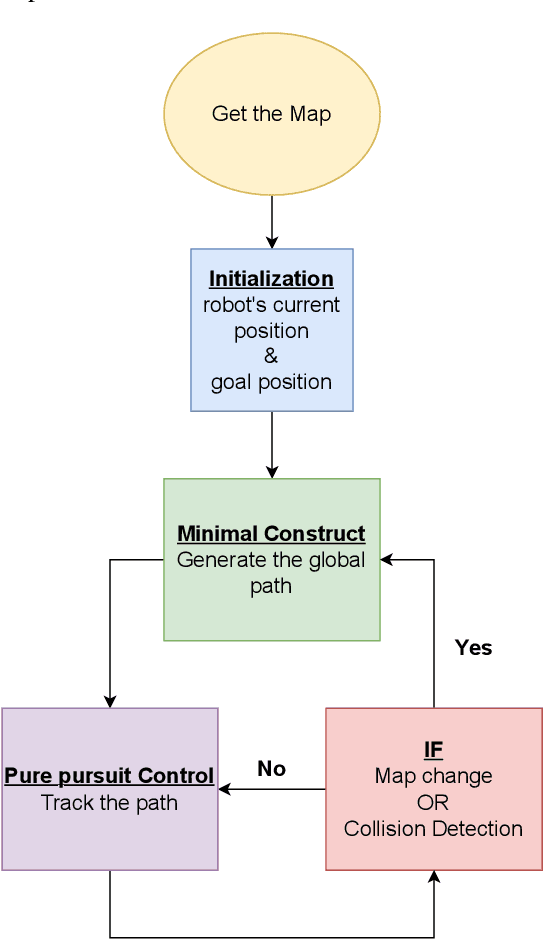
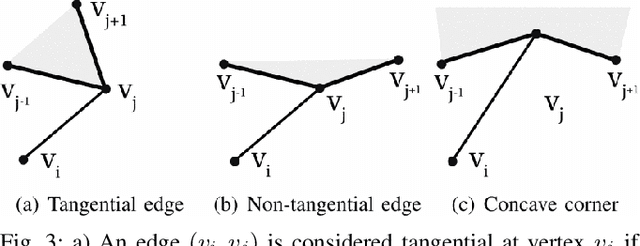
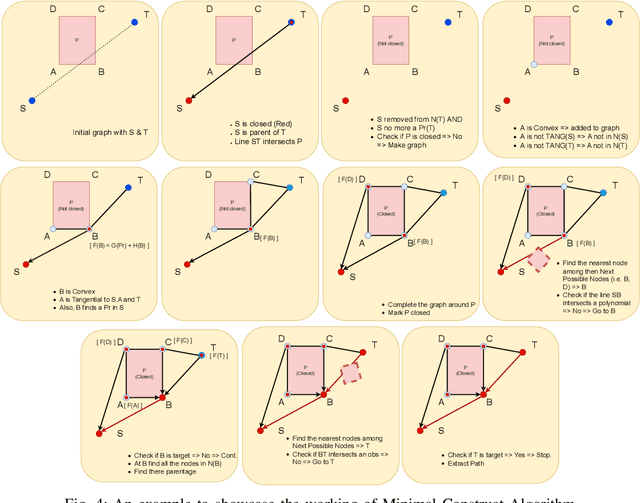
Autonomous agents face the challenge of coordinating multiple tasks (perception, motion planning, controller) which are computationally expensive on a single onboard computer. To utilize the onboard processing capacity optimally, it is imperative to arrive at computationally efficient algorithms for global path planning. In this work, it is attempted to reduce the processing time for global path planning in dynamically evolving polygonal maps. In dynamic environments, maps may not remain valid for long. Hence it is of utmost importance to obtain the shortest path quickly in an ever-changing environment. To address this, an existing rapid path-finding algorithm, the Minimal Construct was used. This algorithm discovers only a necessary portion of the Visibility Graph around obstacles and computes collision tests only for lines that seem heuristically promising. Simulations show that this algorithm finds shortest paths faster than traditional grid-based A* searches in most cases, resulting in smoother and shorter paths even in dynamic environments.