 Add to Chrome
 Add to Firefox
 Add to Edge
Reshoot-Anything: A Self-Supervised Model for In-the-Wild Video Reshooting
Apr 23, 2026
Precise camera control for reshooting dynamic videos is bottlenecked by the severe scarcity of paired multi-view data for non-rigid scenes. We overcome this limitation with a highly scalable self-supervised framework capable of leveraging internet-scale monocular videos. Our core contribution is the generation of pseudo multi-view training triplets, consisting of a source video, a geometric anchor, and a target video. We achieve this by extracting distinct smooth random-walk crop trajectories from a single input video to serve as the source and target views. The anchor is synthetically generated by forward-warping the first frame of the source with a dense tracking field, which effectively simulates the distorted point-cloud inputs expected at inference. Because our independent cropping strategy introduces spatial misalignment and artificial occlusions, the model cannot simply copy information from the current source frame. Instead, it is forced to implicitly learn 4D spatiotemporal structures by actively routing and re-projecting missing high-fidelity textures across distinct times and viewpoints from the source video to reconstruct the target. At inference, our minimally adapted diffusion transformer utilizes a 4D point-cloud derived anchor to achieve state-of-the-art temporal consistency, robust camera control, and high-fidelity novel view synthesis on complex dynamic scenes.

Cambrian-1: A Fully Open, Vision-Centric Exploration of Multimodal LLMs
Jun 24, 2024
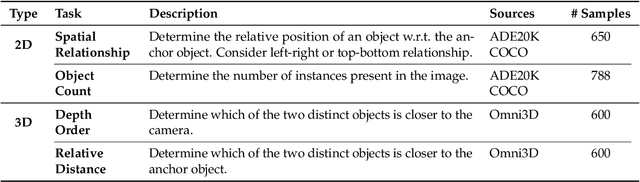

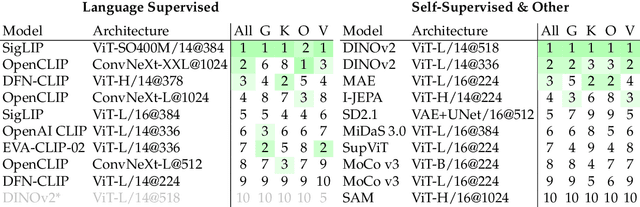
We introduce Cambrian-1, a family of multimodal LLMs (MLLMs) designed with a vision-centric approach. While stronger language models can enhance multimodal capabilities, the design choices for vision components are often insufficiently explored and disconnected from visual representation learning research. This gap hinders accurate sensory grounding in real-world scenarios. Our study uses LLMs and visual instruction tuning as an interface to evaluate various visual representations, offering new insights into different models and architectures -- self-supervised, strongly supervised, or combinations thereof -- based on experiments with over 20 vision encoders. We critically examine existing MLLM benchmarks, addressing the difficulties involved in consolidating and interpreting results from various tasks, and introduce a new vision-centric benchmark, CV-Bench. To further improve visual grounding, we propose the Spatial Vision Aggregator (SVA), a dynamic and spatially-aware connector that integrates high-resolution vision features with LLMs while reducing the number of tokens. Additionally, we discuss the curation of high-quality visual instruction-tuning data from publicly available sources, emphasizing the importance of data source balancing and distribution ratio. Collectively, Cambrian-1 not only achieves state-of-the-art performance but also serves as a comprehensive, open cookbook for instruction-tuned MLLMs. We provide model weights, code, supporting tools, datasets, and detailed instruction-tuning and evaluation recipes. We hope our release will inspire and accelerate advancements in multimodal systems and visual representation learning.
STENCIL: Submodular Mutual Information Based Weak Supervision for Cold-Start Active Learning
Feb 21, 2024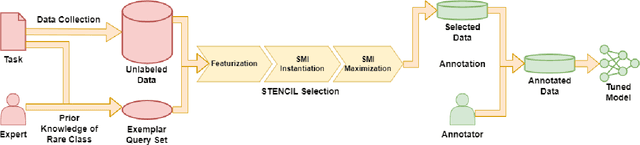
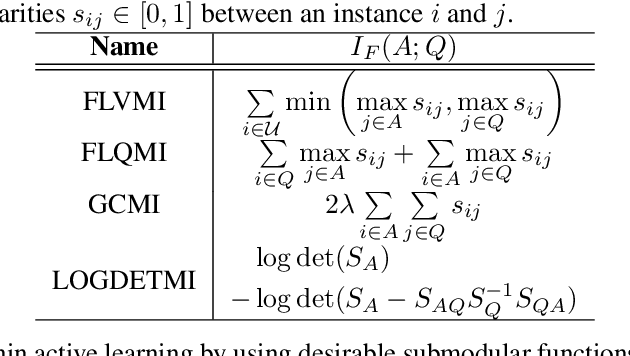
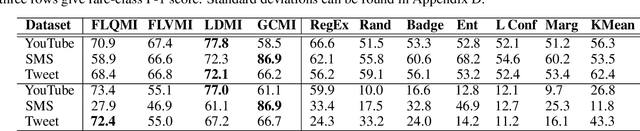
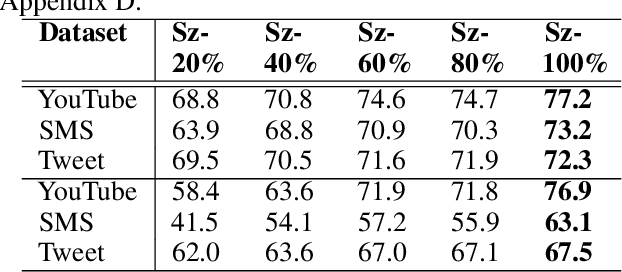
As supervised fine-tuning of pre-trained models within NLP applications increases in popularity, larger corpora of annotated data are required, especially with increasing parameter counts in large language models. Active learning, which attempts to mine and annotate unlabeled instances to improve model performance maximally fast, is a common choice for reducing the annotation cost; however, most methods typically ignore class imbalance and either assume access to initial annotated data or require multiple rounds of active learning selection before improving rare classes. We present STENCIL, which utilizes a set of text exemplars and the recently proposed submodular mutual information to select a set of weakly labeled rare-class instances that are then strongly labeled by an annotator. We show that STENCIL improves overall accuracy by $10\%-24\%$ and rare-class F-1 score by $17\%-40\%$ on multiple text classification datasets over common active learning methods within the class-imbalanced cold-start setting.