 Add to Chrome
 Add to Firefox
 Add to Edge
NeuroQA: A Large-Scale Image-Grounded Benchmark for 3D Brain MRI Understanding
May 19, 2026
We present NeuroQA, a large-scale benchmark for visual question answering in 3D brain magnetic resonance imaging (MRI), with 56,953 QA pairs from 12,977 subjects across 12 datasets. It spans ages 5-104 and five clinical domains: Alzheimer's, Parkinson's, tumors, white matter disease, and neurodevelopment. Unlike prior medical Visual Question Answering (VQA) efforts that operate on 2D slices or rely on narrow diagnostic labels, NeuroQA pairs every item with a full 3D volume. It evaluates 11 clinically grounded reasoning skills across Yes/No, multiple-choice, and open-ended formats. Of the 203 templates, 131 are image-grounded (answerable from a 3-plane viewer) and 72 are image-informed (ground truth from quantitative volumetry or clinical instruments). To remove text-only shortcuts, we apply answer-distribution refinement, reducing closed-format text-only accuracy from $>$80% to 44.6%; image necessity is assessed separately through an image-grounding protocol released with the benchmark. A 38-rule deterministic pipeline and two rounds of expert review verify every QA pair against FreeSurfer measurements, metadata, or radiology report fields, with zero same-subject contradictions across templates. We conduct a clinician evaluation in which two clinicians independently assess 100 frozen test items on a three-plane viewer. On closed-format (Yes/No + multiple-choice) test-public items, the best zero-shot vision-language model and a supervised 3D CNN baseline reach 47.5% and 43.7% accuracy respectively, both below the 49.4% text-only majority-template floor. NeuroQA adopts a two-tier release with public QA pairs for open-access datasets and reproducible generation scripts for datasets restricted by data use agreements (DUAs), plus subject-level splits, a held-out private test set, and an online leaderboard.

Interpretable Cross-Network Attention for Resting-State fMRI Representation Learning
Feb 28, 2026Understanding how large-scale functional brain networks reorganize during cognitive decline remains a central challenge in neuroimaging. While recent self-supervised models have shown promise for learning representations from resting-state fMRI, their internal mechanisms are difficult to interpret, limiting mechanistic insight. We propose BrainInterNet, a network-aware self-supervised framework based on masked reconstruction with cross-attention that explicitly models inter-network dependencies in rs-fMRI. By selectively masking predefined functional networks and reconstructing them from remaining context, our approach enables direct quantification of network predictability and interpretable analysis of cross-network interactions. We train BrainInterNet on multi-cohort fMRI data (from the ABCD, HCP Development, HCP Young Adults, and HCP Aging datasets) and evaluate on the Alzheimer's Disease Neuroimaging Initiative (ADNI) dataset, in total comprising 5,582 recordings. Our method reveals systematic alterations in the brain's network interactions under AD, including in the default mode, limbic, and attention networks. In parallel, the learned representations support accurate Alzheimer's-spectrum classification and yield a compact summary marker that tracks disease severity longitudinally. Together, these results demonstrate that network-guided masked modeling with cross-attention provides an interpretable and effective framework for characterizing functional reorganization in neurodegeneration.
Decoding Visual Experience and Mapping Semantics through Whole-Brain Analysis Using fMRI Foundation Models
Nov 11, 2024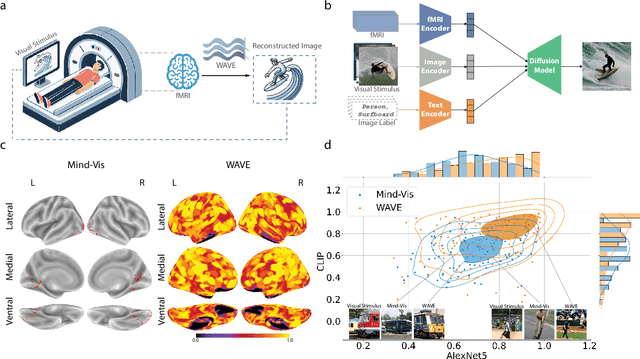



Neural decoding, the process of understanding how brain activity corresponds to different stimuli, has been a primary objective in cognitive sciences. Over the past three decades, advancements in functional Magnetic Resonance Imaging and machine learning have greatly improved our ability to map visual stimuli to brain activity, especially in the visual cortex. Concurrently, research has expanded into decoding more complex processes like language and memory across the whole brain, utilizing techniques to handle greater variability and improve signal accuracy. We argue that "seeing" involves more than just mapping visual stimuli onto the visual cortex; it engages the entire brain, as various emotions and cognitive states can emerge from observing different scenes. In this paper, we develop algorithms to enhance our understanding of visual processes by incorporating whole-brain activation maps while individuals are exposed to visual stimuli. We utilize large-scale fMRI encoders and Image generative models pre-trained on large public datasets, which are then fine-tuned through Image-fMRI contrastive learning. Our models hence can decode visual experience across the entire cerebral cortex, surpassing the traditional confines of the visual cortex. We first compare our method with state-of-the-art approaches to decoding visual processing and show improved predictive semantic accuracy by 43%. A network ablation analysis suggests that beyond the visual cortex, the default mode network contributes most to decoding stimuli, in line with the proposed role of this network in sense-making and semantic processing. Additionally, we implemented zero-shot imagination decoding on an extra validation dataset, achieving a p-value of 0.0206 for mapping the reconstructed images and ground-truth text stimuli, which substantiates the model's capability to capture semantic meanings across various scenarios.