 Add to Chrome
 Add to Firefox
 Add to Edge
Provably avoiding over-optimization in Direct Preference Optimization without knowing the data distribution
Feb 05, 2026
We introduce PEPO (Pessimistic Ensemble based Preference Optimization), a single-step Direct Preference Optimization (DPO)-like algorithm to mitigate the well-known over-optimization issue in preference learning without requiring the knowledge of the data-generating distribution or learning an explicit reward model. PEPO achieves pessimism via an ensemble of preference-optimized policies trained on disjoint data subsets and then aggregates them through a worst case construction that favors the agreement across models. In the tabular setting, PEPO achieves sample complexity guarantees depending only on a single-policy concentrability coefficient, thus avoiding the all-policy concentrability which affects the guarantees of algorithms prone to over-optimization, such as DPO. The theoretical findings are corroborated by a convincing practical performance, while retaining the simplicity and the practicality of DPO-style training.

Carrot, stick, or both? Price incentives for sustainable food choice in competitive environments
Dec 15, 2025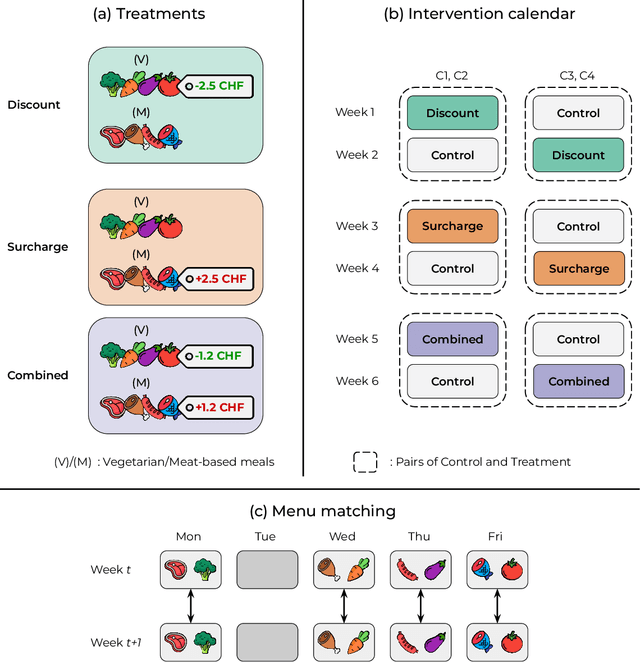
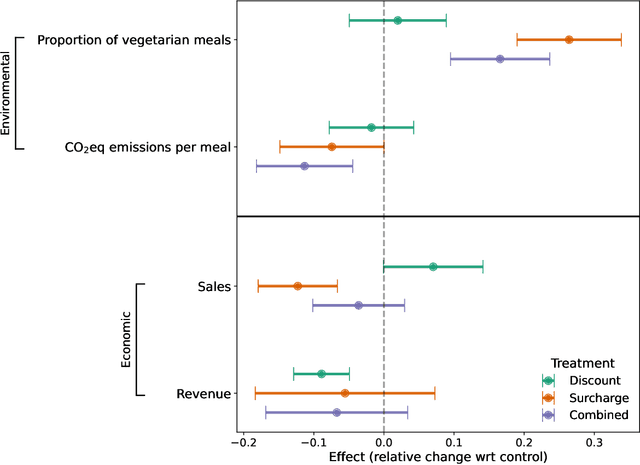
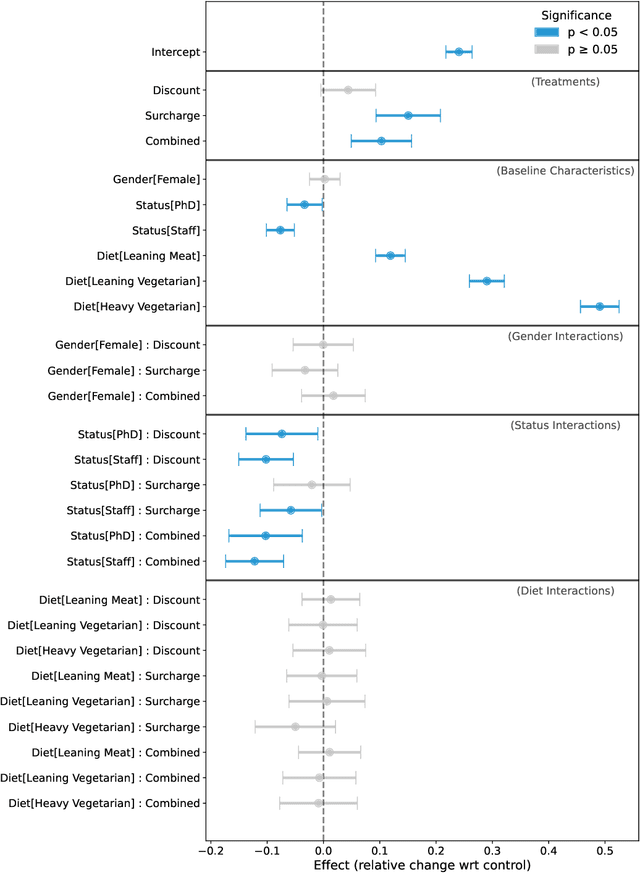
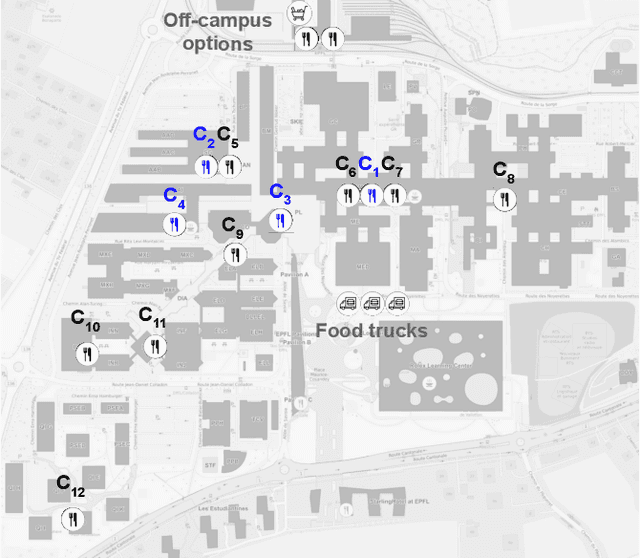
Meat consumption is a major driver of global greenhouse gas emissions. While pricing interventions have shown potential to reduce meat intake, previous studies have focused on highly constrained environments with limited consumer choice. Here, we present the first large-scale field experiment to evaluate multiple pricing interventions in a real-world, competitive setting. Using a sequential crossover design with matched menus in a Swiss university campus, we systematically compared vegetarian-meal discounts (-2.5 CHF), meat surcharges (+2.5 CHF), and a combined scheme (-1.2 CHF=+1.2 CHF) across four campus cafeterias. Only the surcharge and combined interventions led to significant increases in vegetarian meal uptake--by 26.4% and 16.6%, respectively--and reduced CO2 emissions per meal by 7.4% and 11.3%, respectively. The surcharge, while effective, triggered a 12.3% drop in sales at intervention sites and a corresponding 14.9% increase in non-treated locations, hence causing a spillover effect that completely offset environmental gains. In contrast, the combined approach achieved meaningful emission reductions without significant effects on overall sales or revenue, making it both effective and economically viable. Notably, pricing interventions were equally effective for both vegetarian-leaning customers and habitual meat-eaters, stimulating change even within entrenched dietary habits. Our results show that balanced pricing strategies can reduce the carbon footprint of realistic food environments, but require coordinated implementation to maximize climate benefits and avoid unintended spillover effects.