 Add to Chrome
 Add to Firefox
 Add to Edge
PC-MIL: Decoupling Feature Resolution from Supervision Scale in Whole-Slide Learning
Apr 13, 2026
Whole-slide image (WSI) classification in computational pathology is commonly formulated as slide-level Multiple Instance Learning (MIL) with a single global bag representation. However, slide-level MIL is fundamentally underconstrained: optimizing only global labels encourages models to aggregate features without learning anatomically meaningful localization. This creates a mismatch between the scale of supervision and the scale of clinical reasoning. Clinicians assess tumor burden, focal lesions, and architectural patterns within millimeter-scale regions, whereas standard MIL is trained only to predict whether "somewhere in the slide there is cancer." As a result, the model's inductive bias effectively erases anatomical structure. We propose Progressive-Context MIL (PC-MIL), a framework that treats the spatial extent of supervision as a first-class design dimension. Rather than altering magnification, patch size, or introducing pixel-level segmentation, we decouple feature resolution from supervision scale. Using fixed 20x features, we vary MIL bag extent in millimeter units and anchor supervision at a clinically motivated 2mm scale to preserve comparable tumor burden and avoid confounding scale with lesion density. PC-MIL progressively mixes slide- and region-level supervision in controlled proportions, enabling explicit train-context x test-context analysis. On 1,476 prostate WSIs from five public datasets for binary cancer detection, we show that anatomical context is an independent axis of generalization in MIL, orthogonal to feature resolution: modest regional supervision improves cross-context performance, and balanced multi-context training stabilizes accuracy across slide and regional evaluation without sacrificing global performance. These results demonstrate that supervision extent shapes MIL inductive bias and support anatomically grounded WSI generalization.

SIMPLER: H&E-Informed Representation Learning for Structured Illumination Microscopy
Apr 11, 2026Structured Illumination Microscopy (SIM) enables rapid, high-contrast optical sectioning of fresh tissue without staining or physical sectioning, making it promising for intraoperative and point-of-care diagnostics. Recent foundation and large-scale self-supervised models in digital pathology have demonstrated strong performance on section-based modalities such as Hematoxylin and Eosin (H&E) and immunohistochemistry (IHC). However, these approaches are predominantly trained on thin tissue sections and do not explicitly address thick-tissue fluorescence modalities such as SIM. When transferred directly to SIM, performance is constrained by substantial modality shift, and naive fine-tuning often overfits to modality-specific appearance rather than underlying histological structure. We introduce SIMPLER (Structured Illumination Microscopy-Powered Learning for Embedding Representations), a cross-modality self-supervised pretraining framework that leverages H&E as a semantic anchor to learn reusable SIM representations. H&E encodes rich cellular and glandular structure aligned with established clinical annotations, while SIM provides rapid, nondestructive imaging of fresh tissue. During pretraining, SIM and H&E are progressively aligned through adversarial, contrastive, and reconstruction-based objectives, encouraging SIM embeddings to internalize histological structure from H&E without collapsing modality-specific characteristics. A single pretrained SIMPLER encoder transfers across multiple downstream tasks, including multiple instance learning and morphological clustering, consistently outperforming SIM models trained from scratch or H&E-only pretraining. Importantly, joint alignment enhances SIM performance without degrading H&E representations, demonstrating asymmetric enrichment rather
EfficientMorph: Parameter-Efficient Transformer-Based Architecture for 3D Image Registration
Mar 16, 2024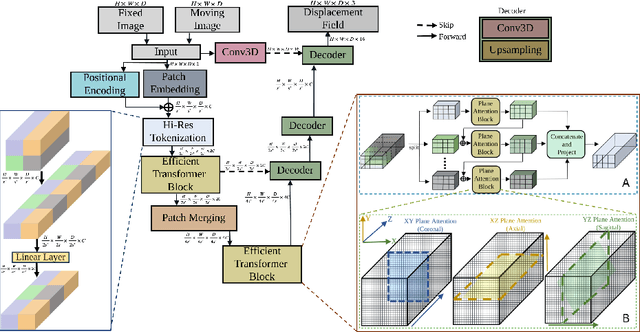
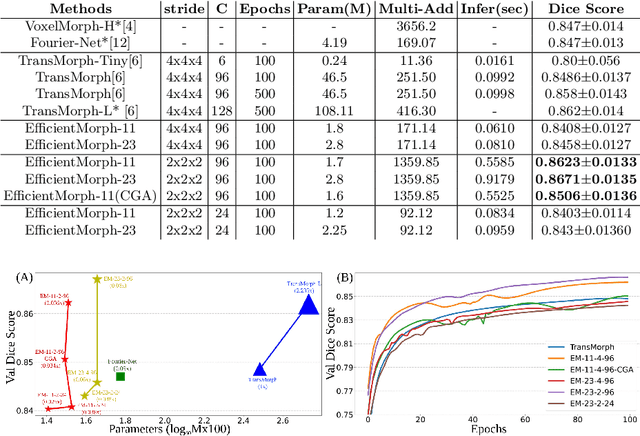
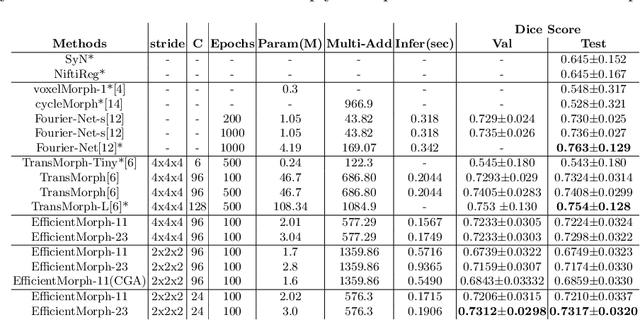
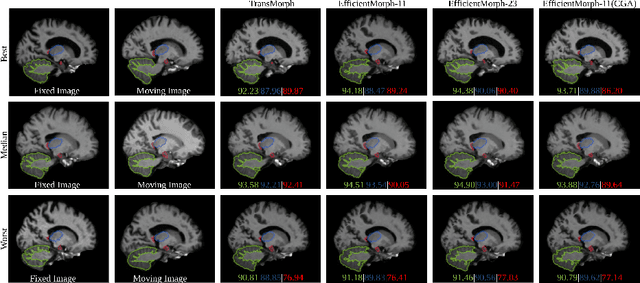
Transformers have emerged as the state-of-the-art architecture in medical image registration, outperforming convolutional neural networks (CNNs) by addressing their limited receptive fields and overcoming gradient instability in deeper models. Despite their success, transformer-based models require substantial resources for training, including data, memory, and computational power, which may restrict their applicability for end users with limited resources. In particular, existing transformer-based 3D image registration architectures face three critical gaps that challenge their efficiency and effectiveness. Firstly, while mitigating the quadratic complexity of full attention by focusing on local regions, window-based attention mechanisms often fail to adequately integrate local and global information. Secondly, feature similarities across attention heads that were recently found in multi-head attention architectures indicate a significant computational redundancy, suggesting that the capacity of the network could be better utilized to enhance performance. Lastly, the granularity of tokenization, a key factor in registration accuracy, presents a trade-off; smaller tokens improve detail capture at the cost of higher computational complexity, increased memory demands, and a risk of overfitting. Here, we propose EfficientMorph, a transformer-based architecture for unsupervised 3D image registration. It optimizes the balance between local and global attention through a plane-based attention mechanism, reduces computational redundancy via cascaded group attention, and captures fine details without compromising computational efficiency, thanks to a Hi-Res tokenization strategy complemented by merging operations. Notably, EfficientMorph sets a new benchmark for performance on the OASIS dataset with 16-27x fewer parameters.
Progressive DeepSSM: Training Methodology for Image-To-Shape Deep Models
Oct 02, 2023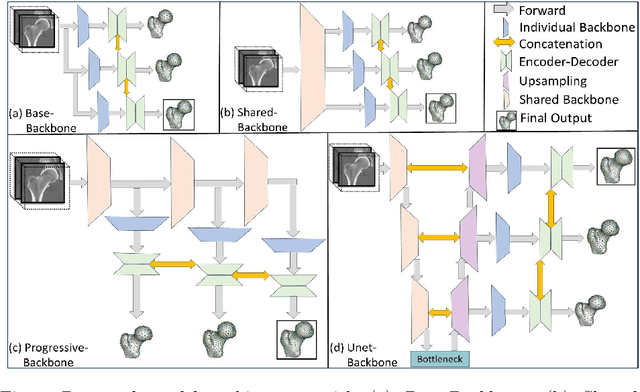
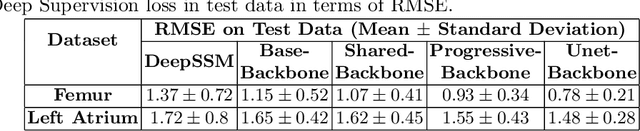
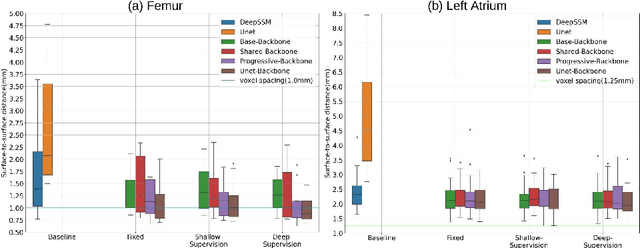

Statistical shape modeling (SSM) is an enabling quantitative tool to study anatomical shapes in various medical applications. However, directly using 3D images in these applications still has a long way to go. Recent deep learning methods have paved the way for reducing the substantial preprocessing steps to construct SSMs directly from unsegmented images. Nevertheless, the performance of these models is not up to the mark. Inspired by multiscale/multiresolution learning, we propose a new training strategy, progressive DeepSSM, to train image-to-shape deep learning models. The training is performed in multiple scales, and each scale utilizes the output from the previous scale. This strategy enables the model to learn coarse shape features in the first scales and gradually learn detailed fine shape features in the later scales. We leverage shape priors via segmentation-guided multi-task learning and employ deep supervision loss to ensure learning at each scale. Experiments show the superiority of models trained by the proposed strategy from both quantitative and qualitative perspectives. This training methodology can be employed to improve the stability and accuracy of any deep learning method for inferring statistical representations of anatomies from medical images and can be adopted by existing deep learning methods to improve model accuracy and training stability.