 Add to Chrome
 Add to Firefox
 Add to Edge
Vision-Guided Iterative Refinement for Frontend Code Generation
Apr 07, 2026
Code generation with large language models often relies on multi-stage human-in-the-loop refinement, which is effective but very costly - particularly in domains such as frontend web development where the solution quality depends on rendered visual output. We present a fully automated critic-in-the-loop framework in which a vision-language model serves as a visual critic that provides structured feedback on rendered webpages to guide iterative refinement of generated code. Across real-world user requests from the WebDev Arena dataset, this approach yields consistent improvements in solution quality, achieving up to 17.8% increase in performance over three refinement cycles. Next, we investigate parameter-efficient fine-tuning using LoRA to understand whether the improvements provided by the critic can be internalized by the code-generating LLM. Fine-tuning achieves 25% of the gains from the best critic-in-the-loop solution without a significant increase in token counts. Our findings indicate that automated, VLM-based critique of frontend code generation leads to significantly higher quality solutions than can be achieved through a single LLM inference pass, and highlight the importance of iterative refinement for the complex visual outputs associated with web development.

Demand Prediction and Placement Optimization for Electric Vehicle Charging Stations
Jul 13, 2016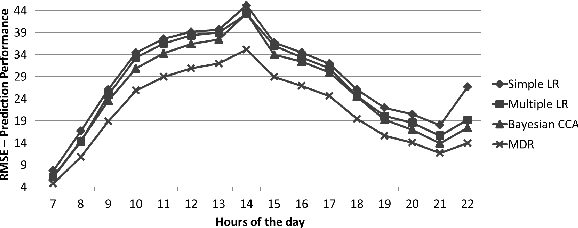

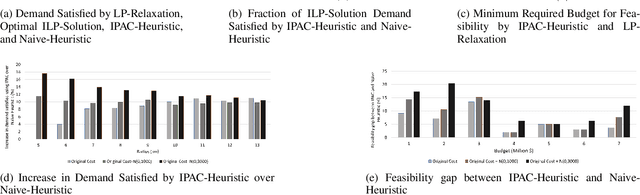
Effective placement of charging stations plays a key role in Electric Vehicle (EV) adoption. In the placement problem, given a set of candidate sites, an optimal subset needs to be selected with respect to the concerns of both (a) the charging station service provider, such as the demand at the candidate sites and the budget for deployment, and (b) the EV user, such as charging station reachability and short waiting times at the station. This work addresses these concerns, making the following three novel contributions: (i) a supervised multi-view learning framework using Canonical Correlation Analysis (CCA) for demand prediction at candidate sites, using multiple datasets such as points of interest information, traffic density, and the historical usage at existing charging stations; (ii) a mixed-packing-and- covering optimization framework that models competing concerns of the service provider and EV users; (iii) an iterative heuristic to solve these problems by alternately invoking knapsack and set cover algorithms. The performance of the demand prediction model and the placement optimization heuristic are evaluated using real world data.
Probabilistic Dependency Networks for Prediction and Diagnostics
Aug 13, 2015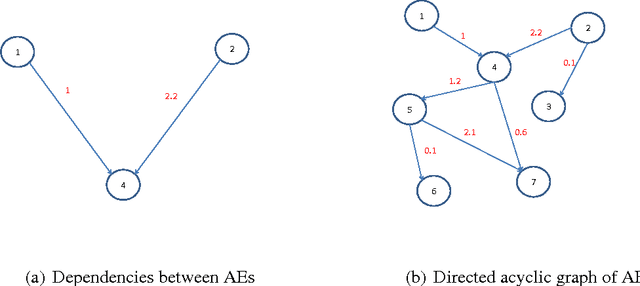
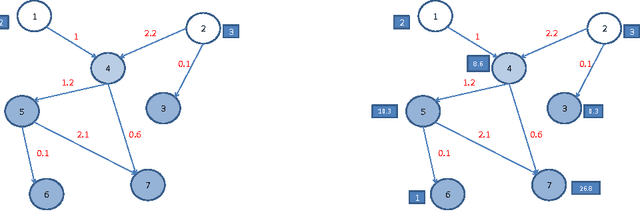
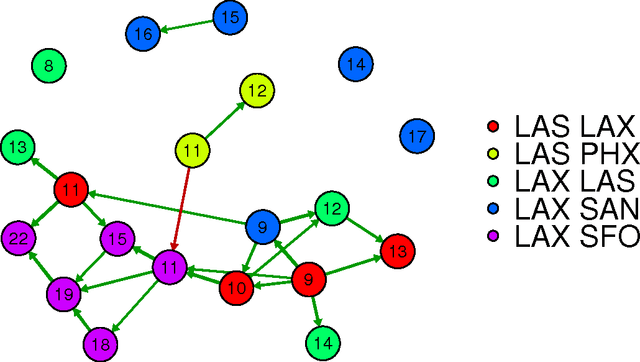
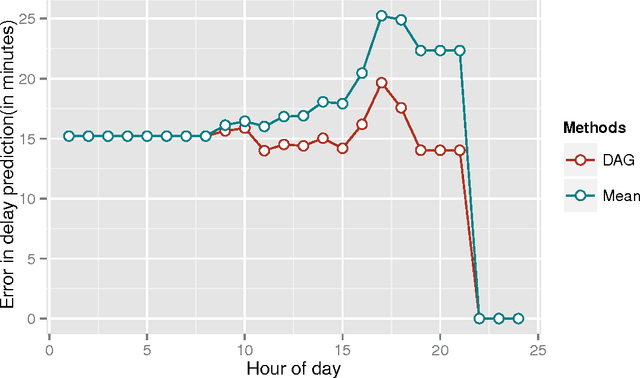
Research in transportation frequently involve modelling and predicting attributes of events that occur at regular intervals. The event could be arrival of a bus at a bus stop, the volume of a traffic at a particular point, the demand at a particular bus stop etc. In this work, we propose a specific implementation of probabilistic graphical models to learn the probabilistic dependency between the events that occur in a network. A dependency graph is built from the past observed instances of the event and we use the graph to understand the causal effects of some events on others in the system. The dependency graph is also used to predict the attributes of future events and is shown to have a good prediction accuracy compared to the state of the art.
Group-sparse Embeddings in Collective Matrix Factorization
Feb 18, 2014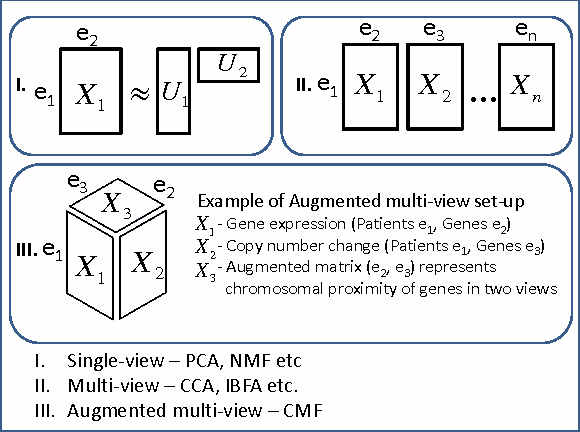
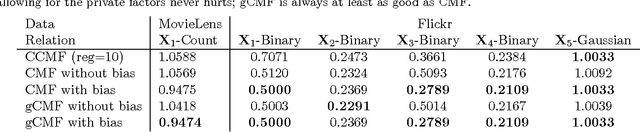
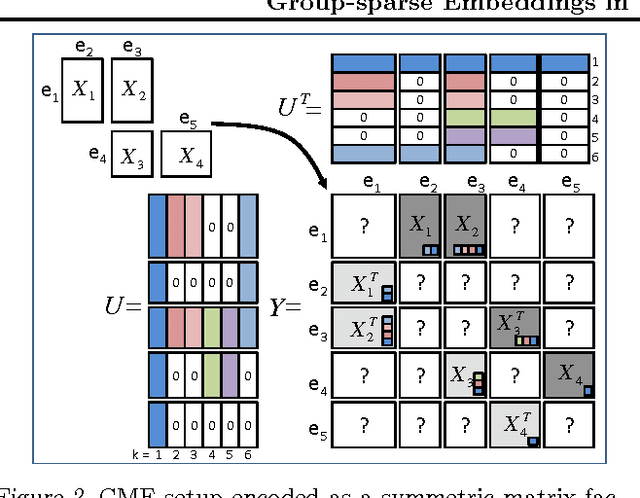
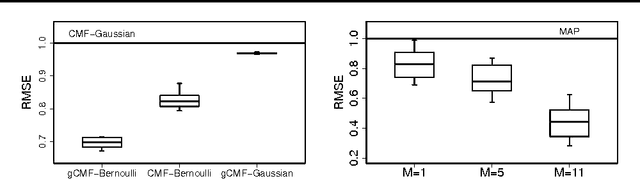
CMF is a technique for simultaneously learning low-rank representations based on a collection of matrices with shared entities. A typical example is the joint modeling of user-item, item-property, and user-feature matrices in a recommender system. The key idea in CMF is that the embeddings are shared across the matrices, which enables transferring information between them. The existing solutions, however, break down when the individual matrices have low-rank structure not shared with others. In this work we present a novel CMF solution that allows each of the matrices to have a separate low-rank structure that is independent of the other matrices, as well as structures that are shared only by a subset of them. We compare MAP and variational Bayesian solutions based on alternating optimization algorithms and show that the model automatically infers the nature of each factor using group-wise sparsity. Our approach supports in a principled way continuous, binary and count observations and is efficient for sparse matrices involving missing data. We illustrate the solution on a number of examples, focusing in particular on an interesting use-case of augmented multi-view learning.