 Add to Chrome
 Add to Firefox
 Add to Edge
LiNC: Lightweight Noise Correction via Per-Sample Trust and Gaussian Mixture Modeling
Aug 04, 2026
Label noise is common in medical imaging datasets due to factors such as inter-rater variability, annotation errors, and ambiguous cases. This can severely undermine the reliability and clinical effectiveness of machine learning models trained using those datasets. To address this challenge, we introduce Lightweight Noise Correction (LiNC), which adds a single trainable trust parameter per training sample and learns when to use the observed label and when to defer to the model during a standard training loop. The key idea is to train using a convex combination of the observed label and the model's own predictive distribution, controlled by a per-sample trust parameter. We show that the gradient of this objective drives trust values in opposite directions for clean versus noisy samples in the early training phase, yielding separable trust distributions. We use a 3-component Gaussian Mixture Model over the trust values to separate them into clean, ambiguous, and noisy cases and then execute a short soft-correction phase on the noisy cases and a final hard correction phase. Experiments on ten 2D datasets from MedMNISTv2 under label noise of up to 50% show consistent gains in accuracy and strong mislabel detection. LiNC adds negligible asymptotic overhead: the training-time complexity remains dominated by the base network, with additional memory growing linearly with the size of the training set.

Socially Grounded Agentic AI: Coordinating Plural Perspectives through Social Theory
Aug 04, 2026As AI systems are deployed across increasingly diverse social contexts, alignment can no longer be framed as the optimization of a single, unified set of values. Instead, systems must be able to recognize, represent, and respond to multiple legitimate perspectives. This has led to growing interest in pluralistic alignment, which seeks to move beyond one-size-fits-all models of appropriate behaviour. However, current approaches often lack a clear account of how values are socially organized, contested, and coordinated in practice. In this paper, we argue that social theory provides essential conceptual and design resources for addressing these challenges. Drawing on established traditions in sociology, we show how perspectives can be understood as structured by roles, shaped through interaction, and distributed across fields of power and expertise. We translate these insights into concrete implications for AI system design, including role-based representations, structured coordination among perspectives, and context-sensitive evaluation. For agentic systems, this requires aligning not only final outputs, but also the role activations, deliberative traces, aggregation rules, and feedback loops through which those outputs are produced. Our contribution is to reposition pluralistic alignment as a problem of socially grounded coordination rather than output diversification. We outline a design space for systems that engage multiple perspectives in structured and accountable ways, and we identify directions for future work to implement and empirically evaluate these approaches in real-world settings.
When Does RL Help Medical VLMs? Disentangling Vision, SFT, and RL Gains
Mar 01, 2026Reinforcement learning (RL) is increasingly used to post-train medical Vision-Language Models (VLMs), yet it remains unclear whether RL improves medical visual reasoning or mainly sharpens behaviors already induced by supervised fine-tuning (SFT). We present a controlled study that disentangles these effects along three axes: vision, SFT, and RL. Using MedMNIST as a multi-modality testbed, we probe visual perception by benchmarking VLM vision towers against vision-only baselines, quantify reasoning support and sampling efficiency via Accuracy@1 versus Pass@K, and evaluate when RL closes the support gap and how gains transfer across modalities. We find that RL is most effective when the model already has non-trivial support (high Pass@K): it primarily sharpens the output distribution, improving Acc@1 and sampling efficiency, while SFT expands support and makes RL effective. Based on these findings, we propose a boundary-aware recipe and instantiate it by RL post-training an OctoMed-initialized model on a small, balanced subset of PMC multiple-choice VQA, achieving strong average performance across six medical VQA benchmarks.
3D Reasoning for Unsupervised Anomaly Detection in Pediatric WbMRI
Mar 24, 2021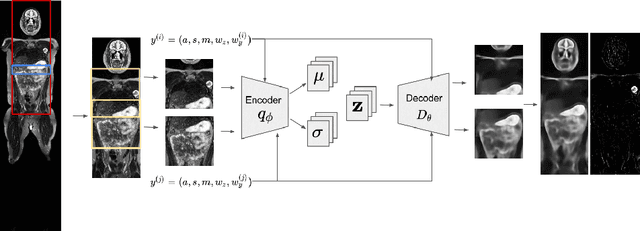
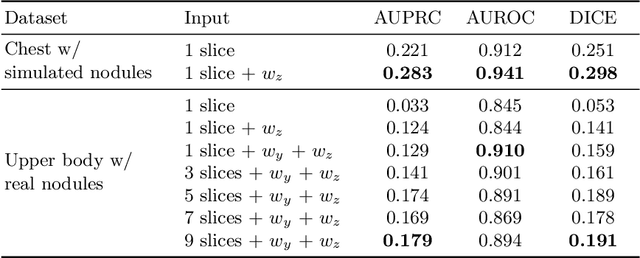
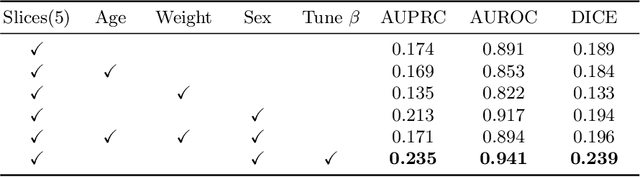
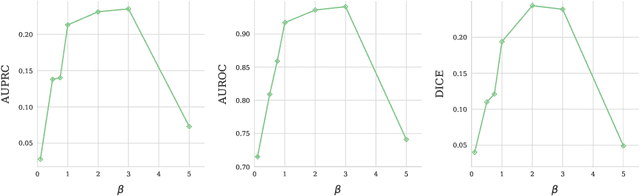
Modern deep unsupervised learning methods have shown great promise for detecting diseases across a variety of medical imaging modalities. While previous generative modeling approaches successfully perform anomaly detection by learning the distribution of healthy 2D image slices, they process such slices independently and ignore the fact that they are correlated, all being sampled from a 3D volume. We show that incorporating the 3D context and processing whole-body MRI volumes is beneficial to distinguishing anomalies from their benign counterparts. In our work, we introduce a multi-channel sliding window generative model to perform lesion detection in whole-body MRI (wbMRI). Our experiments demonstrate that our proposed method significantly outperforms processing individual images in isolation and our ablations clearly show the importance of 3D reasoning. Moreover, our work also shows that it is beneficial to include additional patient-specific features to further improve anomaly detection in pediatric scans.
Unobtrusive Pain Monitoring in Older Adults with Dementia using Pairwise and Contrastive Training
Jan 08, 2021
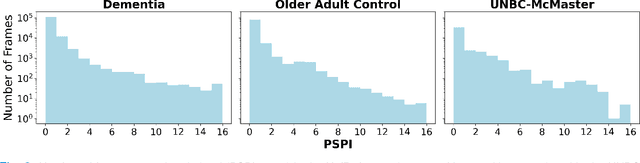
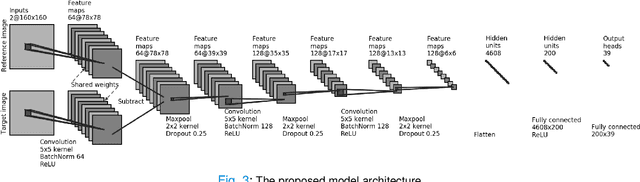
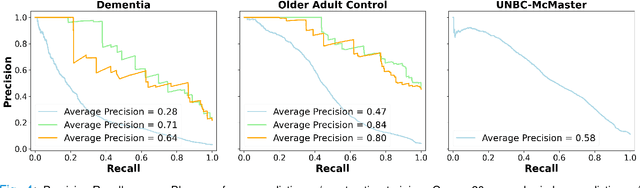
Although pain is frequent in old age, older adults are often undertreated for pain. This is especially the case for long-term care residents with moderate to severe dementia who cannot report their pain because of cognitive impairments that accompany dementia. Nursing staff acknowledge the challenges of effectively recognizing and managing pain in long-term care facilities due to lack of human resources and, sometimes, expertise to use validated pain assessment approaches on a regular basis. Vision-based ambient monitoring will allow for frequent automated assessments so care staff could be automatically notified when signs of pain are displayed. However, existing computer vision techniques for pain detection are not validated on faces of older adults or people with dementia, and this population is not represented in existing facial expression datasets of pain. We present the first fully automated vision-based technique validated on a dementia cohort. Our contributions are threefold. First, we develop a deep learning-based computer vision system for detecting painful facial expressions on a video dataset that is collected unobtrusively from older adult participants with and without dementia. Second, we introduce a pairwise comparative inference method that calibrates to each person and is sensitive to changes in facial expression while using training data more efficiently than sequence models. Third, we introduce a fast contrastive training method that improves cross-dataset performance. Our pain estimation model outperforms baselines by a wide margin, especially when evaluated on faces of people with dementia. Pre-trained model and demo code available at https://github.com/TaatiTeam/pain_detection_demo
Using Generative Models for Pediatric wbMRI
Jun 01, 2020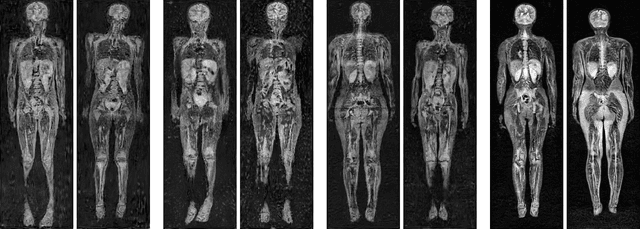
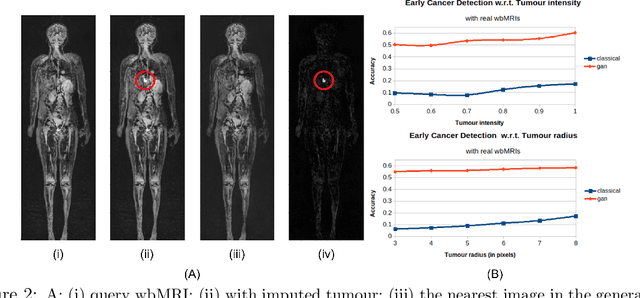
Early detection of cancer is key to a good prognosis and requires frequent testing, especially in pediatrics. Whole-body magnetic resonance imaging (wbMRI) is an essential part of several well-established screening protocols, with screening starting in early childhood. To date, machine learning (ML) has been used on wbMRI images to stage adult cancer patients. It is not possible to use such tools in pediatrics due to the changing bone signal throughout growth, the difficulty of obtaining these images in young children due to movement and limited compliance, and the rarity of positive cases. We evaluate the quality of wbMRI images generated using generative adversarial networks (GANs) trained on wbMRI data from The Hospital for Sick Children in Toronto. We use the Frchet Inception Distance (FID) metric, Domain Frchet Distance (DFD), and blind tests with a radiology fellow for evaluation. We demonstrate that StyleGAN2 provides the best performance in generating wbMRI images with respect to all three metrics.