 Add to Chrome
 Add to Firefox
 Add to Edge
Admissibility-Preserving Control for Strict-Feedback Nonlinear Systems with Asymmetric Actuator Constraints
Aug 15, 2026
This paper develops Admissibility-Preserving Control (APC), a realization-centered safety-critical control framework for strict-feedback systems subject to asymmetric actuator limits, time-varying output constraints, and actuator-rate limitations. APC denotes the overall control architecture, whereas an Admissibility-Preserving Input Realization (APIR) denotes its constraint-realization module. Therein, the APIR dynamically generates the physical plant input while rendering its prescribed asymmetric actuator set forward invariant. In contrast to algebraic clipping and post-design saturation compensation, the actuator limits are embedded directly in a continuously differentiable dynamic realization with user-selectable regularity and interpretable tuning parameters. The APIR is integrated with recursive backstepping by treating the realized plant input as an additional state. The resulting design does not require an input-to-state stability assumption on the uncontrolled plant. Instead, the nonlinear drift terms are compensated recursively, subject to an explicit compatibility condition between the desired motion, the available control authority, and the APIR interior gain. The framework is further extended to time-varying output-safe tracking through a smooth asymmetric logarithmic barrier coordinate and its associated Lyapunov function and to simultaneous actuator-magnitude and rate constraints through a cascaded APIR. Rigorous Lyapunov and invariance analyses establish regional asymptotic tracking, forward invariance of the compatible admissible sets, and boundedness of all closed-loop signals. Numerical studies illustrate asymmetric actuator utilization, output-safety preservation, and magnitude-rate constraint enforcement.

Contact-Persistent Full Actuation for Aerial Physical Interaction
Jul 22, 2026Fully actuated unmanned aerial vehicles (UAVs) are usually certified through rank conditions on a control-allocation matrix or through free-flight tracking performance. For aerial physical interaction, this certification may be incomplete. During sustained contact, part of the available wrench is consumed by the interaction task, and only the residual wrench remains available for stabilization, disturbance rejection, and maneuvering. This paper introduces a control-theoretic framework for \emph{contact-persistent full actuation}. A rigid-body model on $\R^{3}\times\SO\left(3\right)$ is combined with a morphology-dependent wrench map that captures fixed-tilt, variable-tilt, coaxial, and overactuated multirotor architectures. We define feasible wrench sets under actuator limits, residual wrench sets under task loading, and residual authority margins that strengthen the usual rank-based notion of full actuation. The main result shows that contact-persistent full actuation is equivalent to interiority of the task wrench in the constrained feasible wrench polytope, and that the residual authority radius is exactly the distance to the polytope boundary. We further introduce a signed residual-margin certificate for infeasible and boundary cases, a slack-maximizing allocation certificate, and a robust implementability condition that can be used as a margin-aware safety filter. Numerical evaluation on an abstract tilted hexarotor shows that full row rank alone does not imply feasible contact operation. Intermediate tilt angles preserve residual authority during pushing, whereas small or excessive tilts fail because of lateral-force deficiency or hover-margin loss.
Distributed Safe Consensus Under Asymmetric Input and Time-Varying Output Constraints
Jun 15, 2026This paper studies safe distributed consensus for single-integrator multi-agent systems over connected undirected graphs under simultaneous asymmetric actuator constraints and output safety constraints. Each agent is equipped with a continuously differentiable asymmetric actuator dynamics that maps a commanded control signal to the realized plant input while keeping the latter strictly inside a prescribed admissible interval. To address output safety, a barrier-coordinate transformation is introduced over a common time-varying safe interval, and a distributed synchronization law is designed in the transformed coordinates. The resulting controller integrates a graph-based coordination layer with an actuator-side tracking layer, thereby enabling simultaneous enforcement of input admissibility, forward invariance of the safe output set, and asymptotic synchronization. For compact admissible sets of initial conditions, it is shown that the closed-loop solution is complete, all signals remain bounded, the actuator inputs remain strictly within their asymmetric bounds, and the agent outputs remain inside the prescribed safe interval for all time. Moreover, the transformed synchronization errors converge exponentially to zero, and the original agent outputs asymptotically synchronize to a designer-selected admissible trajectory embedded in the common safe interval. Numerical simulations validate the proposed framework and demonstrate safe consensus under both asymmetric actuation bounds and time-varying output constraints.
Terminal Time and Angle-Constrained Nonlinear Intercept Guidance
Jun 01, 2026This paper considers the problem of simultaneously controlling an interceptor's impact time and impact angle using its lateral acceleration as the sole control input. With a single control input, the nonlinear engagement kinematics is inherently underactuated, which complicates guidance law synthesis. To overcome this challenge, a hierarchical sliding mode-based guidance law is developed to concurrently regulate the two terminal constraints. The proposed architecture consists of a two-layer sliding manifold. The first layer comprises two sub-sliding surfaces corresponding to the impact time and impact angle error dynamics, respectively, while the second layer introduces a composite sliding manifold that combines the two individual sub-surfaces. Then, a variable-gain adaptive guidance law is designed to ensure time and angle-constrained interception against a stationary target, which is further extended to intercept a constant velocity target. Simulations are conducted for various engagement scenarios to attest to the efficacy of the proposed approach.
Bounded-Input True Proportional Navigation for Impact-Time Control
May 13, 2026This paper proposes a nonlinear guidance strategy capable of intercepting a constant-velocity, non-maneuvering target while strictly satisfying the prescribed bounds on the control input (commanded acceleration). Unlike conventional strategies that estimate time-to-go using linearization or small-angle approximations, the proposed strategy employs true proportional-navigation guidance (TPNG) as a baseline, which utilizes an exact time-to-go formulation and is applicable over a wide range of target motions. In contrast to most existing strategies, which do not incorporate control input bounds into the guidance design, the proposed approach explicitly accounts for these limits by modeling the interceptor acceleration as a dynamic variable. Based on the sliding mode control technique, an effective guidance law that achieves time-constrained interception while accounting for bounded input is then derived. The performance of the proposed strategy is evaluated for various engagement scenarios.
Engagement-Zone-Aware Input-Constrained Guidance for Safe Target Interception in Contested Environments
Mar 24, 2026We address target interception in contested environments in the presence of multiple defenders whose interception capability is limited by finite ranges. Conventional methods typically impose conservative stand-off constraints based on maximum engagement distance and neglect the interceptors' actuator limitations. Instead, we formulate safety constraints using defender-induced engagement zones. To account for actuator limits, the vehicle model is augmented with input saturation dynamics. A time-varying safe-set tightening parameter is introduced to compensate for transient constraint violations induced by actuator dynamics. To ensure scalable safety enforcement in multi-defender scenarios, a smooth aggregate safety function is constructed using a log-sum-exp operator combining individual threat measures associated with each defender's capability. A smooth switching guidance strategy is then developed to coordinate interception and safety objectives. The attacker pursues the target when sufficiently distant from threat boundaries and progressively activates evasive motion as the EZ boundaries are approached. The resulting controller relies only on relative measurements and does not require knowledge of defender control inputs, thus facilitating a fully distributed and scalable implementation. Rigorous analysis provides sufficient conditions guaranteeing target interception, practical safety with respect to all defender engagement zones, and satisfaction of actuator bounds. An input-constrained guidance law based on conservative stand-off distance is also developed to quantify the conservatism of maximum-range-based safety formulations. Simulations with stationary and maneuvering defenders demonstrate that the proposed formulation yields shorter interception paths and reduced interception time compared with conventional methods while maintaining safety throughout the engagement.
Predefined-time One-Shot Cooperative Estimation, Guidance, and Control for Simultaneous Target Interception
Jan 12, 2026This work develops a unified nonlinear estimation-guidance-control framework for cooperative simultaneous interception of a stationary target under a heterogeneous sensing topology, where sensing capabilities are non-uniform across interceptors. Specifically, only a subset of agents is instrumented with onboard seekers (informed/seeker-equipped agents), whereas the rest of them (seeker-less agents) acquire the information about the target indirectly via the informed agents and execute a distributed cooperative guidance for simultaneous target interception. To address the resulting partial observability, a predefined-time distributed observer is leveraged, guaranteeing convergence of the target state estimates for seeker-less agents through information exchange with seeker-equipped neighbors over a directed communication graph. Thereafter, an improved time-to-go estimate accounting for wide launch envelopes is utilized to design the distributed cooperative guidance commands. This estimate is coupled with a predefined-time consensus protocol, ensuring consensus in the agents' time-to-go values. The temporal upper bounds within which both observer error and time-to-go consensus error converge to zero can be prescribed as design parameters. Furthermore, the cooperative guidance commands are realized by means of an autopilot, wherein the interceptor is steered by canard actuation. The corresponding fin deflection commands are generated using a predefined-time convergent sliding mode control law. This enables the autopilot to precisely track the commanded lateral acceleration within a design-specified time, while maintaining non-singularity of the overall design. Theoretical guarantees are supported by numerical simulations across diverse engagement geometries, verifying the estimation accuracy, the cooperative interception performance, and the autopilot response using the proposed scheme.
Cooperative Integrated Estimation-Guidance for Simultaneous Interception of Moving Targets
Oct 30, 2025This paper proposes a cooperative integrated estimation-guidance framework for simultaneous interception of a non-maneuvering target using a team of unmanned autonomous vehicles, assuming only a subset of vehicles are equipped with dedicated sensors to measure the target's states. Unlike earlier approaches that focus solely on either estimation or guidance design, the proposed framework unifies both within a cooperative architecture. To circumvent the limitation posed by heterogeneity in target observability, sensorless vehicles estimate the target's state by leveraging information exchanged with neighboring agents over a directed communication topology through a prescribed-time observer. The proposed approach employs true proportional navigation guidance (TPNG), which uses an exact time-to-go formulation and is applicable across a wide spectrum of target motions. Furthermore, prescribed-time observer and controller are employed to achieve convergence to true target's state and consensus in time-to-go within set predefined times, respectively. Simulations demonstrate the effectiveness of the proposed framework under various engagement scenarios.
Cooperative Guidance for Aerial Defense in Multiagent Systems
Oct 02, 2025This paper addresses a critical aerial defense challenge in contested airspace, involving three autonomous aerial vehicles -- a hostile drone (the pursuer), a high-value drone (the evader), and a protective drone (the defender). We present a cooperative guidance framework for the evader-defender team that guarantees interception of the pursuer before it can capture the evader, even under highly dynamic and uncertain engagement conditions. Unlike traditional heuristic, optimal control, or differential game-based methods, we approach the problem within a time-constrained guidance framework, leveraging true proportional navigation based approach that ensures robust and guaranteed solutions to the aerial defense problem. The proposed strategy is computationally lightweight, scalable to a large number of agent configurations, and does not require knowledge of the pursuer's strategy or control laws. From arbitrary initial geometries, our method guarantees that key engagement errors are driven to zero within a fixed time, leading to a successful mission. Extensive simulations across diverse and adversarial scenarios confirm the effectiveness of the proposed strategy and its relevance for real-time autonomous defense in contested airspace environments.
Nonlinear Cooperative Salvo Guidance with Seeker-Limited Interceptors
Sep 18, 2025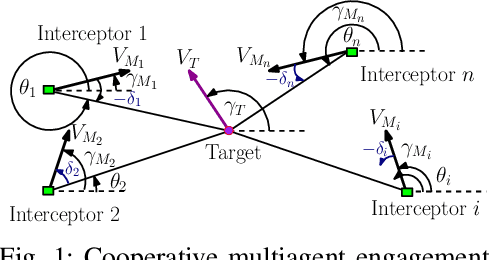
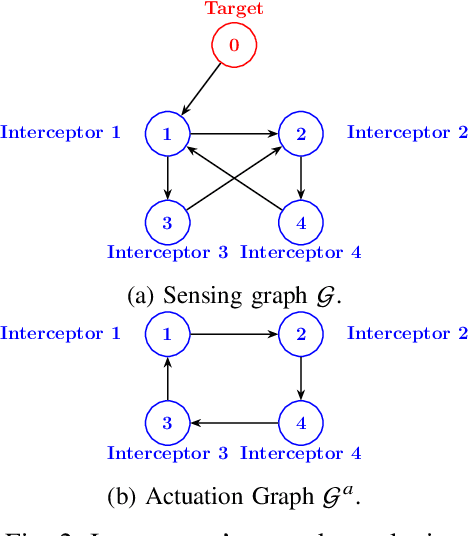
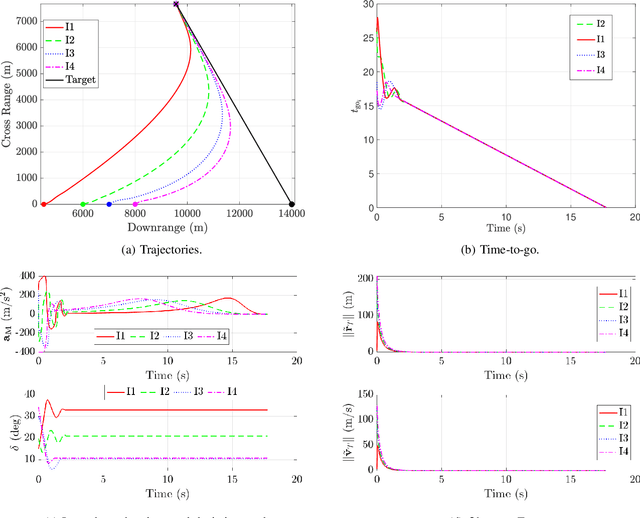
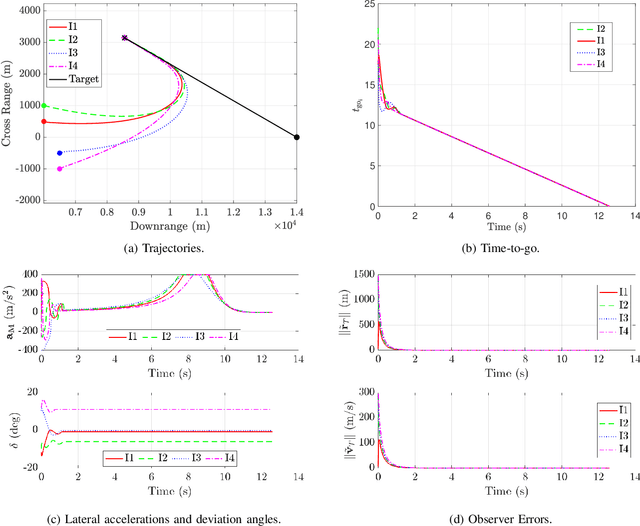
This paper presents a cooperative guidance strategy for the simultaneous interception of a constant-velocity, non-maneuvering target, addressing the realistic scenario where only a subset of interceptors are equipped with onboard seekers. To overcome the resulting heterogeneity in target observability, a fixed-time distributed observer is employed, enabling seeker-less interceptors to estimate the target state using information from seeker-equipped agents and local neighbors over a directed communication topology. Departing from conventional strategies that approximate time-to-go via linearization or small-angle assumptions, the proposed approach leverages deviated pursuit guidance where the time-to-go expression is exact for such a target. Moreover, a higher-order sliding mode consensus protocol is utilized to establish time-to-go consensus within a finite time. The effectiveness of the proposed guidance and estimation architecture is demonstrated through simulations.