 Add to Chrome
 Add to Firefox
 Add to Edge
Bounded-Input True Proportional Navigation for Impact-Time Control
May 13, 2026
This paper proposes a nonlinear guidance strategy capable of intercepting a constant-velocity, non-maneuvering target while strictly satisfying the prescribed bounds on the control input (commanded acceleration). Unlike conventional strategies that estimate time-to-go using linearization or small-angle approximations, the proposed strategy employs true proportional-navigation guidance (TPNG) as a baseline, which utilizes an exact time-to-go formulation and is applicable over a wide range of target motions. In contrast to most existing strategies, which do not incorporate control input bounds into the guidance design, the proposed approach explicitly accounts for these limits by modeling the interceptor acceleration as a dynamic variable. Based on the sliding mode control technique, an effective guidance law that achieves time-constrained interception while accounting for bounded input is then derived. The performance of the proposed strategy is evaluated for various engagement scenarios.

Predefined-time One-Shot Cooperative Estimation, Guidance, and Control for Simultaneous Target Interception
Jan 12, 2026This work develops a unified nonlinear estimation-guidance-control framework for cooperative simultaneous interception of a stationary target under a heterogeneous sensing topology, where sensing capabilities are non-uniform across interceptors. Specifically, only a subset of agents is instrumented with onboard seekers (informed/seeker-equipped agents), whereas the rest of them (seeker-less agents) acquire the information about the target indirectly via the informed agents and execute a distributed cooperative guidance for simultaneous target interception. To address the resulting partial observability, a predefined-time distributed observer is leveraged, guaranteeing convergence of the target state estimates for seeker-less agents through information exchange with seeker-equipped neighbors over a directed communication graph. Thereafter, an improved time-to-go estimate accounting for wide launch envelopes is utilized to design the distributed cooperative guidance commands. This estimate is coupled with a predefined-time consensus protocol, ensuring consensus in the agents' time-to-go values. The temporal upper bounds within which both observer error and time-to-go consensus error converge to zero can be prescribed as design parameters. Furthermore, the cooperative guidance commands are realized by means of an autopilot, wherein the interceptor is steered by canard actuation. The corresponding fin deflection commands are generated using a predefined-time convergent sliding mode control law. This enables the autopilot to precisely track the commanded lateral acceleration within a design-specified time, while maintaining non-singularity of the overall design. Theoretical guarantees are supported by numerical simulations across diverse engagement geometries, verifying the estimation accuracy, the cooperative interception performance, and the autopilot response using the proposed scheme.
Cooperative Integrated Estimation-Guidance for Simultaneous Interception of Moving Targets
Oct 30, 2025This paper proposes a cooperative integrated estimation-guidance framework for simultaneous interception of a non-maneuvering target using a team of unmanned autonomous vehicles, assuming only a subset of vehicles are equipped with dedicated sensors to measure the target's states. Unlike earlier approaches that focus solely on either estimation or guidance design, the proposed framework unifies both within a cooperative architecture. To circumvent the limitation posed by heterogeneity in target observability, sensorless vehicles estimate the target's state by leveraging information exchanged with neighboring agents over a directed communication topology through a prescribed-time observer. The proposed approach employs true proportional navigation guidance (TPNG), which uses an exact time-to-go formulation and is applicable across a wide spectrum of target motions. Furthermore, prescribed-time observer and controller are employed to achieve convergence to true target's state and consensus in time-to-go within set predefined times, respectively. Simulations demonstrate the effectiveness of the proposed framework under various engagement scenarios.
Nonlinear Cooperative Salvo Guidance with Seeker-Limited Interceptors
Sep 18, 2025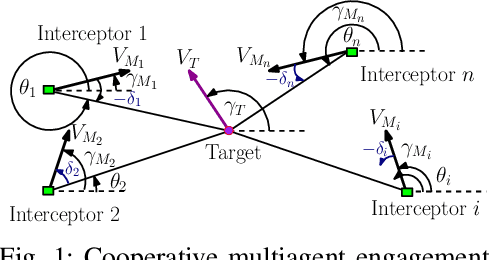
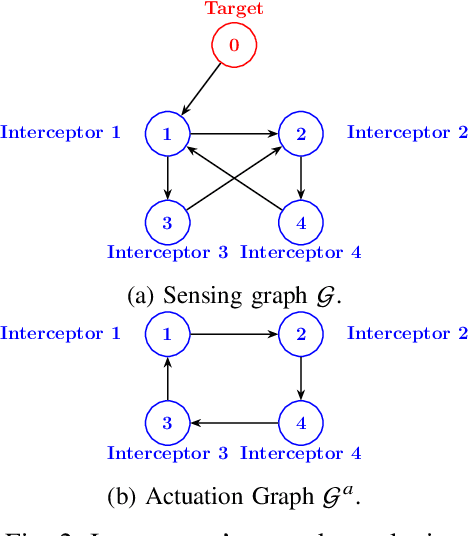
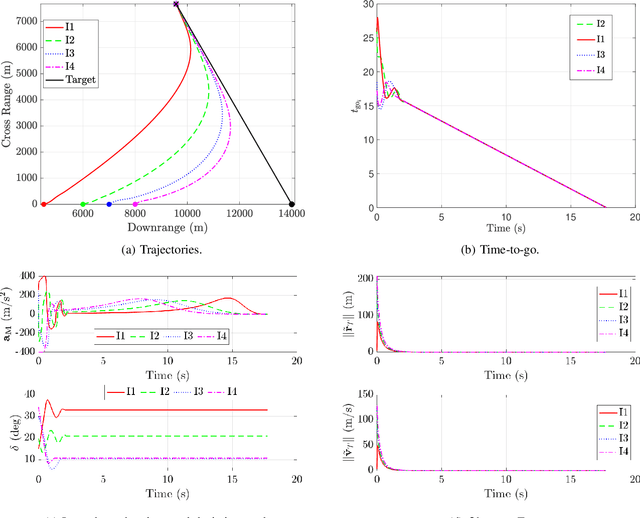
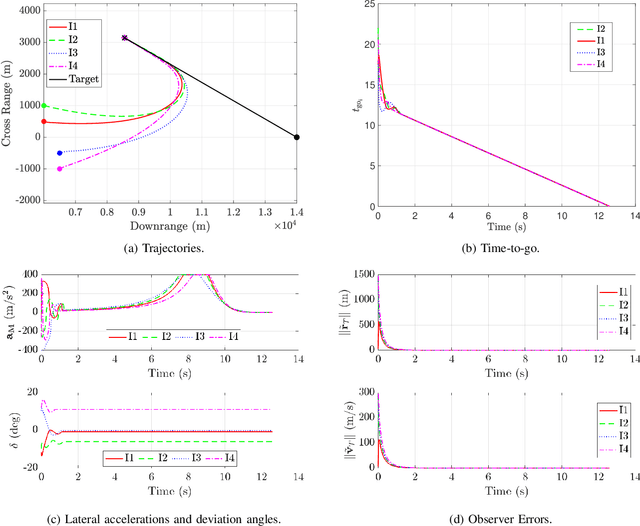
This paper presents a cooperative guidance strategy for the simultaneous interception of a constant-velocity, non-maneuvering target, addressing the realistic scenario where only a subset of interceptors are equipped with onboard seekers. To overcome the resulting heterogeneity in target observability, a fixed-time distributed observer is employed, enabling seeker-less interceptors to estimate the target state using information from seeker-equipped agents and local neighbors over a directed communication topology. Departing from conventional strategies that approximate time-to-go via linearization or small-angle assumptions, the proposed approach leverages deviated pursuit guidance where the time-to-go expression is exact for such a target. Moreover, a higher-order sliding mode consensus protocol is utilized to establish time-to-go consensus within a finite time. The effectiveness of the proposed guidance and estimation architecture is demonstrated through simulations.