 Add to Chrome
 Add to Firefox
 Add to Edge
Engagement-Zone-Aware Input-Constrained Guidance for Safe Target Interception in Contested Environments
Mar 24, 2026
We address target interception in contested environments in the presence of multiple defenders whose interception capability is limited by finite ranges. Conventional methods typically impose conservative stand-off constraints based on maximum engagement distance and neglect the interceptors' actuator limitations. Instead, we formulate safety constraints using defender-induced engagement zones. To account for actuator limits, the vehicle model is augmented with input saturation dynamics. A time-varying safe-set tightening parameter is introduced to compensate for transient constraint violations induced by actuator dynamics. To ensure scalable safety enforcement in multi-defender scenarios, a smooth aggregate safety function is constructed using a log-sum-exp operator combining individual threat measures associated with each defender's capability. A smooth switching guidance strategy is then developed to coordinate interception and safety objectives. The attacker pursues the target when sufficiently distant from threat boundaries and progressively activates evasive motion as the EZ boundaries are approached. The resulting controller relies only on relative measurements and does not require knowledge of defender control inputs, thus facilitating a fully distributed and scalable implementation. Rigorous analysis provides sufficient conditions guaranteeing target interception, practical safety with respect to all defender engagement zones, and satisfaction of actuator bounds. An input-constrained guidance law based on conservative stand-off distance is also developed to quantify the conservatism of maximum-range-based safety formulations. Simulations with stationary and maneuvering defenders demonstrate that the proposed formulation yields shorter interception paths and reduced interception time compared with conventional methods while maintaining safety throughout the engagement.

3D Guidance Law for Maximal Coverage and Target Enclosing with Inherent Safety
Apr 25, 2024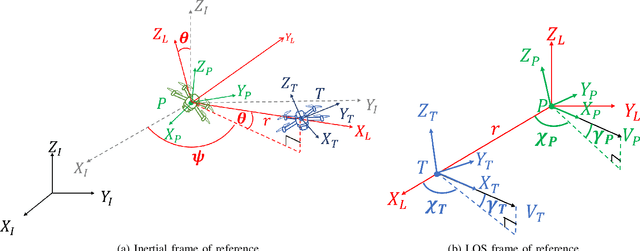
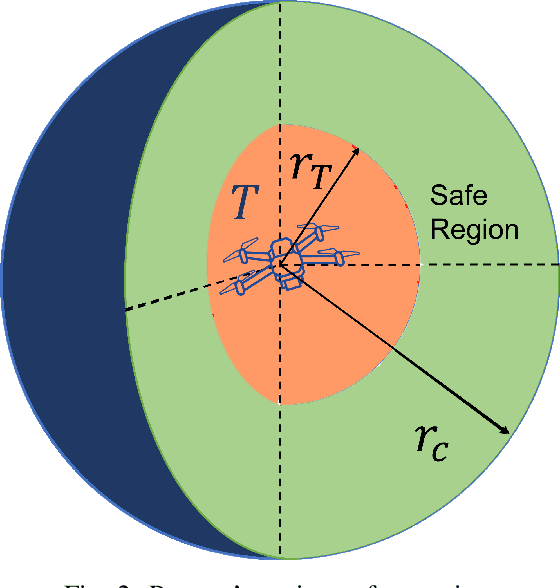
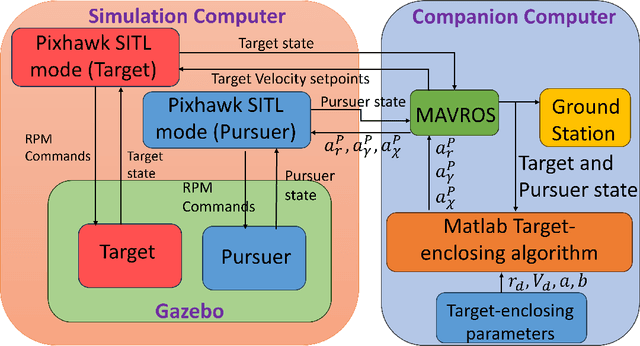
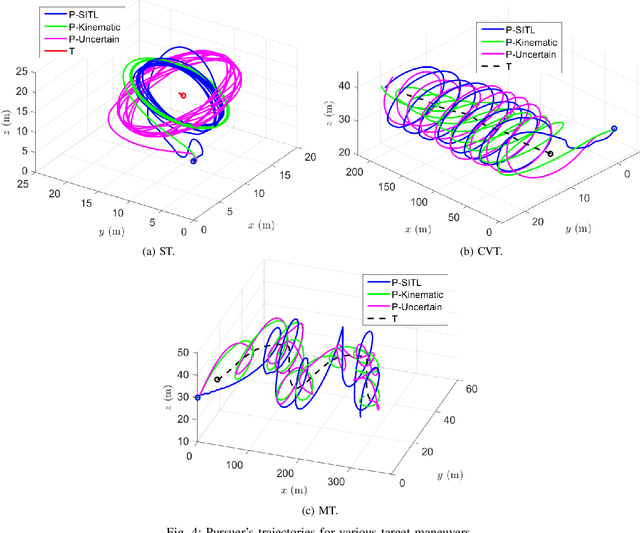
In this paper, we address the problem of enclosing an arbitrarily moving target in three dimensions by a single pursuer, which is an unmanned aerial vehicle (UAV), for maximum coverage while also ensuring the pursuer's safety by preventing collisions with the target. The proposed guidance strategy steers the pursuer to a safe region of space surrounding the target, allowing it to maintain a certain distance from the latter while offering greater flexibility in positioning and converging to any orbit within this safe zone. Our approach is distinguished by the use of nonholonomic constraints to model vehicles with accelerations serving as control inputs and coupled engagement kinematics to craft the pursuer's guidance law meticulously. Furthermore, we leverage the concept of the Lyapunov Barrier Function as a powerful tool to constrain the distance between the pursuer and the target within asymmetric bounds, thereby ensuring the pursuer's safety within the predefined region. To validate the efficacy and robustness of our algorithm, we conduct experimental tests by implementing a high-fidelity quadrotor model within Software-in-the-loop (SITL) simulations, encompassing various challenging target maneuver scenarios. The results obtained showcase the resilience of the proposed guidance law, effectively handling arbitrarily maneuvering targets, vehicle/autopilot dynamics, and external disturbances. Our method consistently delivers stable global enclosing behaviors, even in response to aggressive target maneuvers, and requires only relative information for successful execution.
Self-organizing Multiagent Target Enclosing under Limited Information and Safety Guarantees
Apr 06, 2024This paper introduces an approach to address the target enclosing problem using non-holonomic multiagent systems, where agents autonomously self-organize themselves in the desired formation around a fixed target. Our approach combines global enclosing behavior and local collision avoidance mechanisms by devising a novel potential function and sliding manifold. In our approach, agents independently move toward the desired enclosing geometry when apart and activate the collision avoidance mechanism when a collision is imminent, thereby guaranteeing inter-agent safety. We rigorously show that an agent does not need to ensure safety with every other agent and put forth a concept of the nearest colliding agent (for any arbitrary agent) with whom ensuring safety is sufficient to avoid collisions in the entire swarm. The proposed control eliminates the need for a fixed or pre-established agent arrangement around the target and requires only relative information between an agent and the target. This makes our design particularly appealing for scenarios with limited global information, hence significantly reducing communication requirements. We finally present simulation results to vindicate the efficacy of the proposed method.