 Add to Chrome
 Add to Firefox
 Add to Edge
Pixel Perfect: Relational Image Quality Assessment with Spatially-Aware Distortions
May 04, 2026
Traditional image quality assessment (IQA) methods rely on mean opinion scores (MOS), which are resource-intensive to collect and fail to provide interpretable, localized feedback on specific image distortions. We overcome these limitations by shifting from absolute quality prediction to a relational and directional assessment. Our approach utilizes a self-supervised synthetic distortion engine to generate training data, eliminating the need for manual annotation. A distortion prediction network is trained with an anti-symmetric objective to produce spatially-aware, disentangled maps that identify the type, intensity, and direction of distortions relative to a reference image. Subsequently, a scoring network is trained via contrastive learning on ordinally ranked image sets to predict a relational quality score. Our method provides a more granular and interpretable approach to IQA for the targeted optimization of image processing algorithms without requiring any human-labeled quality scores.

DRIFT: Deep Restoration, ISP Fusion, and Tone-mapping
Apr 03, 2026Smartphone cameras have gained immense popularity with the adoption of high-resolution and high-dynamic range imaging. As a result, high-performance camera Image Signal Processors (ISPs) are crucial in generating high-quality images for the end user while keeping computational costs low. In this paper, we propose DRIFT (Deep Restoration, ISP Fusion, and Tone-mapping): an efficient AI mobile camera pipeline that generates high quality RGB images from hand-held raw captures. The first stage of DRIFT is a Multi-Frame Processing (MFP) network that is trained using a adversarial perceptual loss to perform multi-frame alignment, denoising, demosaicing, and super-resolution. Then, the output of DRIFT-MFP is processed by a novel deep-learning based tone-mapping (DRIFT-TM) solution that allows for tone tunability, ensures tone-consistency with a reference pipeline, and can be run efficiently for high-resolution images on a mobile device. We show qualitative and quantitative comparisons against state-of-the-art MFP and tone-mapping methods to demonstrate the effectiveness of our approach.
GenMFSR: Generative Multi-Frame Image Restoration and Super-Resolution
Mar 19, 2026Camera pipelines receive raw Bayer-format frames that need to be denoised, demosaiced, and often super-resolved. Multiple frames are captured to utilize natural hand tremors and enhance resolution. Multi-frame super-resolution is therefore a fundamental problem in camera pipelines. Existing adversarial methods are constrained by the quality of ground truth. We propose GenMFSR, the first Generative Multi-Frame Raw-to-RGB Super Resolution pipeline, that incorporates image priors from foundation models to obtain sub-pixel information for camera ISP applications. GenMFSR can align multiple raw frames, unlike existing single-frame super-resolution methods, and we propose a loss term that restricts generation to high-frequency regions in the raw domain, thus preventing low-frequency artifacts.
F2IDiff: Real-world Image Super-resolution using Feature to Image Diffusion Foundation Model
Dec 30, 2025With the advent of Generative AI, Single Image Super-Resolution (SISR) quality has seen substantial improvement, as the strong priors learned by Text-2-Image Diffusion (T2IDiff) Foundation Models (FM) can bridge the gap between High-Resolution (HR) and Low-Resolution (LR) images. However, flagship smartphone cameras have been slow to adopt generative models because strong generation can lead to undesirable hallucinations. For substantially degraded LR images, as seen in academia, strong generation is required and hallucinations are more tolerable because of the wide gap between LR and HR images. In contrast, in consumer photography, the LR image has substantially higher fidelity, requiring only minimal hallucination-free generation. We hypothesize that generation in SISR is controlled by the stringency and richness of the FM's conditioning feature. First, text features are high level features, which often cannot describe subtle textures in an image. Additionally, Smartphone LR images are at least $12MP$, whereas SISR networks built on T2IDiff FM are designed to perform inference on much smaller images ($<1MP$). As a result, SISR inference has to be performed on small patches, which often cannot be accurately described by text feature. To address these shortcomings, we introduce an SISR network built on a FM with lower-level feature conditioning, specifically DINOv2 features, which we call a Feature-to-Image Diffusion (F2IDiff) Foundation Model (FM). Lower level features provide stricter conditioning while being rich descriptors of even small patches.
MFSR-GAN: Multi-Frame Super-Resolution with Handheld Motion Modeling
Feb 28, 2025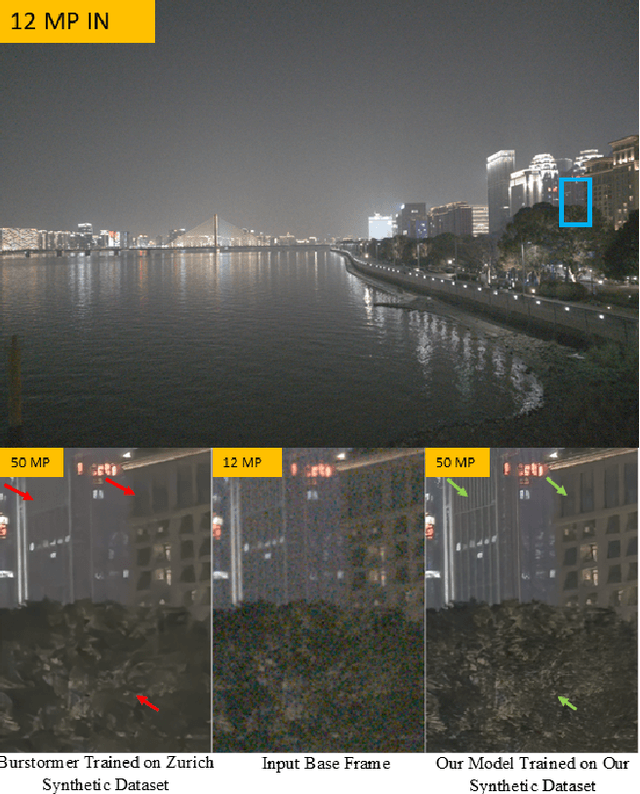
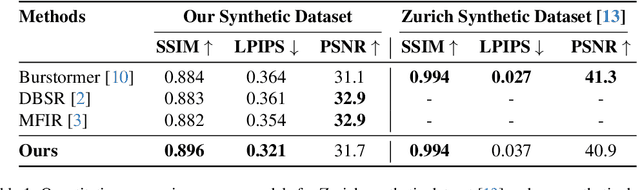
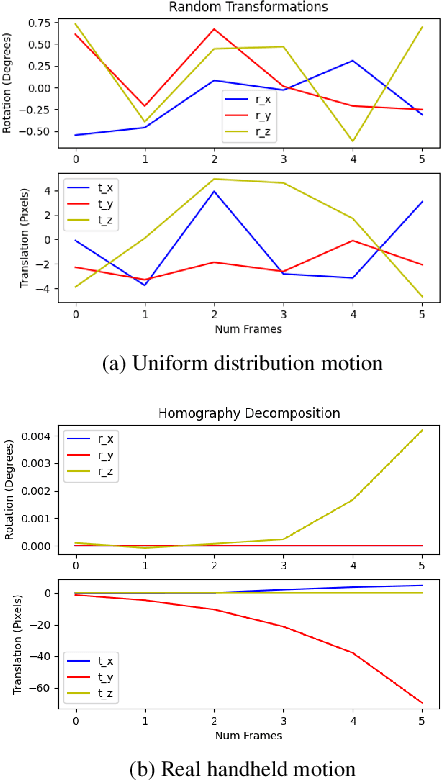
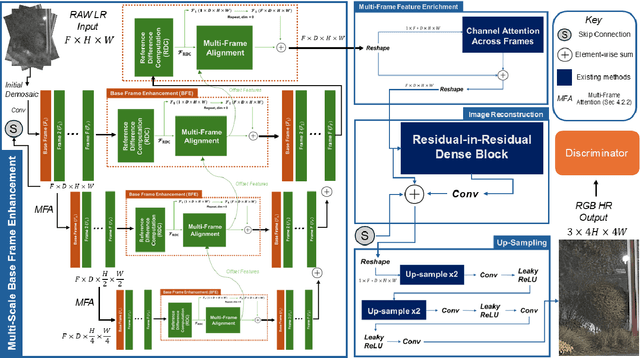
Smartphone cameras have become ubiquitous imaging tools, yet their small sensors and compact optics often limit spatial resolution and introduce distortions. Combining information from multiple low-resolution (LR) frames to produce a high-resolution (HR) image has been explored to overcome the inherent limitations of smartphone cameras. Despite the promise of multi-frame super-resolution (MFSR), current approaches are hindered by datasets that fail to capture the characteristic noise and motion patterns found in real-world handheld burst images. In this work, we address this gap by introducing a novel synthetic data engine that uses multi-exposure static images to synthesize LR-HR training pairs while preserving sensor-specific noise characteristics and image motion found during handheld burst photography. We also propose MFSR-GAN: a multi-scale RAW-to-RGB network for MFSR. Compared to prior approaches, MFSR-GAN emphasizes a "base frame" throughout its architecture to mitigate artifacts. Experimental results on both synthetic and real data demonstrates that MFSR-GAN trained with our synthetic engine yields sharper, more realistic reconstructions than existing methods for real-world MFSR.