 Add to Chrome
 Add to Firefox
 Add to Edge
STEM Agent: A Self-Adapting, Tool-Enabled, Extensible Architecture for Multi-Protocol AI Agent Systems
Mar 22, 2026
Current AI agent frameworks commit early to a single interaction protocol, a fixed tool integration strategy, and static user models, limiting their deployment across diverse interaction paradigms. To address these constraints, we introduce STEM Agent (Self-adapting, Tool-enabled, Extensible, Multi-agent), a modular architecture inspired by biological pluripotency in which an undifferentiated agent core differentiates into specialized protocol handlers, tool bindings, and memory subsystems that compose into a fully functioning AI system. The framework unifies five interoperability protocols (A2A, AG-UI, A2UI, UCP, and AP2) behind a single gateway, introduces a Caller Profiler that continuously learns user preferences across more than twenty behavioral dimensions, externalizes all domain capabilities through the Model Context Protocol (MCP), and implements a biologically inspired skills acquisition system in which recurring interaction patterns crystallize into reusable agent skills through a maturation lifecycle analogous to cell differentiation. Complementing these capabilities, the memory system incorporates consolidation mechanisms, including episodic pruning, semantic deduplication, and pattern extraction, designed for sub-linear growth under sustained interaction. A comprehensive 413-test suite validates protocol handler behavior and component integration across all five architectural layers, completing in under three seconds.

Gated Sparse Attention: Combining Computational Efficiency with Training Stability for Long-Context Language Models
Jan 12, 2026The computational burden of attention in long-context language models has motivated two largely independent lines of work: sparse attention mechanisms that reduce complexity by attending to selected tokens, and gated attention variants that improve training sta-bility while mitigating the attention sink phenomenon. We observe that these approaches address complementary weaknesses and propose Gated Sparse Attention (GSA), an architecture that realizes the benefits of both. GSA incorporates a gated lightning indexer with sigmoid activations that produce bounded, interpretable selection scores, an adaptive sparsity controller that modulates the number of attended tokens based on local uncertainty, and dual gating at the value and output stages. We establish theoretical foundations for the approach, including complexity analysis, expressiveness results, and convergence guarantees. In experiments with 1.7B parameter models trained on 400B tokens, GSA matches the efficiency of sparse-only baselines (12-16x speedup at 128K context) while achieving the quality gains associated with gated attention: perplexity improves from 6.03 to 5.70, RULER scores at 128K context nearly double, and attention to the first token, a proxy for attention sinks, drops from 47% to under 4%. Training stability improves markedly, with loss spikes reduced by 98%.
SwiftSolve: A Self-Iterative, Complexity-Aware Multi-Agent Framework for Competitive Programming
Oct 26, 2025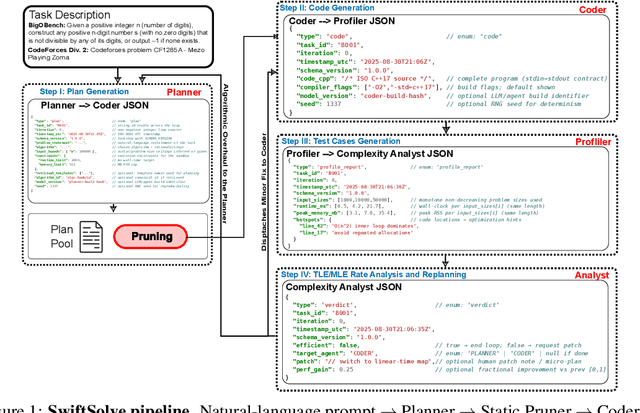

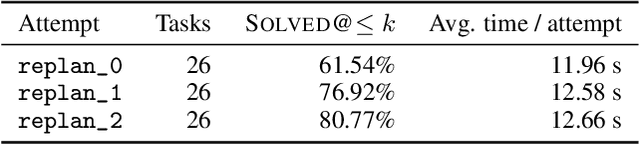
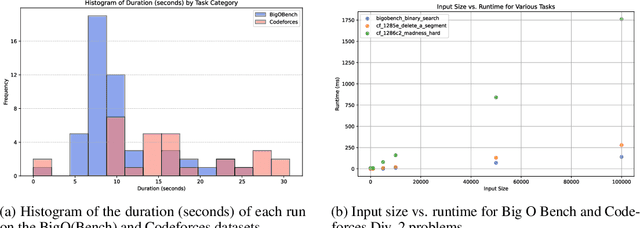
Correctness alone is insufficient: LLM-generated programs frequently satisfy unit tests while violating contest time or memory budgets. We present SwiftSolve, a complexity-aware multi-agent system for competitive programming that couples algorithmic planning with empirical profiling and complexity-guided repair. We frame competitive programming as a software environment where specialized agents act as programmers, each assuming roles such as planning, coding, profiling, and complexity analysis. A Planner proposes an algorithmic sketch; a deterministic Static Pruner filters high-risk plans; a Coder emits ISO C++17; a Profiler compiles and executes candidates on a fixed input-size schedule to record wall time and peak memory; and a Complexity Analyst fits log-log growth (s, R2) with an LLM fallback to assign a complexity class and dispatch targeted patches to either the Planner or Coder. Agents communicate via typed, versioned JSON; a controller enforces iteration caps and diminishing returns stopping. Evaluated on 26 problems (16 BigO, 10 Codeforces Div. 2) in a POSIX sandbox (2 s / 256-512 MB), SwiftSolve attains pass@1 = 61.54% (16/26) on the first attempt and Solved@<=3 = 80.77% with marginal latency change (mean 11.96 s to 12.66 s per attempt). Aggregate run-level success is 73.08% at 12.40 s mean. Failures are predominantly resource-bound, indicating inefficiency rather than logic errors. Against Claude Opus 4, SwiftSolve improves run-level success (73.1% vs 52.6%) at approximately 2x runtime overhead (12.4 s vs 6.8 s). Beyond correctness (pass@k), we report efficiency metrics (eff@k for runtime and memory, incidence of TLE or MLE, and complexity fit accuracy on BigO), demonstrating that profiling and complexity-guided replanning reduce inefficiency while preserving accuracy.