 Add to Chrome
 Add to Firefox
 Add to Edge
Patches of Nonlinearity: Instruction Vectors in Large Language Models
Feb 08, 2026
Despite the recent success of instruction-tuned language models and their ubiquitous usage, very little is known of how models process instructions internally. In this work, we address this gap from a mechanistic point of view by investigating how instruction-specific representations are constructed and utilized in different stages of post-training: Supervised Fine-Tuning (SFT) and Direct Preference Optimization (DPO). Via causal mediation, we identify that instruction representation is fairly localized in models. These representations, which we call Instruction Vectors (IVs), demonstrate a curious juxtaposition of linear separability along with non-linear causal interaction, broadly questioning the scope of the linear representation hypothesis commonplace in mechanistic interpretability. To disentangle the non-linear causal interaction, we propose a novel method to localize information processing in language models that is free from the implicit linear assumptions of patching-based techniques. We find that, conditioned on the task representations formed in the early layers, different information pathways are selected in the later layers to solve that task, i.e., IVs act as circuit selectors.

SwiftSolve: A Self-Iterative, Complexity-Aware Multi-Agent Framework for Competitive Programming
Oct 26, 2025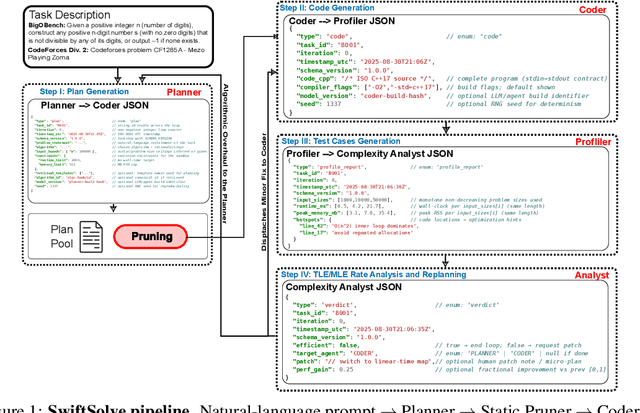

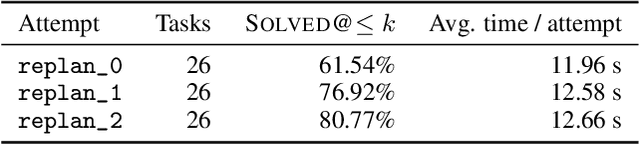
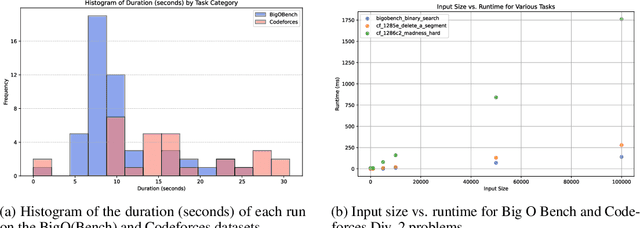
Correctness alone is insufficient: LLM-generated programs frequently satisfy unit tests while violating contest time or memory budgets. We present SwiftSolve, a complexity-aware multi-agent system for competitive programming that couples algorithmic planning with empirical profiling and complexity-guided repair. We frame competitive programming as a software environment where specialized agents act as programmers, each assuming roles such as planning, coding, profiling, and complexity analysis. A Planner proposes an algorithmic sketch; a deterministic Static Pruner filters high-risk plans; a Coder emits ISO C++17; a Profiler compiles and executes candidates on a fixed input-size schedule to record wall time and peak memory; and a Complexity Analyst fits log-log growth (s, R2) with an LLM fallback to assign a complexity class and dispatch targeted patches to either the Planner or Coder. Agents communicate via typed, versioned JSON; a controller enforces iteration caps and diminishing returns stopping. Evaluated on 26 problems (16 BigO, 10 Codeforces Div. 2) in a POSIX sandbox (2 s / 256-512 MB), SwiftSolve attains pass@1 = 61.54% (16/26) on the first attempt and Solved@<=3 = 80.77% with marginal latency change (mean 11.96 s to 12.66 s per attempt). Aggregate run-level success is 73.08% at 12.40 s mean. Failures are predominantly resource-bound, indicating inefficiency rather than logic errors. Against Claude Opus 4, SwiftSolve improves run-level success (73.1% vs 52.6%) at approximately 2x runtime overhead (12.4 s vs 6.8 s). Beyond correctness (pass@k), we report efficiency metrics (eff@k for runtime and memory, incidence of TLE or MLE, and complexity fit accuracy on BigO), demonstrating that profiling and complexity-guided replanning reduce inefficiency while preserving accuracy.