 Add to Chrome
 Add to Firefox
 Add to Edge
Joint Nuclear and $\ell_1$ Regularization for Logistic Matrix Regression with Applications to Brain Imaging
Jun 12, 2026
We introduce a new convex optimization framework for logistic scalar-on-matrix regression which incorporates nuclear and $\ell_1$ norm penalties to enforce simultaneously low-rank and sparse structures in the estimated coefficient matrix. The proposed method enables interpretable modeling of high-dimensional matrix-valued predictors in the presence of binary responses. We derive a custom algorithm based on the Alternating Direction Method of Multipliers (ADMM) to efficiently solve the resulting convex optimization problem and establish the theoretical properties of the obtained solution. Numerical experiments clearly demonstrate the effectiveness of our method in recovering meaningful predictive patterns. Finally, we apply our method to the brain imaging data to identify structures in functional brain connectivity matrices that are characteristic of subjects with a family history of alcohol use disorders (AUDs).

LaMDA: Language Models for Dialog Applications
Feb 10, 2022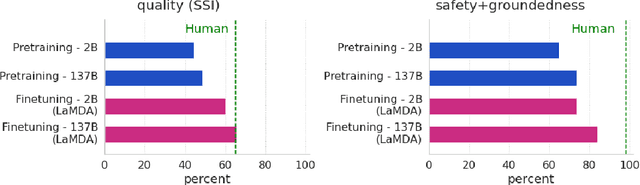
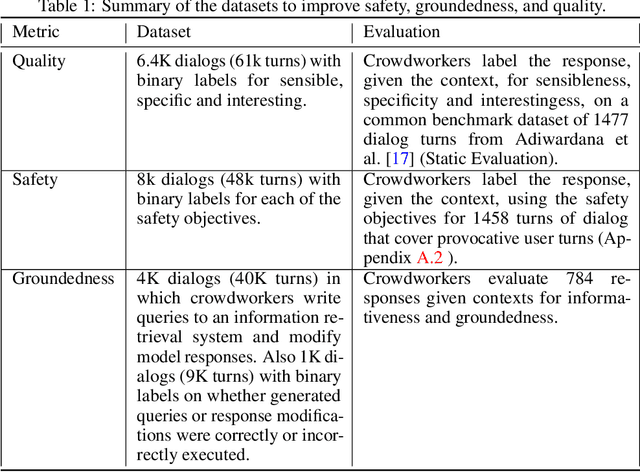
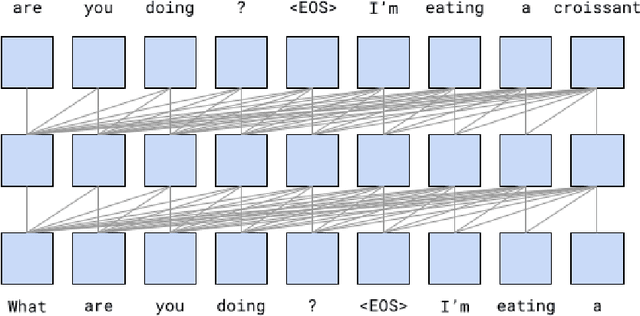

We present LaMDA: Language Models for Dialog Applications. LaMDA is a family of Transformer-based neural language models specialized for dialog, which have up to 137B parameters and are pre-trained on 1.56T words of public dialog data and web text. While model scaling alone can improve quality, it shows less improvements on safety and factual grounding. We demonstrate that fine-tuning with annotated data and enabling the model to consult external knowledge sources can lead to significant improvements towards the two key challenges of safety and factual grounding. The first challenge, safety, involves ensuring that the model's responses are consistent with a set of human values, such as preventing harmful suggestions and unfair bias. We quantify safety using a metric based on an illustrative set of human values, and we find that filtering candidate responses using a LaMDA classifier fine-tuned with a small amount of crowdworker-annotated data offers a promising approach to improving model safety. The second challenge, factual grounding, involves enabling the model to consult external knowledge sources, such as an information retrieval system, a language translator, and a calculator. We quantify factuality using a groundedness metric, and we find that our approach enables the model to generate responses grounded in known sources, rather than responses that merely sound plausible. Finally, we explore the use of LaMDA in the domains of education and content recommendations, and analyze their helpfulness and role consistency.