 Add to Chrome
 Add to Firefox
 Add to Edge
SpectralEarth-FM: Bringing Hyperspectral Imagery into Multimodal Earth Observation Pretraining
May 20, 2026
Earth observation (EO) foundation models (FMs) are increasingly trained on multisensor data, spanning multispectral imagery (MSI), synthetic aperture radar (SAR), and derived geospatial layers, but hyperspectral imagery (HSI) remains underrepresented. Conversely, existing hyperspectral FMs are trained on HSI alone, leaving joint pretraining and fusion of HSI with co-located EO sensors unexplored. We introduce SpectralEarth-FM, a hierarchical transformer for multisensor EO input with heterogeneous spectral dimensionality. The architecture combines spectral tokenization for hyperspectral inputs, sensor-specific encoders, a cross-sensor fusion module, and a shared hierarchical encoder, enabling joint processing of HSI and lower-channel observations. To pretrain SpectralEarth-FM, we curate SpectralEarth-MM, a dataset that co-locates HSI from three spaceborne sensors (EnMAP, EMIT, DESIS) with Sentinel-2, Landsat-8/9 optical imagery, Landsat land surface temperature (LST), and Sentinel-1 SAR, over common geographic footprints. It comprises approximately 2M globally distributed locations, 25M georeferenced patches, and over 40TB of data. Pretraining uses a Joint-Embedding Predictive Architecture (JEPA)-style objective that matches representations between global views and single-sensor local views from the same location. We evaluate SpectralEarth-FM on hyperspectral downstream tasks and standard EO benchmarks following the PANGAEA protocol, achieving state-of-the-art results across both evaluation settings.

HyBiomass: Global Hyperspectral Imagery Benchmark Dataset for Evaluating Geospatial Foundation Models in Forest Aboveground Biomass Estimation
Jun 12, 2025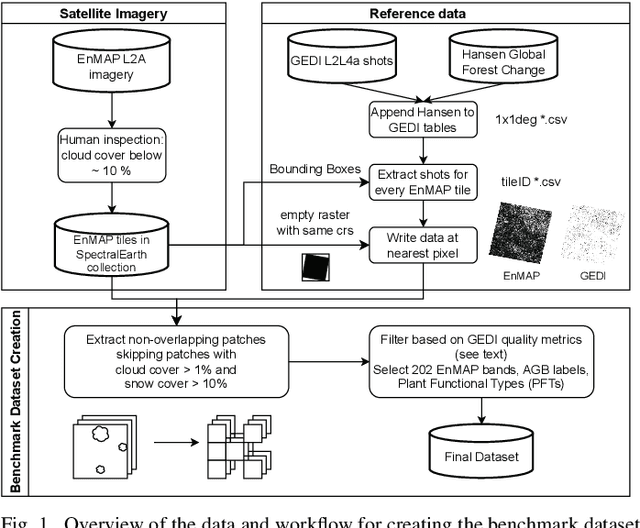
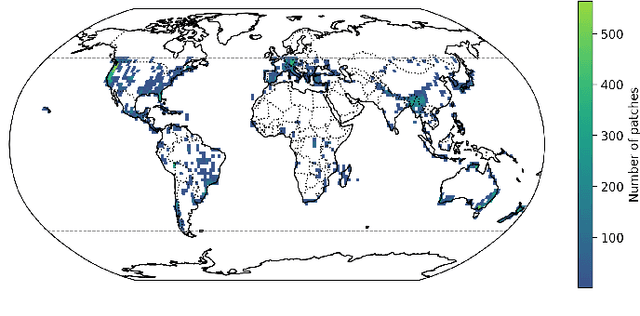
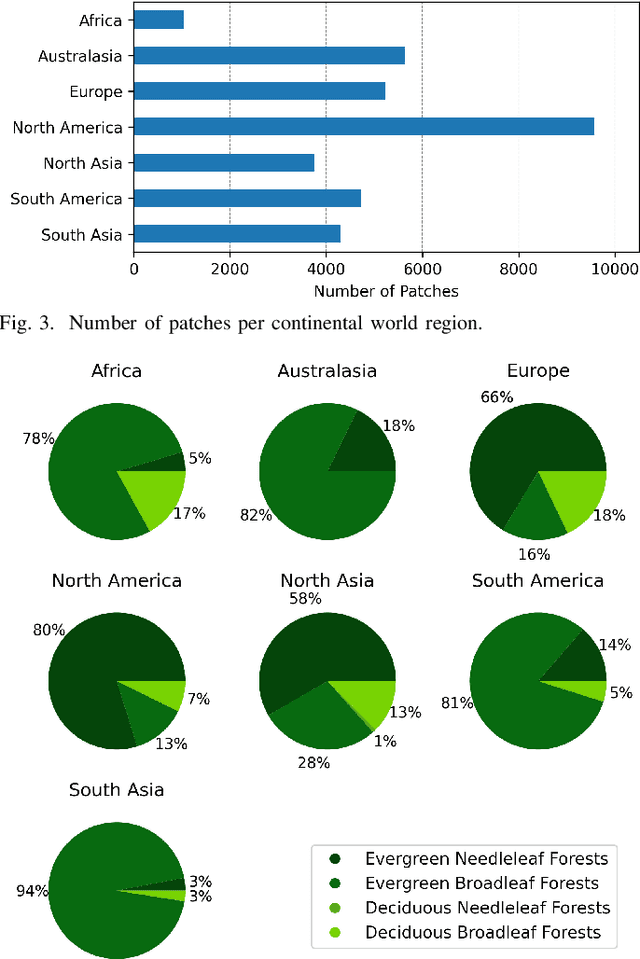
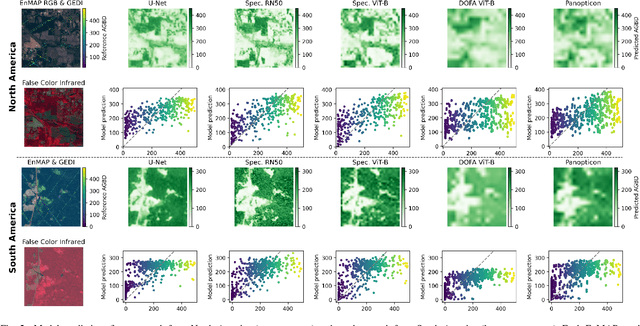
Comprehensive evaluation of geospatial foundation models (Geo-FMs) requires benchmarking across diverse tasks, sensors, and geographic regions. However, most existing benchmark datasets are limited to segmentation or classification tasks, and focus on specific geographic areas. To address this gap, we introduce a globally distributed dataset for forest aboveground biomass (AGB) estimation, a pixel-wise regression task. This benchmark dataset combines co-located hyperspectral imagery (HSI) from the Environmental Mapping and Analysis Program (EnMAP) satellite and predictions of AGB density estimates derived from the Global Ecosystem Dynamics Investigation lidars, covering seven continental regions. Our experimental results on this dataset demonstrate that the evaluated Geo-FMs can match or, in some cases, surpass the performance of a baseline U-Net, especially when fine-tuning the encoder. We also find that the performance difference between the U-Net and Geo-FMs depends on the dataset size for each region and highlight the importance of the token patch size in the Vision Transformer backbone for accurate predictions in pixel-wise regression tasks. By releasing this globally distributed hyperspectral benchmark dataset, we aim to facilitate the development and evaluation of Geo-FMs for HSI applications. Leveraging this dataset additionally enables research into geographic bias and generalization capacity of Geo-FMs. The dataset and source code will be made publicly available.